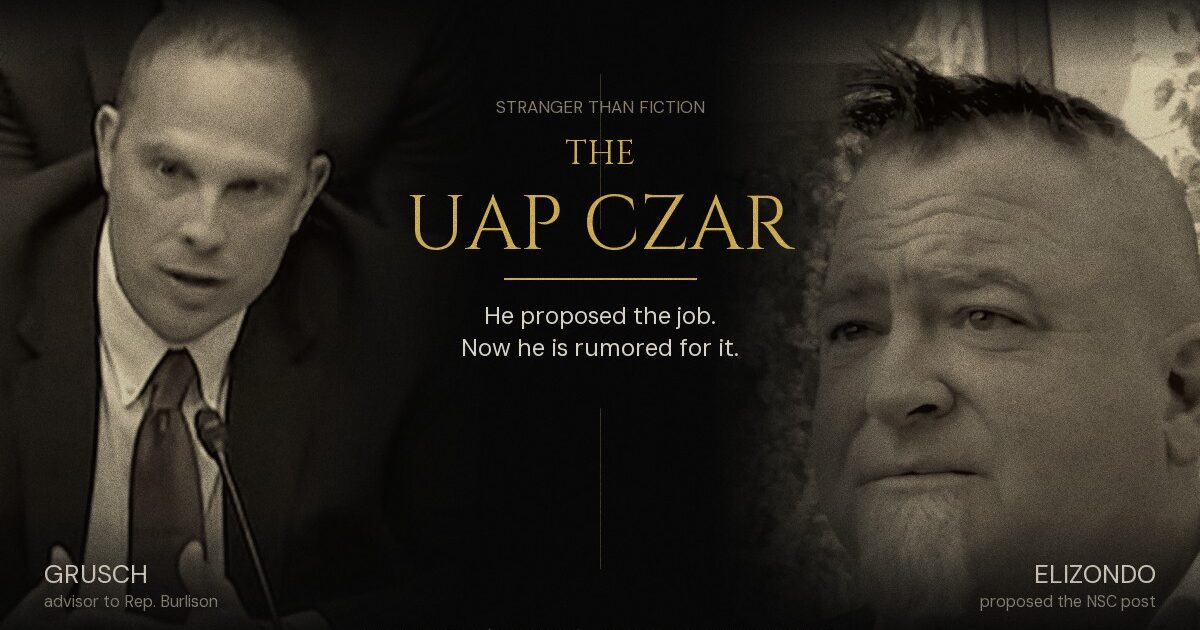
Before the current administration took office, Luis Elizondo sent it a policy brief proposing that the federal response to unidentified anomalous phenomena be consolidated under a single senior official seated inside the National Security Council. In the eighteen months since, the UAP czar has gone from a paragraph in a memo to a vacancy that people in the disclosure community talk about as though it already exists, and Elizondo has moved permanently to Washington. He has not confirmed that a position is coming. He has not denied it either.
David Grusch, the other name that has carried this subject since 2023, went through a different door and got there first. He has been on a congressional payroll since the spring of 2025.
What follows is the documented record of how two men who came forward alleging that the government hid the truth about UAP both ended up inside the machinery they accused, and what is known and unknown about the job one of them designed.
The UAP Czar Job Elizondo Drafted
The UAP czar proposal is not a rumor. Elizondo submitted a policy brief to the incoming administration recommending the creation of a czar for emerging and disruptive technologies with UAP explicitly in the portfolio. The post as described would sit within the National Security Council, coordinate the federal government’s response across departments, and lead the relevant discussions at NSC and Cabinet level.
Read plainly, that is a proposal to take a subject currently split between the All-domain Anomaly Resolution Office, the intelligence agencies, and congressional committees, and place authority over it with one presidentially selected official. Whoever holds it would sit above the agencies that have spent years telling Congress they have nothing to add, and would decide the sequence and content of whatever the executive branch chose to release.
There is a reasonable case for it. Fragmentation is the documented problem: agencies have repeatedly declined to answer for one another, and a coordinating authority is the ordinary Washington answer to that. There is also an obvious hazard. A single office with the power to coordinate disclosure is equally a single office with the power to meter it, and the same chokepoint that ends the runaround can end the leaks.
The Move to Washington
In late July 2026 Elizondo relocated from Wyoming to the Washington area. He announced it himself, on camera, filming from his truck at a rest stop partway through the drive, and characterized the move as a consequence of the work: fighting for disclosure, he said, is a full-time job.
The rumor that attached itself to the move is that he is being lined up for the UAP czar role. That has not been verified by any outlet, no appointment has been announced, and Elizondo has not asserted one. What he has also not done is say that no such position is under discussion. The result is a man who proposed a job, declined to confirm or rule out receiving it, and moved to the city where it would be performed.
None of that is improper. People who care about a policy area move to Washington to work on it, and the person who best understands a proposed office is often the person who proposed it. It is simply a set of facts that a reader is entitled to see assembled rather than encountered separately.
The Other Door, Already Taken
Grusch resolved the same question earlier and more conventionally. In March 2025 Representative Eric Burlison announced his appointment as a special advisor on UAP matters, effective that April, and his security clearance was reinstated as part of the arrangement. He had spent 2023 and 2024 as a private citizen whose clearance had been revoked and restored on appeal.
So the two most prominent UAP witnesses of the decade now occupy, or are rumored to occupy, positions on opposite sides of the constitutional divide. Grusch advises a member of the legislative branch that has been trying to pry records out of the executive. Elizondo is associated with an executive branch office that would control what the legislative branch receives. If both arrangements hold, the same two men would sit on both ends of the oversight relationship.
The Credential Under Dispute
A UAP czar drawn from the disclosure community would arrive carrying an unresolved argument about his own resume.
Elizondo has consistently described himself as the head of the Advanced Aerospace Threat Identification Program. The biography his side filed with the House Oversight Committee for his November 13, 2024 testimony states that “by 2012, Lue was the senior ranking person of the DOD’s Advanced Aerospace Threat Identification Program.”
The Department of Defense has said the opposite for years, in consistent language from spokesperson Susan Gough: “Mr. Elizondo had no assigned responsibilities for AATIP while he was in OUSD(I).” When a 2009 memo from Senator Harry Reid surfaced that appeared to bear on the program, the Department confirmed the memo was genuine and said it changed nothing.
The documentary record that has since emerged sits closer to the Department’s account. Defense Department emails released to The Black Vault and published in 2025 record a 2019 official describing Elizondo’s contribution as connections and introductions to other Pentagon elements, consisting of office and small group meetings, advice, and correspondences, with no funding lines associated with his work and no significant resources expended. That is a description of informal coordination, not command of a funded program.
The dispute has also been defended by threat of litigation. In August 2022, after John Greenewald of The Black Vault announced a podcast examining Elizondo’s Inspector General complaint, Elizondo’s then attorney Todd McMurtry posted publicly that Elizondo’s directorship was well documented and that “any participation in a plan to cast doubt on that #TRUTH is a knowing effort to defame and sow disinformation. It’s legally actionable.” Greenewald’s method is filing records requests and publishing the returns.
What the AARO Historical Record Report described in March 2024 complicates the credential from the other side. The AAWSAP and AATIP effort it documents produced exploratory papers across twelve scientific areas that were never thoroughly peer reviewed, investigated an alleged hotspot of anomalous activity at a Utah property including reports of shadow figures and creatures, and contemplated hiring psychics to study interdimensional phenomena. The Defense Intelligence Agency, per the report, did not seek nor specifically authorize that work, and the program was terminated in 2012. The Utah property is Skinwalker Ranch, and the contracting history behind it is its own story. Whether leading that program is the qualification for a UAP czar depends entirely on which description of it a reader accepts.
The Legal and Political Apparatus Already in Place
The disclosure movement is often described as a loose community of witnesses and podcasters. It has more structure than that, and the structure runs through one attorney.
Daniel Sheehan, a constitutional lawyer with a long record in public interest litigation, served as general counsel to Elizondo and in May 2021 filed the sixty-four page complaint with the Department of Defense Inspector General alleging disinformation and reprisal by senior officials. In 2023 Sheehan founded the New Paradigm Institute as a program of the Romero Institute, the Santa Cruz, California law and public policy center he also runs, at 210 High Street.
In February 2024 the institute launched Citizens for Disclosure, a grassroots arm built to organize supporters in their own congressional districts and press their representatives on UAP transparency. Public materials describe it as a citizen mobilization campaign, and no Federal Election Commission registration under that name is evident, so it is district-level political organizing rather than a committee that raises and spends money on candidates. The distinction matters for what it can lawfully do and should not be blurred.
Alongside it, the institute has run voter contact drives, publicly pressured members of Congress over the Schumer and Rounds UAP Disclosure Act, and opened a Washington office to lobby for UAP transparency.
Assembled, the picture is this: an advocacy organization headquartered in Santa Cruz with a Washington lobbying presence and a district-level organizing arm, founded by the lawyer who served as general counsel to the man now associated with a proposed executive branch UAP post, campaigning for the legislation that would govern the subject. None of that is a scandal. It is what an organized political interest looks like, and Washington is built out of them. It is worth stating plainly only because the movement’s rhetorical position is that it stands outside the system, and this is what standing inside it looks like.
The Chain of Command Runs Through Clapper
Elizondo’s own account of his career contains a detail that bears on how much an insider’s word is worth without documents behind it.
He says he was brought back to the Pentagon in 2008 and assigned as Director, National Programs Special Management Staff, inside the Office of the Under Secretary of Defense for Intelligence. James Clapper held that under secretary post from April 2007 until the summer of 2010, when he became Director of National Intelligence. Elizondo entered the directorate Clapper ran, in the window AAWSAP was standing up.
On March 12, 2013, Senator Ron Wyden asked Clapper in open session whether the National Security Agency collected “any type of data at all on millions or hundreds of millions of Americans.” Clapper answered, “No, sir. Not wittingly.” The Snowden disclosures established months later that bulk collection of American telephone metadata was underway. Clapper later called his answer the “least untruthful” one available and acknowledged it was clearly erroneous. Wyden’s office has said Clapper’s staff privately recognized the problem within days while taking fourteen weeks to correct the record. No charge followed.
Guilt does not travel through an organizational chart, and nothing suggests Elizondo had any part in that testimony. The relevance is to the argument, not the man. The case for a UAP czar rests on trusting a senior official to decide what the public learns and when. The last time this apparatus was asked a direct question about domestic collection under oath, the answer was untrue and the consequence was nothing. Who holds the senior intelligence job has mattered before, and it is a reasonable thing to weigh.
The Two Men Are Not Competitors on the Facts
Framing this as a rivalry would overstate the daylight between them.
Their government tenures did not overlap. Elizondo resigned in October 2017; Grusch joined the UAP Task Force as the National Reconnaissance Office’s representative in 2019, moved to the National Geospatial-Intelligence Agency in late 2021 as its co-lead for UAP analysis, and left government on April 7, 2023. Leslie Kean, who reported both men’s stories, has said the programs they describe are completely separate.
But at the November 2024 hearing, Representative Tim Burchett asked Elizondo whether he knew Grusch. Elizondo answered: “Absolutely, sir. I had the privilege and honor of working with him myself several years ago at U.S. Space Force.” That is the only assertion of a direct working relationship between them. The United States Space Force was established in December 2019, more than two years after Elizondo left the Pentagon, so any such collaboration postdates his departmental service and cannot describe the AATIP period. He did not elaborate, and nobody at the hearing asked.
Burchett then put Grusch’s multi-decade crash retrieval and reverse engineering claim to him directly and asked whether he agreed. Elizondo said, “Yes, sir.” Where the two still differ is interpretation: pressed by Representative Anna Paulina Luna on Grusch’s testimony about interdimensional beings, Elizondo declined, saying he was not qualified to speculate about points of origin.
Two accounts that began as different allegations have converged, and one of the men says under oath that he worked with the other. That is not evidence of coordination and should not be read as any. It does mean they are no longer independent tests of the same proposition, which matters when their mutual endorsement is offered as corroboration.
It should also be recorded that the substance remains unconfirmed. Opening the November 2024 hearing, Chairwoman Nancy Mace said that of the agencies the committee had dealt with, “none of them have been able to substantiate the claims made at this hearing last year by David Grusch, despite our Committee Members endlessly questioning these agencies inside and outside of the SCIF.”
The NDA Directive Changes the Board
In late July 2026 the President directed the Department of Defense and the intelligence community to waive prior non-disclosure agreements for current and former employees and contractors holding UAP information, so they can speak to authorized representatives of the All-domain Anomaly Resolution Office or the President’s UAP task force without legal jeopardy. Intelligence community elements were given thirty days to coordinate with the Office of the Director of National Intelligence and name a designee.
This is the thing the disclosure movement has demanded for years, and it is narrower than the headlines suggest. It is not a declassification order. It removes the legal barrier that kept witnesses silent, and routes them to cleared government investigators. Anything they say still passes through existing review before any of it reaches the public.
Representative Eric Burlison, who has been calling for exactly this, welcomed it on July 29 and then said something that deserves more attention than it received. His office had asked to see the directive and had not yet been shown it. He wrote that “we are uncertain whether the abrogation of NDAs will apply to testimony received by Congress before referral to the executive branch,” and advised anyone considering speaking to the executive branch to bring not only an attorney but a member of Congress into the room.
That is a sitting congressman telling whistleblowers not to walk into the executive channel alone. His special advisor on UAP matters is David Grusch. So the two men in this story now sit on opposite sides of a live procedural fight over who receives whistleblower testimony, which is a more concrete disagreement than anything either has said about the other.
What a Protected Channel Has Been Worth
The directive is a promise about how a channel will behave. There is a recent test of that promise, and it involves two men this site has covered separately.
On September 9, 2025, Dylan Borland, the former Air Force geospatial intelligence specialist who says reporting what he saw at Langley cost him his career, testified before the House Oversight Task Force on the Declassification of Federal Secrets. The hearing was titled “Restoring Public Trust Through UAP Transparency and Whistleblower Protection.” Protection was not incidental to that proceeding. It was half its stated purpose.
Matthew Brown, who wrote the Immaculate Constellation report, says that afterward he was invited to Liberty Crossing, the intelligence campus in the Washington area operated by the Office of the Director of National Intelligence. By his account he was told his clearances were active, that the meeting would be fully protected, and that a formal whistleblower protection program for this subject would be offered to him. He says none of that happened: the program was never mentioned in the room, never offered, and no paperwork was produced.
That is Brown’s description of a meeting for which there is no independent record, and the Office of the Director of National Intelligence has given no public account of it. What is not in question is what the two men did next. Brown and Borland launched a nonprofit, Vanguard, built to pursue disclosure through the courts by filing suit where Congress has stalled, and to provide direct material support to witnesses, a gap Brown has described as unfilled. It is a whistleblower protection fund founded by whistleblowers, because the protection they were told to expect did not arrive.
Vanguard should not be confused with the UAP Disclosure Fund, a separate organization on whose board Elizondo sits.
Set that beside Burlison telling witnesses to bring a member of Congress into the room. He is not being alarmist. He is describing a documented distance between what witnesses are promised and what they receive, and the NDA directive asks those same witnesses to trust the same apparatus again.
The thread is still live. On March 31, 2026, the Task Force wrote to the Secretary of Defense requesting four specific UAP video files by April 14, stating that whistleblowers had informed it that AARO possesses additional video records, and noting that AARO’s responses, when questioned about sightings and the data behind them, had been “less than adequate.” That is a congressional task force putting in writing that the office built to resolve this subject has not been answering it. Whoever takes the coordinating job inherits exactly that.
The Controlled Disclosure Allegation
In late July 2026 the independent researcher known as UAP Gerb told Ross Coulthart on NewsNation that Elizondo had worked in technology and program protection for the legacy programs before going public, and that he is now being positioned for the National Security Council role precisely in order to deliver a limited and managed disclosure.
Gerb produced no documents. The account rests on unnamed sources and has not been independently verified, and it belongs in the same category as any other uncorroborated insider claim. Elizondo rejected it, said the claims are built on false information, and noted he had given Gerb his phone number and never received a call. STF has cited Gerb’s document research before; he is an independent researcher with no affiliation to this publication, and his claims get the same handling as anyone else’s.
The first half of the allegation earns more attention than an unsourced claim usually would, because Elizondo has described the underlying role himself. In his written testimony to the House Oversight Committee he told Congress: “For many years, I was entrusted with protecting some of our nation’s most sensitive programs.” Program protection is what he says he did. The distance between that sentence and Gerb’s version is not a distance of fact but of timing and motive. Gerb has not shown the function continued past 2017. Elizondo has not produced records showing it stopped.
The Case That Gerb Is Wrong
The controlled disclosure thesis has a weakness worth stating as plainly as the thesis itself: every fact it rests on fits an innocent reading equally well, and in one respect the innocent reading is the more natural one.
A person who spent nine years arguing that the system suppresses witnesses, offered a seat where he could force agencies to comply with a directive that frees them, would be negligent to refuse it. Fragmentation is the documented obstacle. A coordinating authority is the standard remedy. Proposing that office and then being considered for it is what subject matter expertise looks like from the outside, and it is not evidence of capture. Taking a job is not proof of being bought, and Gerb has produced nothing beyond the sequence itself.
There is also a test coming that neither man can stage-manage. The NDA directive creates an authorized channel through which someone bound by secrecy agreements can finally speak to cleared investigators. Elizondo has said for years that his own knowledge is constrained by what he is still not permitted to say. If he walks through that channel himself, submits to an authorized debrief under the waiver, and does it while holding or seeking a government position, that is a costly, verifiable act that a person running a managed narrative has no reason to perform. He would become the most prominent figure to use the mechanism rather than campaign for it.
If instead the directive’s main visible effect is that witnesses are routed into an executive process, reviewed, and not heard from again, Gerb’s reading gains ground without him having to prove anything. Both futures are still available, and the difference between them will be visible within a year.
One piece of the record complicates the generous reading, and it comes from the Immaculate Constellation file rather than from Gerb. Matthew Brown, the former Department of Defense and State Department advisor who wrote that report and identified himself as its author, describes the alleged program in his own text as “an unacknowledged Special Access Program established after the exposure of AATIP in 2017 by former USDI officer Lue Elizondo.”
Read that carefully, because it points in two directions at once. Brown is claiming that the institutional response to Elizondo’s disclosure was to build a tighter compartment: the leak produced more secrecy, not less. For Gerb, that is the pattern repeating, a disclosure event that ends in consolidation. For Elizondo, it is the opposite and rather stronger point, because a program built specifically to contain the damage he caused is evidence that the damage was real. Brown’s claim remains uncorroborated, and the document’s own status is contested. What it establishes for present purposes is only that the last time Elizondo produced a disclosure event, the alleged result was a new compartment, and that is the precedent a UAP czar would inherit either way.
What Would Move This
The UAP czar question resolves itself on a schedule nobody controls. Either an appointment is announced or it is not, and if one is, its occupant and reporting line will be a matter of public record. That is the rare claim in this subject with a built-in expiry date.
The AATIP credential could be settled with one document: a personnel record, a tasking order, or an organizational chart placing Elizondo in a defined role, or a full and searchable release containing none. The Department has asserted a negative for years without publishing the records. Elizondo has asserted a positive without producing them.
The Space Force claim is the cheapest open question here and nobody has asked it. Elizondo named an organization and a working relationship under oath. What capacity was he in, under what arrangement, and does Grusch describe it the same way. One follow-up at a hearing would settle it, and in the time since, no one has put it.
For Grusch, movement comes from his witnesses. He gave names to the Inspector General and to Congress in classified session, and any one of them testifying publicly converts his account from referral to corroboration.
The useful question is not whether Elizondo deserves the job. It is whether the job should exist in the shape proposed. An office created to coordinate disclosure is an office that can schedule it, and the argument for building one rests on trusting whoever occupies it. The people asking for that trust have spent a decade explaining why it should not be extended to officials in exactly that position. Whether a UAP czar becomes the mechanism that finally opens the file, or the last door closing on it, depends on details that have not been written down yet.
Sources & Further Reading
- Liberation Times — the policy brief proposing a UAP-focused emerging technologies czar inside the National Security Council
- UFO News — Elizondo’s relocation to Washington and the spread of the czar rumors
- Office of Rep. Eric Burlison — announcement of David Grusch’s appointment as special advisor
- Congress.gov — Louis “Lue” Elizondo, witness biography filed for the November 13, 2024 hearing (PDF)
- House Oversight Committee — written testimony of Luis Elizondo, November 13, 2024 (PDF)
- House Committee Repository — full transcript of the November 13, 2024 hearing, including the Space Force exchange (PDF)
- House Oversight Committee — the July 26, 2023 hearing at which David Grusch testified under oath
- The Debrief — Leslie Kean and Ralph Blumenthal’s June 2023 report introducing Grusch’s claims
- The Black Vault — the Pentagon’s repeated statement that Elizondo had no assigned responsibilities for AATIP
- The Black Vault — Defense Department emails on Elizondo’s role, and the 2022 legal threat from his attorney
- The Black Vault — document archive on the 2021 DoD Inspector General complaint filed for Elizondo
- AARO Historical Record Report, Volume 1 (March 2024), full PDF
- New Paradigm Institute — Daniel Sheehan’s biography and the institute’s founding as a Romero Institute program
- Romero Institute — the Santa Cruz law and public policy center that houses the New Paradigm Institute
- EIN Presswire — the New Paradigm Institute’s voter contact campaign over the UAP Disclosure Act
- New Paradigm Institute — the February 2024 launch of Citizens for Disclosure
- National Geospatial-Intelligence Agency — official biography of James R. Clapper, including his tenure as Under Secretary of Defense for Intelligence
- PolitiFact — Clapper’s March 2013 testimony to Senator Wyden, reviewed a year later
- NBC News — Clapper’s apology for his “clearly erroneous” NSA testimony
- IBTimes UK — UAP Gerb’s July 2026 allegations and Elizondo’s response
- Office of Rep. Eric Burlison — July 29, 2026 statement on the UAP NDA directive, and his advice to witnesses
- IBTimes UK — the July 2026 directive waiving UAP non-disclosure agreements, and its limits
- Fox News — agencies directed to waive NDAs for UAP witnesses
- Unexplained.ie — Matthew Brown identifies himself as the Immaculate Constellation author, and the report’s language on Elizondo
- House Oversight Task Force — “Restoring Public Trust Through UAP Transparency and Whistleblower Protection,” September 9, 2025
- House Oversight Task Force — written testimony of Dylan Borland, September 9, 2025 (PDF)
- House Oversight Task Force — March 31, 2026 letter requesting four UAP video files, citing AARO’s “less than adequate” responses (PDF)
- DefenseScoop — military whistleblowers present new evidence at the September 2025 transparency hearing
- Matthew Brown and Dylan Borland’s own announcement of Vanguard, the whistleblower protection fund
- The Intercept — the August 2023 story on Grusch’s clearance and the records obtained under Virginia FOIA
Leave a Reply