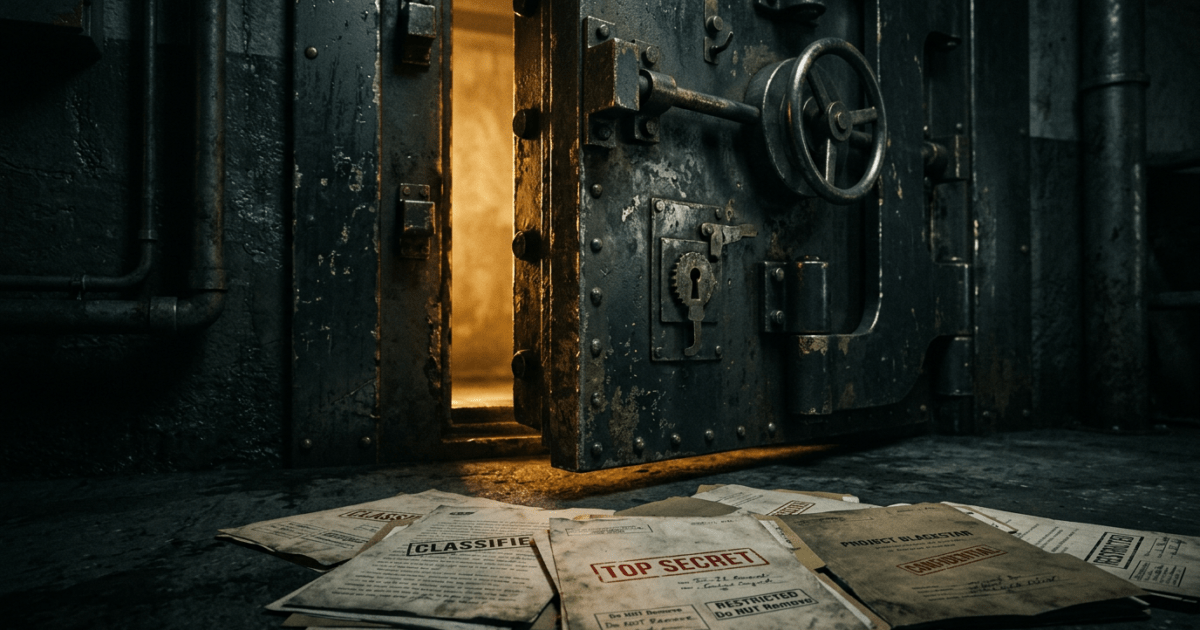
On May 22, 2026, Director of National Intelligence Tulsi Gabbard announced her resignation, effective June 30. The stated reason was her husband’s diagnosis with a rare form of bone cancer. The unstated context was months of friction with the White House over Iran policy, a near-firing in April reportedly blocked by Roger Stone, and a behind-the-scenes feud with the CIA that had gone public only days earlier. President Trump named Principal Deputy DNI Aaron Lukas as acting director. Lukas is a career CIA officer and former chief of station. The agency accused of obstructing Gabbard’s disclosure efforts now holds the office that was trying to compel them. The DNI transition and disclosure are now inseparable questions.
The DNI transition and its implications for disclosure are architectural, not personal. The Office of the Director of National Intelligence is the only civilian position with statutory authority over all eighteen agencies in the intelligence community, including the CIA. When that office is held by an outsider willing to use that authority, it creates friction. Friction is where institutional secrets become visible. When the office reverts to a career insider, the friction stops. The architecture remains intact. Nothing needs to be actively concealed because nothing is being actively challenged.
The Man in the Chair: Aaron Lukas
Aaron Paul Lukas was born on May 18, 1971, in Toms River, New Jersey, and raised in Arkansas. He graduated from Texas A&M University in 1993 with a degree in political science, then earned a master’s in international affairs from George Washington University in 1997. His early career bore no resemblance to the clandestine world he would later inhabit. As a graduate student, Lukas interned at the Cato Institute, the libertarian think tank, and stayed on as a policy analyst until 2002. His published work during this period focused on trade policy, immigration economics, and free-market orthodoxy. He met his wife, Carrie Lukas, at Cato; she went on to lead the Independent Women’s Forum and write for Forbes and National Review.
From 2002 to 2004, Lukas served as chief speechwriter for Robert Zoellick, the U.S. Trade Representative. His last Cato publication appeared in April 2004. That same month, he joined the Central Intelligence Agency as an analyst. Within a year, he had moved to the operations side: clandestine service, the business of running agents, managing foreign assets, and conducting covert actions abroad. Various news outlets, including Reuters, reported Lukas as a State Department foreign service officer during this period. He was not. The State Department cover was itself a CIA operational tool, a standard practice for agency officers operating under diplomatic cover in foreign countries.
Over the next two decades, Lukas rose through the CIA’s operational ranks. His official ODNI biography describes him as “certified in the CIA’s most advanced tradecraft,” a designation that indicates completion of the agency’s highest-tier operational training programs. He served as a CIA chief of station, the senior intelligence officer in a foreign country, responsible for managing all agency operations, assets, and liaison relationships within that country’s borders. The specific countries where Lukas served remain classified. In a January 2026 recruiting video, Lukas described his work as involving “handing out briefcases of cash” as an operative. At his April 2025 confirmation hearing, he told the Senate Intelligence Committee: “For the past twenty-plus years, I have worked as a CIA operations officer in the shadows, never calling attention to my real work, staying away from social media, and living my covers, sometimes even operating under different names.”
Lukas’s first crossover into the political side of intelligence came in 2020, when he was detailed to the Office of the Director of National Intelligence as chief of staff to acting DNI Richard Grenell. Grenell’s brief, turbulent tenure was characterized by aggressive declassification of intelligence related to the Trump-Russia investigation and the rapid ouster of career officials who resisted the administration’s direction. Lukas served as Grenell’s operational right hand during that period. He subsequently moved to the National Security Council as Deputy Senior Director for Europe and Russia, a position he held from 2020 to 2021, spanning the final months of Trump’s first term.
Trump nominated Lukas as Principal Deputy DNI on March 11, 2025. His confirmation hearing on April 9 before the Senate Intelligence Committee included questions about his participation in the Signal group chat that became public through Jeffrey Goldberg’s reporting in The Atlantic. The Senate confirmed him on July 22, 2025, by a vote of 51-46. Gabbard swore him in two days later.
The biographical arc is clean and legible. A libertarian policy analyst pivots to clandestine service at 33, spends two decades running operations abroad under cover identities, surfaces briefly during the first Trump administration’s intelligence wars, then returns as the number-two official at ODNI. He is, by every available measure, a competent and experienced intelligence professional. He is also a man whose entire adult professional identity was formed inside the institution the DNI is supposed to oversee. The question is not whether Lukas is capable. The question is whether a career CIA operations officer, trained to protect sources and methods, socialized to prioritize operational security above transparency, and professionally rewarded for two decades of successful concealment, is structurally positioned to continue the disclosure friction his predecessor created.
There is, however, a complicating detail. Lukas chose to work for Richard Grenell. That choice deserves scrutiny, because Grenell was the most hostile acting DNI the CIA had faced in the office’s history, and career CIA officers did not line up to serve under him.
The Grenell Precedent
Richard Allen Grenell, born September 18, 1966, was a communications operative, not an intelligence professional. He held a bachelor’s from Evangel College and a master’s in public administration from Harvard’s Kennedy School. His career was built in media and political communications: eight years as a U.S. spokesman at the United Nations under four ambassadors during the George W. Bush administration, a stint as foreign policy spokesperson for Mitt Romney’s 2012 presidential campaign, and the founding of Capitol Media Partners, an international consulting firm. He worked as a Fox News contributor. He had zero intelligence community experience when Trump appointed him.
Trump named Grenell as U.S. Ambassador to Germany in 2018. His tenure in Berlin was characterized by aggressive promotion of America First policy positions, public clashes with German officials over NATO spending and trade, and an increasingly isolated diplomatic posture. By 2019, he was politically estranged from Germany’s mainstream political establishment and closely associated with the far-right Alternative for Germany (AfD). Trump simultaneously appointed him Special Presidential Envoy for Serbia and Kosovo Peace Negotiations, a role he held concurrently with the ambassadorship. He made history as the first openly gay individual to hold a U.S. cabinet-level position.
On February 20, 2020, Trump installed Grenell as acting Director of National Intelligence. The appointment followed Trump’s fury at learning that the ODNI’s top election security official, Shelby Pierson, had briefed Congress that Russia was interfering in the 2020 election to support Trump’s reelection. The previous acting DNI, Vice Admiral Joseph Maguire, was removed for allowing the briefing. His deputy, Andrew Hallman, a career CIA officer with thirty years of experience, was immediately pushed out when Grenell arrived. Kash Patel, then at the National Security Council, was brought in as Grenell’s senior adviser.
What followed over the next three months was the most aggressive use of the DNI’s declassification authority in the office’s history. Grenell declassified the names of Obama administration officials who had “unmasked” Michael Flynn’s communications with Russian Ambassador Sergey Kislyak. He released over 6,000 pages of transcripts from the House Intelligence Committee’s Russia investigation. He declassified dozens of previously redacted footnotes from the Department of Justice inspector general’s report on the FBI’s Crossfire Hurricane investigation. He declassified transcripts of the Flynn-Kislyak phone calls themselves. Each release was designed to support the narrative that the Trump-Russia investigation was politically motivated, and each was executed over the objections of career intelligence officials who argued the releases compromised sources, methods, and ongoing investigations.
Grenell also fired Intelligence Community Inspector General Michael Atkinson, the independent watchdog who had determined the Ukraine whistleblower complaint was “credible” and “urgent” and ensured Congress received it, triggering Trump’s first impeachment. Grenell removed Russ Travers, the acting director of the National Counterterrorism Center, and his deputy Pete Hall. He initiated a hiring freeze and began restructuring ODNI’s cybersecurity operations, which had been involved in tracking Russian election interference. The Senate Intelligence Committee sent Grenell a letter urging him to “avoid making significant changes” at the agency. He ignored it.
Democrats and career intelligence officials called Grenell the least experienced and most overtly political DNI in the office’s history. They accused him of weaponizing the intelligence apparatus for Trump’s reelection. A twenty-year Reuters veteran called him “the most dishonest and deceptive press person I ever worked with.” The intelligence community’s institutional immune system treated him as a pathogen.
And Aaron Lukas chose to be his chief of staff.
That detail cuts against the simple institutional-reversion narrative. Career CIA officers do not typically volunteer to serve as the operational right hand of a political appointee who is actively purging their colleagues and declassifying material over their agency’s objections. Lukas did. Whatever his reasons, the choice placed him on the side of an acting DNI who used the office’s authority as a weapon against the intelligence community’s institutional preferences. When Lukas says, as he did at his 2025 confirmation hearing, that he spent twenty years “in the shadows,” the Grenell detail suggests a willingness to step into the light when the institutional conditions demand it.
This does not resolve the structural question. A man who served Grenell’s declassification campaign could still, as DNI, default to the institutional reflexes of his CIA formation. The Grenell service could indicate genuine alignment with a confrontational posture toward IC self-protection, or it could indicate the operational flexibility of a career clandestine officer who adapts to whoever holds the authority. Both readings are consistent with the evidence. The honest position is that Lukas’s institutional lean is genuinely ambiguous in a way that Gabbard’s was not.
The DNI Transition and the Disclosure Architecture
Gabbard’s tenure produced exactly one significant disclosure-related development. On May 14, 2026, a CIA insider from Gabbard’s Directors Initiative Group testified before the Senate Homeland Security Committee that the CIA had obstructed ODNI’s efforts to uncover information about the JFK assassination files, COVID-19’s origins, and Anomalous Health Incidents commonly known as Havana Syndrome. A CIA spokesperson disputed the testimony. The dispute itself is the point: it is the first time in the public record that an ODNI-affiliated witness accused the CIA of obstruction under oath, in a congressional hearing, while the DNI who authorized the investigation was still in office.
That hearing happened eight days before Gabbard resigned. The timing is not subtle. Whether the resignation was voluntary, forced, or a convergence of both, the institutional effect is identical: the office that authorized the investigation is now held by a product of the agency under investigation. Lukas does not need to be a bad actor for this to be consequential. He needs only to be what he is: an institutionally socialized career officer whose professional formation occurred inside the CIA. The intelligence community does not require conspiracies to protect itself. It requires normal people following normal career incentives within structures designed to resist external pressure.
This is the pattern the DOE and CIA disclosure analysis documented. The Department of Energy’s born-classified Restricted Data doctrine under the Atomic Energy Act creates a statutory firewall that executive orders cannot penetrate. CIA compartmented programs sit above AARO’s access level. The two agencies most frequently named in retrieval testimony are the two with the strongest legal shields against compelled disclosure. With Gabbard’s departure, the one office that was testing those shields from above has been neutralized.
The Offshore Precedent
The structural problem extends beyond domestic institutional politics. The U.S. intelligence community has a documented history of using foreign partners and foreign soil to conduct operations that would be illegal domestically. This is not speculation. It is the operational record.
MKULTRA Subproject 68 funded Dr. Ewen Cameron’s depatterning experiments at the Allan Memorial Institute in Montreal, a facility of McGill University in Canada. The CIA routed funding through cutout foundations to a Canadian institution, where Canadian citizens were subjected to experimental procedures that included drug-induced comas, massive electroshock therapy, and weeks of recorded-message loops designed to reprogram their cognitive architecture. The experiments were conducted on patients who had sought treatment for conditions as minor as postpartum depression. The jurisdictional logic was functional: by operating through a Canadian institution with Canadian subjects, the program existed in a governance gap between U.S. and Canadian legal authority. When Canadian victims later sued the CIA in U.S. federal court, the agency fought for dismissal on sovereign immunity grounds.
The Five Eyes intelligence-sharing alliance, established in 1946, formalized this jurisdictional architecture at scale. Edward Snowden’s 2013 disclosures documented the reciprocal collection arrangement: GCHQ collected on American citizens and shared the product with the NSA; the NSA collected on British citizens and shared the product with GCHQ. Neither agency technically violated its own domestic collection laws. The architecture was designed so that each partner could do for the other what it could not legally do for itself.
Gabbard herself demonstrated the mechanism’s flexibility in a different direction. Her July 20, 2025 NOFORN directive classified all intelligence related to Russia-Ukraine peace negotiations as off-limits to Five Eyes partners. The directive showed that the same alliance structure used to circumvent domestic oversight can also be used to wall off allied oversight when convenient. The sharing arrangement is not a principle. It is a tool that operates in whatever direction serves the classifying authority’s interests.
The Contractor Firewall
The offshore jurisdictional model converges with a second structural mechanism: the migration of classified programs from government facilities to private contractors. The Church Committee documented the pattern in 1975. Programs that became politically untenable inside government moved to adjacent institutional perimeters where congressional oversight mechanisms, FOIA obligations, and inspector general authority did not apply.
The Wilson-Davis memo, whatever its ultimate authenticity, describes the structural arrangement that this migration produces. A DIA director identifies a program managed by a private aerospace contractor. When he demands access, he is told he lacks the need to know. The program is studying recovered material of unknown origin. The gate is kept by a security director, a program director, and a corporate attorney. The Deputy Director of the Defense Intelligence Agency is denied entry to a program operating under the defense establishment’s own institutional umbrella.
David Grusch’s sworn testimony before the House Oversight Committee in July 2023 describes the same architecture from a different entry point: misappropriated funds, programs hidden from congressional oversight, and an investigative office (AARO) structurally unable to access the programs it was created to investigate. The Schumer-Rounds UAP Disclosure Act was designed to solve this by creating an independent review board with eminent domain authority over technologies of unknown origin held by contractors. The eminent domain provisions were stripped from every enacted version of the legislation.
The contractor firewall does not merely insulate programs from congressional oversight. It insulates them from the intelligence community’s own internal oversight. If a program is compartmented at a level above the DNI’s access, funded through contractor intermediaries, and operationally managed by a private entity, the DNI’s statutory authority over the eighteen intelligence agencies becomes irrelevant. The program is not inside those agencies. It is adjacent to them, funded by them, but governed by corporate security protocols rather than federal oversight structures.
The Multinational Convergence
The offshore precedent and the contractor firewall are not separate problems. They are two faces of the same institutional logic, and their convergence produces the most consequential structural risk in the disclosure fight: the emergence of programs that answer to no single sovereign government.
Consider the documented components. Major defense contractors operate internationally. Lockheed Martin, Northrop Grumman, Raytheon, and Boeing maintain facilities, partnerships, and subsidiary operations across allied nations. Classified programs can be compartmented across national boundaries, with different components housed in different jurisdictions. If a program’s materials analysis is conducted in one allied nation, its engineering work in another, and its security apparatus managed by a corporate entity headquartered in a third, no single government’s oversight authority covers the entire program. Each nation’s intelligence committees can be truthfully told that the program does not operate within their jurisdiction. Each nation’s FOIA equivalent can be truthfully told that the relevant records are not held by their government. The compartmentalization is not just vertical, between classification levels. It is horizontal, between sovereign jurisdictions.
The MKULTRA-to-contractor evolution documented in the institutional record follows this trajectory. The program moved from CIA black sites to university research settings to contractor facilities. Each migration reduced the surface area available to domestic oversight mechanisms. The logical terminus of that migration is a program distributed across multiple national jurisdictions and managed by a multinational corporate entity whose security protocols are not subject to any single nation’s classification authority.
This is not a conspiracy theory. It is a structural prediction derived from documented institutional behavior. When domestic legal constraints tighten, programs migrate to settings where those constraints do not apply. When government oversight mechanisms reach into contractor facilities, the response is further compartmentalization, further distribution, further jurisdictional complexity. The pattern documented by the Church Committee, confirmed by the Snowden disclosures, and described in the Wilson-Davis memo and Grusch testimony does not lead to transparency through accumulating pressure. It leads to programs that have moved so far from any single government’s oversight authority that the concept of national accountability no longer meaningfully applies.
The term for this, in the literature that takes the structural problem seriously, is a breakaway capability. Not a breakaway civilization in the speculative sense, but a breakaway institutional capacity: programs whose funding, personnel, facilities, and operational management are distributed across enough jurisdictions and corporate entities that no single government can compel disclosure, even if it wants to. The programs do not need to be rogue in intent. They become rogue in structure, simply by following the institutional logic of compartmentalization to its conclusion.
What the DNI Seat Represents
The Office of the Director of National Intelligence was created in 2004, in the aftermath of the September 11 intelligence failures, to serve as the civilian authority over the entire intelligence community. In theory, the DNI has the statutory power to compel information sharing, resolve interagency disputes, and ensure that no single agency can compartmentalize information away from senior leadership. In practice, no DNI has ever fully exercised that authority. Every DNI who has tried to assert it against CIA resistance has been co-opted, sidelined, or removed.
Gabbard was unqualified for the position by conventional standards. She was a four-term House member with no intelligence community background, confirmed on a party-line vote. But her lack of institutional ties was, paradoxically, the source of whatever disclosure value her tenure produced. She had no career incentive to protect CIA equities. She had no professional network inside Langley whose goodwill she needed to maintain. She could authorize a Directors Initiative Group to investigate CIA obstruction because she had nothing to lose within the institution by doing so.
That structural independence is now gone. Aaron Lukas is a competent professional. He is also a product of the institution the DNI office is supposed to oversee. His appointment is not evidence of a conspiracy. It is evidence that the system works exactly as designed: outsiders create friction, friction creates institutional discomfort, institutional discomfort creates pressure for the outsider’s removal, and the replacement is an insider who will not create the same problems. The mechanism is self-correcting. It does not require coordination. It requires only that each actor follow their institutional incentives.
The DOE classification firewall remains intact. The CIA compartmentalization structure remains intact. AARO remains structurally unable to access the programs it was created to investigate. The UAPDA’s eminent domain provisions remain stripped from enacted legislation. The contractor firewall remains impervious to congressional subpoena. The multinational jurisdictional distribution remains unaddressed by any oversight framework currently in existence. And the one office that briefly tested the boundaries of these structures from a position of statutory authority has now been handed to someone who spent his career inside the largest of them.
The architecture does not need a conspiracy. It needs each wall to remain standing. As of June 30, 2026, they all do.
“I know the capacity that is there to make tyranny total in America, and we must see to it that this agency and all agencies that possess this technology operate within the law and under proper supervision so that we never cross over that abyss. That is the abyss from which there is no return.” — Senator Frank Church, NBC Meet the Press, August 1975
Sources & Further Reading
- ABC News — Tulsi Gabbard Resigning as Director of National Intelligence (May 2026)
- Axios — Tulsi Gabbard Resigns as Director of National Intelligence (May 2026)
- CBS News — Gabbard Barred Sharing Intelligence on Russia-Ukraine Negotiations with Five Eyes Partners (August 2025)
- National Security Archive — CIA Behavior Control Experiments (2024)
- U.S. Congress — UAP Disclosure Act (Schumer-Rounds Amendment)
- CNN — Tulsi Gabbard Is Resigning as Director of National Intelligence (May 2026)
Leave a Reply