Sean Kirkpatrick spent part of his career as chief scientist at the Missile and Space Intelligence Center, the classified aerospace-threat analysis arm housed at Redstone Arsenal in Huntsville, Alabama. He then became the first director of the All-domain Anomaly Resolution Office, the Pentagon body created in 2022 to investigate reports of exotic aerospace technology, including the kind of claims that come out of Redstone Arsenal itself. The same institutional geography produced both the research and the investigator sent to evaluate it.
That is not a conflict-of-interest allegation. Kirkpatrick’s MSIC background is public record, disclosed in his own official biography, and nothing in it suggests he did anything improper at either job. It is a structural fact about Huntsville: the city that builds classified aerospace hardware is the same city that keeps producing the people tasked with deciding whether someone else’s classified aerospace claims are real.
The Base and the University Next to It
Redstone Arsenal sits beside the University of Alabama in Huntsville, and the personnel move freely between them. Travis Taylor was recruited to Redstone Arsenal out of high school and holds five advanced degrees earned while working there. He conducted classified work for the Defense Intelligence Agency and later served, according to his own public statements, as chief scientist for the Pentagon’s UAP Task Force at the same time he was appearing on the History Channel’s Skinwalker Ranch. Linda Moulton Howe identified him as a “DIA physicist, Redstone Arsenal” as early as 2004, in connection with the metamaterial that would later become known as Art’s Parts.
Ning Li followed a different track through the same ecosystem. A Chinese-born physicist at UAH, she published research between 1991 and 1993 on antigravity effects using rotating superconducting discs. She left the university in 1999 and formed AC Gravity LLC on a $448,000 Department of Defense grant. In 2003 she presented her work at MITRE Corporation alongside a Redstone Arsenal official. The public record on what her research actually produced stops there in any verified form; a claim of “eleven kilowatts of output effect,” attributed to a private email, was never independently confirmed, and Li herself went dark on the subject afterward.
Art’s Parts: The Claim That Went to a Lab and Came Back Ordinary
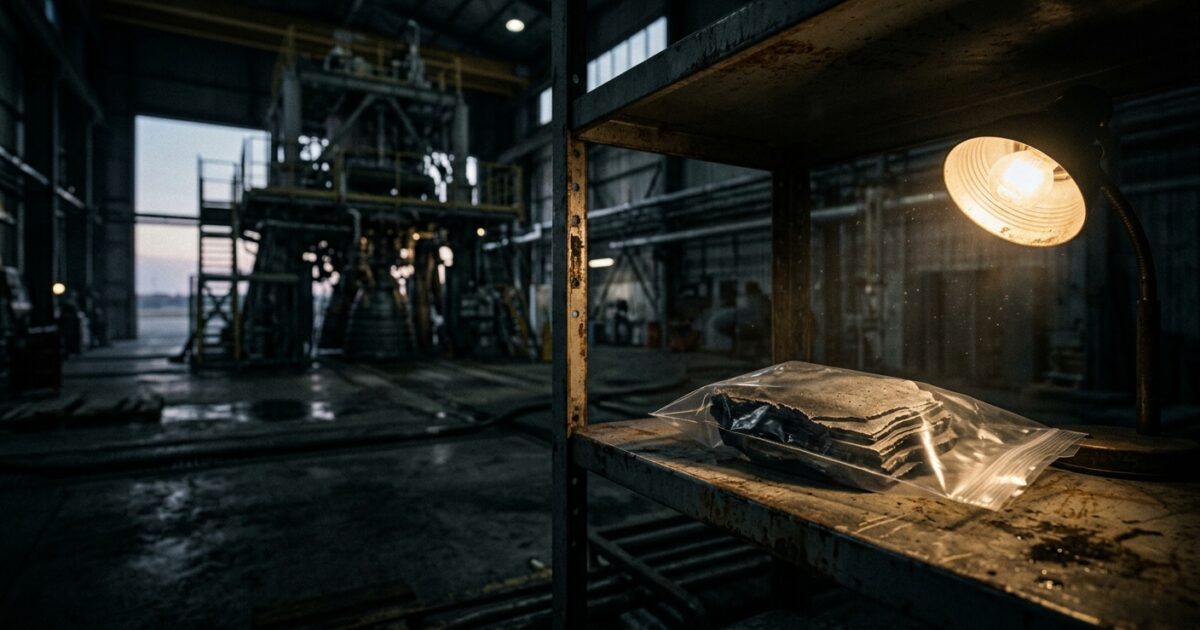
The clearest test case for how Huntsville-adjacent exotic-materials claims actually get resolved is the layered bismuth-magnesium alloy known as Art’s Parts. Its chain of custody is documented in unusual detail: an anonymous 1996 letter to radio host Art Bell, forwarded to investigator Linda Moulton Howe, purchased by To The Stars Academy for $35,000, placed under an Army cooperative research agreement in 2019, and finally analyzed at Oak Ridge National Laboratory in 2022.
Oak Ridge’s conclusion was that the material is terrestrial in origin, consistent with the Betterton-Krohl process, a bismuth-separation method that has been standard industrial practice since the 1930s. Hal Puthoff, who threads through nearly every institutional chapter of this history, held the material for years through his own organization, EarthTech International, and tested it without finding anomalous antigravity properties by 2012, a full decade before Oak Ridge reached the same conclusion by different means. Two independent evaluations, run a decade apart by researchers with opposite institutional incentives, agree that this particular piece of evidence is not what the chain-of-custody drama around it implied.
Art’s Parts is worth stating plainly here because it complicates a simpler version of this article. Not every exotic claim moving through the Redstone ecosystem survives contact with a laboratory. The pattern this piece is actually describing is not that Huntsville is hiding proof of anomalous physics. It is that the same small set of institutions and people keeps generating both the claims and the verdicts on them.
Two Deaths, Two Different Evidentiary Tiers
Amy Eskridge, a UAH graduate who co-founded the Institute for Exotic Science to pursue gravity modification and advanced propulsion research, died on June 11, 2022. Her death was ruled a suicide. That ruling has been contested by independent investigators whose findings were submitted to Congress, and Eskridge had reportedly texted a colleague a prediction of her own death beforehand. What actually happened is not established either way by the public record, and it should not be treated as established in either direction. The documented fact is the ruling and the contest to it. Everything else is claimed, not corroborated.
Ning Li’s later life sits in a different category entirely, one with no serious dispute attached. She was struck by a car in 2014 and sustained permanent brain damage consistent with Alzheimer’s. Her husband died of a heart attack while witnessing the accident, in 2015. She died in July 2021. Her son has confirmed that he continues defense-related work under a top-secret clearance. None of this is contested, and none of it requires a structural argument to be worth stating. It is simply what happened to the physicist whose antigravity research briefly interested the Department of Defense and then went quiet.
What Kirkpatrick Said After He Left
Kirkpatrick departed AARO in December 2023. In a July 2024 interview, he said that he and the office had lobbied Congress against the UAP Disclosure Act, the Schumer-Rounds bill that would have created an independent records review board with eminent domain authority to compel document production. His own words: “we convinced Congress last year not to go down that road.” The bill was subsequently gutted in the House, with provisions stripped by a representative whose district has significant aerospace-contractor presence.
This is the structural payoff of the Redstone connection, and it fits the pattern this publication has traced across the broader disclosure cycle: the office created to investigate exotic-technology claims, run by a man who spent part of his career inside the classified aerospace-research apparatus at Redstone Arsenal, used its institutional position to help kill the one piece of legislation that would have forced broader disclosure regardless of classification level. UAP Disclosure Without Accountability covers the same structural tell across the wider disclosure cycle: what is consistently absent is not evidence, it is any mechanism of actual enforcement.
Hal Puthoff’s own institutional path runs through the same argument from a different angle. He left the Stanford Research Institute’s remote-viewing program in 1985, founded what became EarthTech International in 1991, and was named chief scientist of Bigelow Aerospace Advanced Space Studies in 2008, the entity that held the AAWSAP contract with the Defense Intelligence Agency from 2008 to 2012. Bob Bigelow, AAWSAP, and the Years the Pentagon Investigated a Haunted Ranch covers what that contract actually funded. AAWSAP is the formal institutional predecessor to AATIP, the program whose informal “chief scientist” credit Puthoff received in the 2025 documentary The Age of Disclosure, describing a role that was never a formal Pentagon position.
The Convergence, Stated Plainly
None of the individual pieces here are secret. Kirkpatrick’s biography is public. Taylor’s television career is public. The Oak Ridge report on Art’s Parts is public. Ning Li’s obituary is public. What is not usually stated plainly is that all of it traces back to the same few square miles around Redstone Arsenal and the university beside it, and that the people producing the claims and the people evaluating the claims keep turning out to be drawn from the same institutional pool. A base that builds classified aerospace hardware will, almost by definition, also produce the people qualified to judge someone else’s aerospace claims. Whether that produces better oversight or a closed loop is not a question the geography answers by itself. It is the question every name in this article keeps raising without resolving.
Sources & Further Reading
- Linda Moulton Howe — Earthfiles archive (specific Travis Taylor / Art’s Parts article not independently verifiable via a stable public URL, cited for provenance context only)
- All-domain Anomaly Resolution Office — AARO’s Supplement to Oak Ridge National Laboratory’s Analysis of a Metallic Specimen
- Oak Ridge National Laboratory (via AARO) — Synopsis: Analysis of a Metallic Specimen
- MITRE Corporation — 2003 presentation record, Ning Li and AC Gravity LLC (no stable public URL found; cited from secondary reporting only)
- NewsNation — “Missing scientists: Amy Eskridge texted friend she ‘definitely did not’ plan to die by suicide”
- CNN — “At least 10 people tied to sensitive US research have died or disappeared in recent years, sparking federal investigation”
- Sean Kirkpatrick — July 2024 remarks on AARO and the UAP Disclosure Act
- Stranger Than Fiction — UAP Disclosure Without Accountability
- Stranger Than Fiction — Bob Bigelow, AAWSAP, and the Years the Pentagon Investigated a Haunted Ranch
Leave a Reply