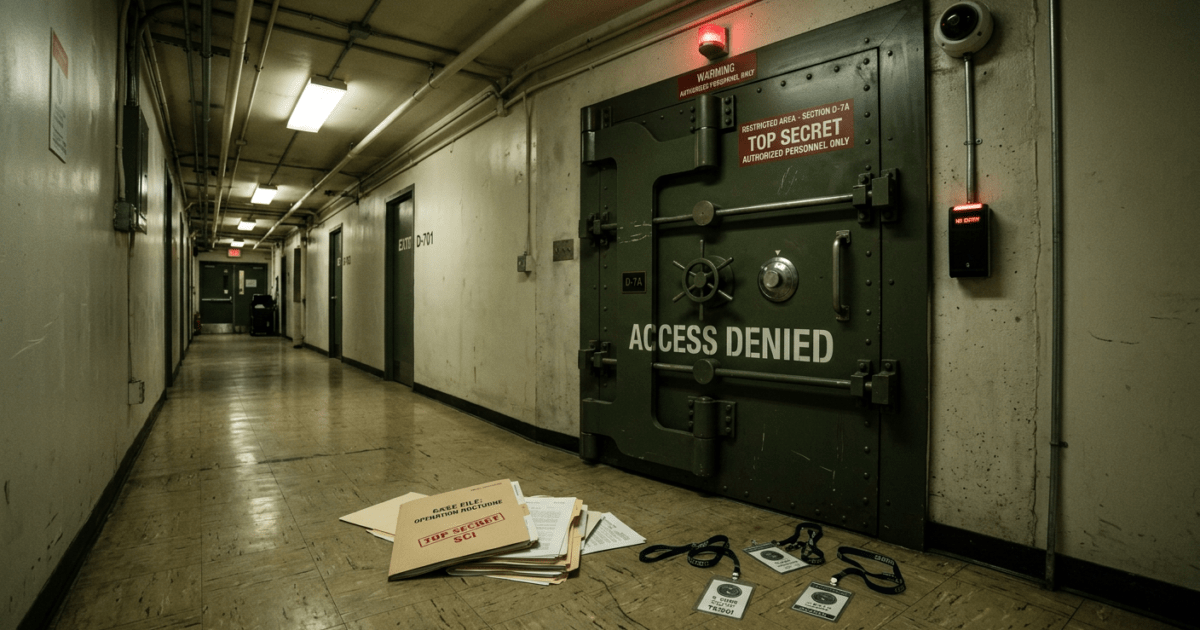
In July 2022, the Department of Defense established the All-domain Anomaly Resolution Office with a mandate to investigate unidentified anomalous phenomena across air, sea, space, and land. Congress funded it. The Pentagon staffed it. Its first director, physicist Sean Kirkpatrick, assembled a team of more than 40 personnel and opened investigations into a caseload exceeding 800 reports. On paper, AARO was the institutional answer to decades of demands for transparency about UAP. In practice, it was built with a structural flaw that may have been the point.
The Clearance Problem
AARO reports to the Under Secretary of Defense for Intelligence and Security. It can issue information requests to various DoD compartments. Those compartments are advised to collaborate. They are not legally compelled to do so — particularly if compliance would compromise classified capabilities housed within Special Access Programs or Unacknowledged SAPs that operate under separate oversight structures.
This is not a theoretical limitation. When David Grusch testified before the House Oversight Committee in July 2023 that he had been denied access to a multi-decade UAP retrieval program, Kirkpatrick’s office responded by noting that Grusch had “refused to speak with AARO.” Grusch’s supporters countered that AARO lacked the clearance level necessary to receive the information in question. Both statements can be true simultaneously — and if they are, the implication is that Congress created an investigative body that is structurally unable to access the programs it was created to investigate.
The denial and the structure it implies are not in contradiction. They are consistent with each other. If a program is compartmented at a level above AARO’s access, AARO can truthfully report that it found no evidence of the program. The program can simultaneously exist. These are not competing claims. They are descriptions of how compartmentalization works.
The Historical Record Report
In March 2024, AARO released its “Report on the Historical Record of U.S. Government Involvement with Unidentified Anomalous Phenomena, Volume 1.” The report concluded that AARO had found no verifiable evidence that any U.S. government investigation, program, or activity had confirmed the existence of extraterrestrial technology. It characterized decades of UAP claims as products of “circular reporting” among a community of believers.
The report was immediately criticized from multiple directions. Researchers identified factual errors and significant omissions — including the absence of any substantive analysis of the Nimitz 2004 encounter, the Gimbal and GoFast videos from 2015, or the testimony of multiple credentialed witnesses who had appeared before Congress. Attorney Daniel Sheehan, in an open letter, accused Kirkpatrick and AARO of “perpetuating a legacy of suppression” and characterized the report as consistent with decades of institutional obfuscation dating to Project Blue Book.
In a July 2024 interview, Kirkpatrick revealed that he and AARO had lobbied Congress against the UAP Disclosure Act — the bipartisan Schumer-Rounds amendment that would have created an independent UAP Records Review Board with eminent domain authority to recover “technologies of unknown origin” from contractors. Kirkpatrick stated: “We convinced Congress last year not to go down that road.” The amendment was ultimately gutted in the House, with key provisions stripped by Representative Mike Turner, whose district includes significant aerospace contractor presence.
The Structural Catch-22
The core problem is architectural. AARO was placed inside the Office of the Under Secretary of Defense for Intelligence and Security — the same organizational structure that critics allege oversees or enables the concealment of UAP-related programs. Asking AARO to investigate programs potentially hidden by its own parent organization is not oversight. It is a closed loop.
Senator Kirsten Gillibrand, who championed AARO’s creation, expressed frustration with the office’s limitations. The Schumer-Rounds UAPDA was designed to solve exactly this problem by creating an independent body outside the DoD chain of command. Its defeat in the House — after lobbying by both AARO and defense industry representatives — left AARO as the sole institutional mechanism for UAP investigation, with all of its structural limitations intact.
Jon Kosloski, who replaced Kirkpatrick as AARO director in August 2024, has struck a notably different tone. In November 2024, he stated that AARO is analyzing several “true anomalies” and that “there are interesting cases that I, with my physics and engineering background and time in the intelligence community, I do not understand.” Whether this signals a substantive shift in AARO’s investigative posture or merely a change in communication strategy remains to be seen.
The Question AARO Cannot Answer
The fundamental issue is not whether AARO’s personnel are competent or acting in good faith. The issue is whether the office has the structural authority to access the information necessary to fulfill its mandate. If UAP-related programs exist at classification levels above AARO’s reach — as Grusch testified, as the Schumer-Rounds amendment implicitly assumed, and as AARO’s own parent office would be positioned to know — then AARO’s conclusions about the absence of such programs carry no investigative weight. They are statements about the limits of AARO’s access, not about the limits of reality.
Congress asked a question. It then built an institution to answer it — and placed that institution inside the organization most likely to have reason to withhold the answer. Whether this was an oversight or a design choice is itself a question that no one in a position of authority has been required to answer under oath.
“There are interesting cases that I, with my physics and engineering background and time in the intelligence community, I do not understand.” — Jon Kosloski, AARO Director, November 2024
Leave a Reply