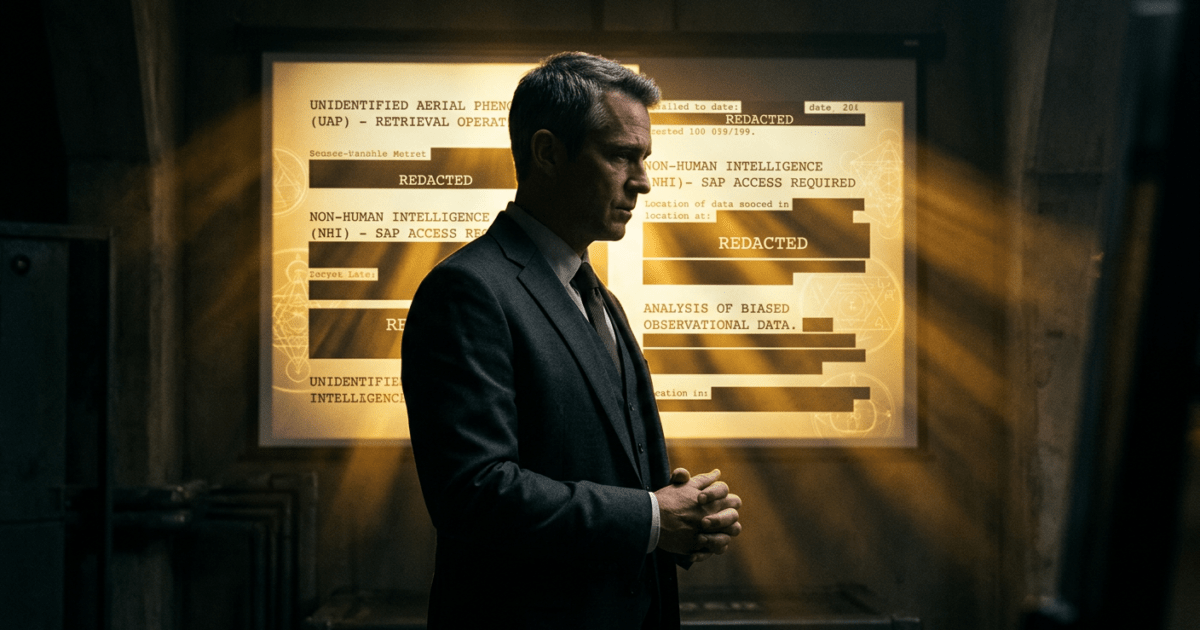
On May 5, 2026, David Grusch sat down with Chris Ferrell on Judicial Watch’s “On Watch” podcast for an hour and fourteen minutes. Ferrell is a former Army intelligence officer. Grusch is a former Air Force intelligence officer who spent fourteen years in the intelligence community, held clearances across what he describes as 85 to 90 percent of all DoD special access programs, briefed the National Security Council on space issues, handled the Presidential Daily Brief at the NRO, and is now a special adviser to Congressman Eric Burlison. The interview was not conducted by a journalist. It was conducted by a peer — someone who navigated the same classification architecture Grusch describes — and the result is the most operationally specific public accounting Grusch has given since his July 2023 congressional testimony.
Several claims in this interview have not appeared in Grusch’s previous public statements. They concern the legal mechanics of concealment, the institutional response to his whistleblowing, and the specific obstacles standing between the current administration and disclosure. None of them resolve the fundamental evidentiary question. All of them are independently verifiable.
The Espionage Act Complaint
Grusch reveals that the Department of the Air Force filed an unauthorized disclosure complaint against him under the Espionage Act shortly after his public statements in June 2023. The complaint was denied — Grusch states he obtained pre-publication clearance from the Defense Office of Prepublication and Security Review for every public statement he made about UAPs and crash retrievals. He has since filed a FOIA lawsuit in the Eastern District of Virginia to obtain the records associated with the complaint. The case — Grusch v. United States Department of Defense (1:2026cv00607) — is on the federal docket.
The significance is structural. If a whistleblower’s public statements were pre-cleared by the responsible security review office and an Espionage Act complaint was filed anyway, the complaint functions not as a legal instrument but as a deterrent signal — a demonstration to anyone else considering public disclosure that the institutional response will be punitive regardless of procedural compliance. Grusch says the complaint was denied because of “the legal preparatory work that I did.” The implication is that a less legally sophisticated whistleblower would not have survived it.
The Atomic Energy Act Problem
Public discussion of UAP disclosure typically assumes that the president can declassify anything. Grusch identifies a specific legal constraint that complicates this assumption: some UAP-related material falls under the Atomic Energy Act of 1954 rather than Executive Order 13526, which governs classified national security information.
Under the AEA, the president does not have unilateral declassification authority over Restricted Data. The statute assigns that authority to the Department of Energy, with the president serving as a tiebreaker if DOE and the Department of Defense disagree. An obscure office within the National Archives — the Information Security Oversight Office — plays a role in that process. Grusch acknowledges that under unitary executive theory, the president could argue he holds broader authority, but as the statute is written, the declassification pathway for AEA-classified material runs through DOE, not the Oval Office.
This is not a speculative claim. The Lawfare Institute published an analysis of exactly this legal question in January 2023, confirming that the AEA’s declassification framework operates independently of the executive order system and does not grant the president blanket declassification power. If UAP-related programs involve nuclear technology, nuclear-adjacent materials, or were historically housed under Atomic Energy Commission or DOE authority — as Grusch states they were — then the “Trump can just declassify it” position requires a constitutional argument that has not been tested in court.
The White House SAP Loophole
Grusch describes a category of classified programs that may represent the structural heart of the concealment architecture: White House Special Access Programs that are non-covert action. Covert action programs — those authorized under 50 USC §3093 — carry mandatory reporting requirements to the Gang of Eight. White House SAPs that do not qualify as covert action carry, according to Grusch, no statutory reporting requirements to congressional leadership at all.
This is a specific, checkable legal claim. If correct, it means that a program could be authorized at the White House level, delegated administratively to a department like DOE or DOD, and operate without any congressional notification requirement — not because reporting was circumvented, but because the statute does not require it. Grusch identifies this as one of the mechanisms used to keep UAP-related programs outside the oversight structure. The distinction between covert action and non-covert White House SAPs is an arcane point of classification law that has received almost no public attention.
What Moved After Testimony
Grusch states that after his late 2022 Senate testimony, physical holdings were moved. He does not specify what kind — materials, documents, or hardware — but attributes the information to sources still inside the relevant programs. “I do know things were moved — physical holdings wise — after my testimony in late 2022, thanks to people I have on the inside.”
If accurate, this describes the concealment or relocation of evidence in response to a congressional investigation. Grusch frames this as one reason the administration may be proceeding slowly: the government may not have full situational awareness of where everything is. “I think part of this is mapping everything to avoid government embarrassment,” he says.
The CIA’s Refusal
Grusch reports that Chairman Comer’s committee sent detailed interrogatories to the CIA — questions informed, Grusch states, by his own experience and knowledge of specific programs. The CIA’s response, according to Grusch, was a blanket refusal: “We are not answering any of these questions. We’ll refer you to AARO.”
He adds that he does not know whether CIA Director John Ratcliffe or General Counsel Michael Ellis were aware of the response. The referral to AARO is consistent with the structural problem documented in AARO’s own mandate — an office that reports to the Under Secretary of Defense for Intelligence and Security cannot compel the CIA to provide information the CIA has decided not to share. Congress created AARO to investigate. The CIA told Congress to ask AARO. AARO lacks the clearance level or statutory authority to compel the CIA to answer. The loop closes.
The Retaliation Architecture
The most substantively important section of the interview is not about UAPs. It is about what happened to people who helped Grusch investigate.
He describes a pattern: his chief of staff at NGA was targeted for clearance revocation. His boss at the NRO had their clearance revoked. Associates have been out of work for over three years. A senior SAP community official was removed and remains in legal appeals years later. Grusch also references “anomalous health incidents” — the term of art for what is commonly called Havana syndrome — affecting government officials who assisted him, stating these were reported to the FBI and counterintelligence elements with “little to no help.”
He draws an explicit connection between UAP disclosure resistance and the government’s posture on anomalous health incidents, noting that both involve institutional denial of phenomena that classified assessments take seriously. The 60 Minutes report in March 2026, which revealed that DHS had acquired a microwave weapon system from Russian illicit arms markets, provides independent corroboration that directed energy weapons of the type associated with anomalous health incidents exist and are in government hands.
This section matters because the standard objection to whistleblower claims — if this were real, more people would come forward — assumes manageable professional risk. Grusch describes a system where the risk includes clearance revocation, Espionage Act investigation, administrative “terrorism” (his word, used in both this interview and his 2023 congressional testimony), directed energy attack, and systematic social isolation. The absence of additional public whistleblowers is, in this framing, evidence of the deterrent’s effectiveness.
The Theological Intervention
Grusch takes direct aim at the “demons” framework that has gained traction through Vice President Vance, Tucker Carlson, and segments of the evangelical-adjacent discourse. Speaking as a practicing Roman Catholic, he calls the blanket equation of non-human intelligence with demonic entities “theologically premature” and “very dangerous language.” He cites three Catholic theologians — the late Paul Thigpen, Diana Pasulka at the University of North Carolina, and Brenton Robinson at Notre Dame — as having developed more sophisticated frameworks for interpreting the phenomenon within Christian theology.
This is a deliberate public intervention. The demons framing provides a religious justification for indefinite secrecy — if these entities are demonic, then exposure serves evil. Grusch is arguing, from within the same theological tradition that Vance and others invoke, that the conclusion is premature and the reasoning dangerous. Whether this argument gains traction within the communities it targets will depend on factors well outside Grusch’s control, but the fact that he made it — explicitly, on the record, citing specific theologians — signals that he considers the demons narrative a strategic threat to disclosure, not merely a theological disagreement.
The 90-Day Window
Grusch states he has “confidence that it’s going to escalate in the next 60 to 90 days” — placing the window roughly between early May and early August 2026. He references congressional actions he declines to specify and notes that Chairwoman Luna is seeking the declassification of approximately 46 UAP-related videos from the Department of Defense. He also describes a “lawfare strategy” involving class action and RICO litigation as a contingency if institutional channels fail, while acknowledging that legal remedies would take years and likely reach the Supreme Court on unitary executive theory grounds.
He explicitly counsels against a multi-year disclosure timeline, arguing that drawn-out releases create operational security opportunities for program insiders to relocate holdings, develop cover stories, and insulate themselves — a pattern he says occurred during the Clinton administration when “there was a burn bag and shred party at a particular agency in the mid-90s.” He recommends that Trump issue a document preservation executive order, potentially non-public, to secure records before evidence destruction occurs.
What the Host Confirmed
Ferrell’s intelligence background changes the interview dynamics in ways that do not occur in standard media appearances. When Grusch describes SAP management, compartmentalization abuse, or program protection strategies, Ferrell does not ask him to explain. He confirms from his own career. He volunteers an anecdote from his time at Supreme Headquarters Allied Powers Europe about an officer who assigned an unauthorized nickname to a classified activity and triggered an immediate security response — corroborating the institutional culture of classification naming that Grusch describes.
Grusch responds at a higher technical register than in any previous interview. He discusses IC governance structures (ICD 96), the DoD SAP senior review group, deconfliction failures between IC and DoD program portfolios, and specific tradecraft techniques like hiding programs within cover programs and rotating unclassified nicknames to defeat institutional memory. This is not a journalist-source interaction. It is two former intelligence officers comparing notes on a system they both navigated.
What This Does Not Contain
No new physical evidence. No program names beyond what is already public. No identification of specific contractors or facilities. No resolution of the fundamental epistemic problem: Grusch’s claims rest on his testimony and the testimony of sources whose identities remain classified.
The interview advances the structural narrative — how programs are hidden, how whistleblowers are punished, what legal mechanisms enable concealment — but does not advance the evidentiary case for the underlying claim that recovered non-human technology exists. The structural claims, however, are independently verifiable in ways the core claim is not. The FOIA lawsuit is on the federal docket. The Atomic Energy Act’s declassification provisions are statutory. The CIA’s refusal to answer interrogatories is a matter of congressional record. The White House SAP reporting gap is a question of law.
None of this proves crash retrieval programs exist. It proves that the system Grusch describes — one capable of hiding such programs from Congress, inspectors general, and even a three-star admiral who was Director of the Defense Intelligence Agency — is not hypothetical. It is how the classification system actually works. Whether that system is currently being used for the purpose Grusch alleges remains, as it has since 2023, on the other side of a classification wall that the current administration has the authority to open and has not yet chosen to.
“I was well positioned. I understood that ecosystem of secrecy. I know how they hid programs from ODNI. I know how they hid programs from the Senate and House Intelligence Committees.” — David Grusch, May 2026
Sources & Further Reading
- Judicial Watch — “On Watch” with Chris Ferrell: David Grusch Interview (May 5, 2026)
- Justia — Grusch v. United States Department of Defense, EDVA (1:2026cv00607)
- Lawfare — “Can Trump Just Declare Nuclear Secrets Unclassified?” (January 2023)
- Rep. Burlison — David Grusch Special Advisor Announcement (March 2025)
- House Oversight Committee — Grusch Opening Statement (July 2023)
- STF — AARO’s Contradiction: Tasked to Investigate Programs It Cannot Access
Leave a Reply