In early 2025 a private venture went public with a claim that would be, if demonstrated, the most consequential result in the history of the subject: that unidentified craft can be brought to a place and a time on purpose rather than waited for. Skywatcher named its methods, named its people, promised data, and said peer review was coming. Eighteen months later the site has not been updated, the principal engineer has left for a government contract, and the last public message asked for patience. The Skywatcher UAP program did not fail in public. It stopped talking.
What follows separates what the venture documented about itself from what has been claimed about where the Skywatcher UAP effort went, and keeps both apart from a third thing: what the Federal Aviation Administration did over the same patch of West Texas.
What the Skywatcher UAP program said it would do
The company described two distinct approaches, and keeping them apart is necessary because they carry very different evidentiary weight.
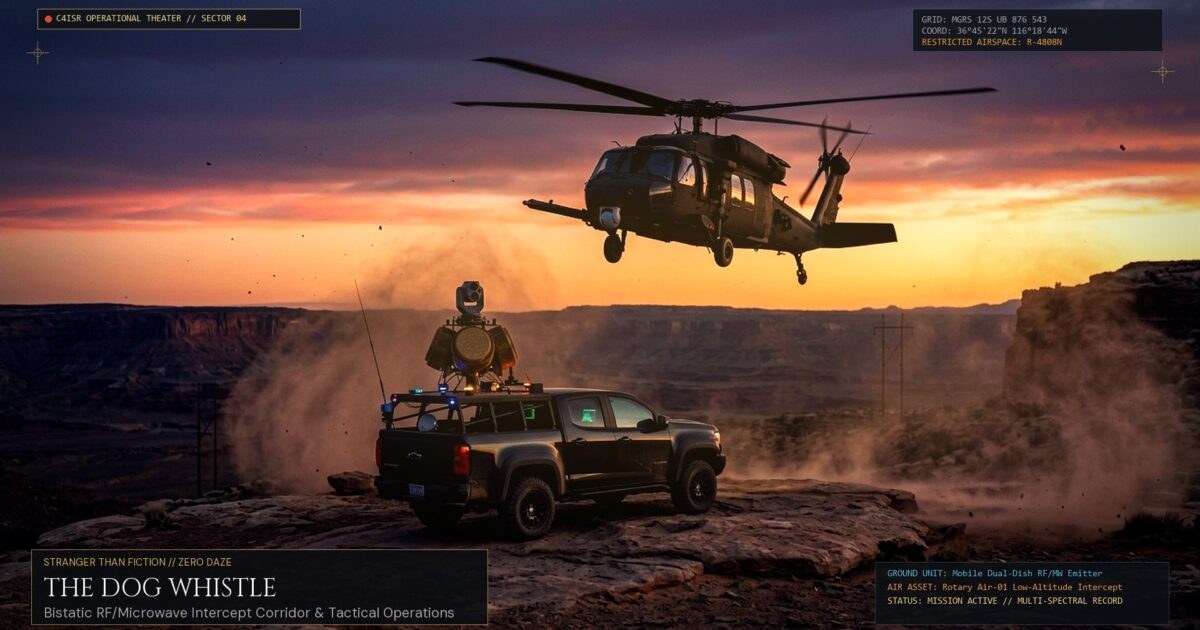
The first is electromechanical, which the team called machine calling and referred to publicly as a dog whistle: a signalling device built over several years with James Fowler as principal engineer, intended to produce a repeatable cause-and-effect relationship between operating the equipment and the appearance of an object. The second is what the company calls psionic calling, described as neuromeditative, in which a human operator rather than a device is the instrument.
Skywatcher also published a taxonomy of nine object classes, including categories it labels Tic Tac, jellyfish, and manta ray.
The names around it are worth stating carefully, because the distinction gets flattened constantly. By the company’s own description, Jake Barber is the founder and James Fowler led the technology team, and the people it places in the field alongside them include Stanford immunologist Garry Nolan, investor Alex Klokus, and national security analyst Matthew Pines. A second and separate group appears in the company’s first film as interview subjects and references rather than as participants: David Grusch, retired Army colonel Karl Nell, and Fred Baker. Being interviewed in a documentary about a venture is not the same as working for it, and this piece does not treat the two as equivalent.
We tracked the venture from its first public phase in BIG Skywatcher update: AARO in the loop and again in Watching the Skywatchers.
The Skywatcher UAP timeline, in order
Field operations ran through July 2025, based at Sierra Blanca, in the Trans-Pecos desert southeast of El Paso. In August 2025 the company posted publicly that Fowler was leaving, congratulating him on a new venture contracting with the United States government and thanking him for his role in field operations and in the data collected. At a symposium in November 2025 Barber described the work moving to a stage of data analysis and independent review. In late December the company’s channel posted a holiday message asking for patience and referring to peer review.
Then nothing. No data release, no specification for the device, no published protocol, and no peer-reviewed submission in the eight months since.
Absence of publication is not evidence of anything by itself. Companies go quiet for funding reasons, legal reasons, personnel reasons, and because a result did not replicate. Each is a sufficient explanation for the Skywatcher UAP silence on its own, and none requires a second story.
The red team, in his own words
Before any of the Skywatcher UAP work began, Barber says he was doing the opposite job. He has described it at length on the record, in a filmed interview with Jesse Michels, and the account is specific enough to be worth quoting rather than summarizing.
His career field, he says, was red teaming. He describes it in the military’s own terms:
“What I was being refined for was a redteamer. I became a red team expert. Red team, you could think of is an opposition force. In fact, that’s exactly what we call it, is OPFOR or opposition force. And red team’s job in any scenario is to exploit all the weaknesses of blue team and find the vulnerabilities and then use those against blue team.”
That skill set, by his account, was eventually pointed at civilians. He describes being sent to a whistleblower conference at the National Press Club hosted by Steven Greer, held shortly after whistleblower protections were activated, and he is blunt about the assignment:
“We were actually sent there on behalf of our employer to look for whistleblowers that we were trying to basically report to the FBI and get arrested, because at that time I was in this weird place between becoming a whistleblower or rounding up the whistleblowers and shutting them up.”
What changed it, he says, was sitting in that room and listening to Michael Herrera, the former Marine who describes a 2009 encounter in Indonesia during earthquake relief operations. Barber says Herrera’s account contained operational detail he recognised, and that the recognition ran the other way from what he was there to do:
“I was able to understand what he was saying was true, or at least had elements that I was fully aware of that he didn’t quite understand, that he couldn’t have been making up… So it was at this moment that we began to help out.”
He describes the reversal in the same vocabulary: they “flipped on red team power in the ultimate fashion” and began working against the people who had sent them. Everything that became the Skywatcher UAP effort dates from after that point.
Two things need saying, and they pull against each other.
Self-incriminating claims carry more weight than self-serving ones. Barber is describing having gone into a room full of people who believed they were speaking safely, under a false presentation, in order to get some of them arrested. That is a costly thing to volunteer.
It also cuts directly against him. To his credit, he raises the problem himself before the interviewer does, invoking the first principle of his own trade:
“Anyone that’s read The Art of War, you know what’s the first rule… Deception. Deception is the first rule in The Art of War, is to deceive and to always act like something you’re not. Now I think about it, that’s probably alarming coming from me right now.”
Michels asks the obvious question, and the answer is the most useful thing in the interview:
“How do we know you’re not red teaming us right now?”
“Well, you don’t. You don’t know that… That was an honest answer.”
He offers a standard in place of an assurance, which is that he should be judged by what his actions produce rather than by his word. That is the correct standard, it is the one this article applies to the Skywatcher UAP claims throughout, and by that standard the data has not arrived. It also means his conversion and his prior deception rest on the same testimony, and no part of it is presently corroborated by a document.
If the account is accurate it implies something larger than one man’s career: that a counter-disclosure effort was being run against these witnesses at named venues, with the aim of having them arrested. That would be a documentable operation rather than a feeling about one, and it would sit alongside Operation Mockingbird Never Ended. It Evolved. It has not been documented. It is one man’s description of his own former job.
The claim that a second story exists
Journalist Ross Coulthart has reported that Skywatcher did not fold but went government, and that a classified operation is now using the Skywatcher UAP signalling and psionic methods directly. The sourcing offered is not named. Barber has separately said his team conducted demonstrations for the Pentagon’s anomaly resolution office under its current director.
There is a structural reason for caution that has nothing to do with Coulthart. An absorbed Skywatcher UAP program and an abandoned one look identical from outside. Both produce silence, a departed engineer, and no data. A hypothesis that predicts exactly what the mundane explanation predicts has not yet earned anything.
February 2026, which is explained
Three times between November 2025 and February 2026, the FAA restricted airspace over this corner of West Texas. Because the Skywatcher UAP operations had run there, the events have been widely joined together. Two of the three come apart on contact with the record.
On 11 February 2026 the FAA issued NOTAM FDC 6/2233 over El Paso, citing special security reasons: a ten-nautical-mile radius around the El Paso VORTAC, from the surface to 17,999 feet, nominally for ten days. It was lifted after roughly eight hours. Reporting attributes it to a Pentagon high-energy counter-drone laser test at Fort Bliss that had not completed coordination with the FAA, and what the laser engaged was four Mylar party balloons. The restriction reportedly came down only after the White House learned of it. El Paso’s mayor, the airport, and local officials say they received no advance notice, and fourteen flights were cancelled with medical flights diverted to Las Cruces.
On 26 February a further restriction went up over Fort Hancock, running through 24 June, after military personnel downed a drone that Customs and Border Protection was operating near US troops without their knowledge.
Those are serious stories. They are stories about federal agencies firing directed-energy weapons over American territory without deconflicting with the aviation regulator, and about one agency shooting down another’s aircraft. Neither is a story about summoned craft.
November 2025, which is not
The remaining one is different, and it is the reason this article exists.
On 8 November 2025, an FAA notice closed a large block of airspace southeast of El Paso and designated it national defense airspace. The designation ran through 7 November 2026, a full year. Pilots were warned that a breach meant interception, detention and interview, with deadly force authorized against an aircraft posing an imminent security threat.
It was cancelled six days later, on 14 November 2025.
A year-long national defense designation that lasts six days is not a routine administrative act. It sits over the ground the Skywatcher UAP experiments described above had been using. And it is absent from essentially all of the February coverage, which reached for the more recent and more dramatic closures instead. Representative Tony Gonzales, whose district covers it, has confirmed on the record only that a closure happened in Hudspeth County that November and was lifted expeditiously.
Two cautions belong here, and the second is uncomfortable.
Skywatcher’s field operations ended in July 2025, four months before the notice went up. Whatever prompted it, the company was not there. That does not explain the notice, but it does argue against the simplest reading, which is that the airspace was closed to shield an operation in progress.
And the detailed parameters above come from reporting rather than from the FAA record itself, carried principally by the same outlet that carries the went-government claim. That is not a reason to discard them. It is a reason to say where they come from, and to note that the underlying notice is a public document nobody appears to have pulled.
What would settle the Skywatcher UAP question
The venture set its own standard, which makes the standard fair to apply. It said it had data and that peer review was the destination. A specification for the device, a published protocol, or a submitted manuscript would each move the claim out of the category it currently occupies, and any of them can be produced at any time by the people holding them. The comparison worth making is with a program that did meet this bar: the government’s own structured psychic functioning methodology from the Stargate era is a declassified manual anyone can read, published by an institution with considerably more reason to keep it quiet. We covered it in Remote Viewing: The Stanford Research Institute Experiments, Stargate.
For November 2025, the open item is narrower and entirely answerable. The notice has an issue date, a cancellation date, a defined area, and a requesting authority. Those are records. Somebody can pull them, and until somebody does, the most anomalous airspace action in this sequence remains the one nobody has examined.
The question the silence leaves is not whether craft were summoned in West Texas. A venture assembled a credentialed roster, said it had results, named peer review as the finish line, and stopped speaking. Whether the reason is a classified absorption, a commercial collapse, or a result that did not hold, the people who know have not said, and nothing yet compels them to.
“In November of 2025, a similar airspace closure occurred in the neighboring Hudspeth County, also in my district. After collaboration with federal partners, this TFR was lifted expeditiously.”
— Rep. Tony Gonzales, February 2026
Sources & Further Reading
- Skywatcher media and technical material
- Skywatcher statement on James Fowler’s departure, August 2025
- “I Retrieved a UFO With My Helicopter!” Jake Barber interviewed by Jesse Michels, American Alchemy. Quotations used above, by timestamp: red team as opposition force, 18:17 and 18:24; deception as the first rule of war, 19:54; “how do we know you’re not red teaming us right now,” 20:06; judged by his fruits, 20:24; sent to the Press Club to identify whistleblowers for arrest, 1:18:37 and 1:18:58; recognising Michael Herrera’s account, 1:36:42; “flipped on red team power,” 1:37:29.
- Ross Coulthart Q&A: Skywatcher didn’t disappear, it went government, NewsNation
- Is the Trump administration running a covert UFO program? NewsNation Reality Check
- El Paso airport grounding was in response to testing of U.S. military technology, NBC News
- FAA issues temporary flight restriction over Fort Hancock, KVIA
Leave a Reply