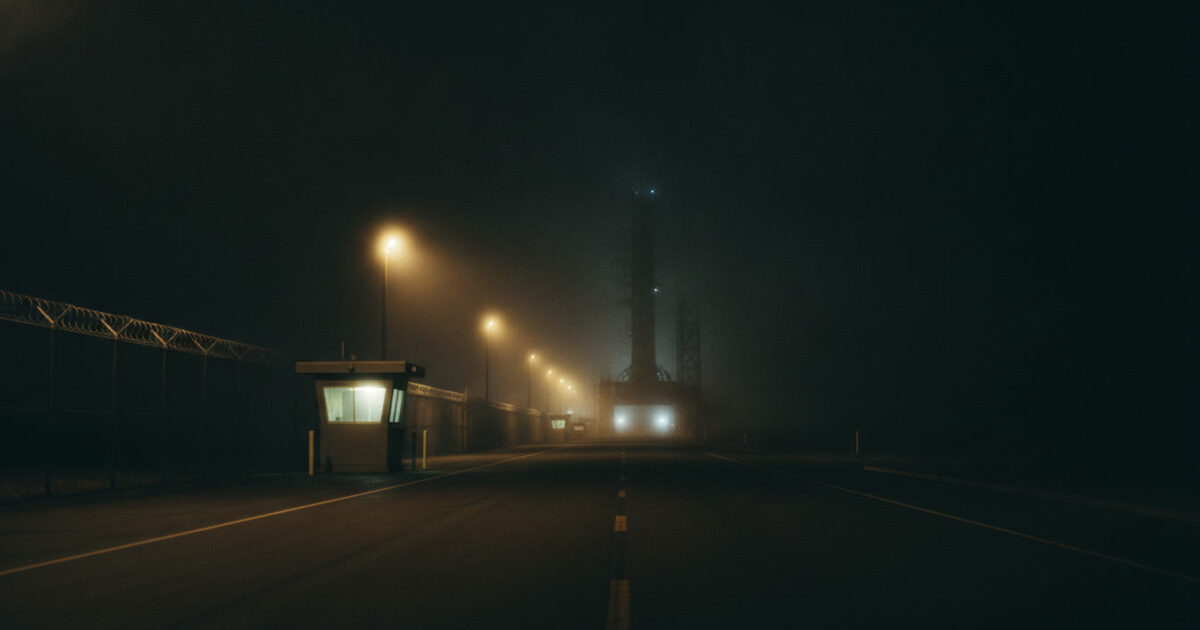
On 9 September 2025, a former Air Force military police officer told a congressional task force what he says came over a missile defense installation twenty-two years earlier. Jeffrey Nuccetelli served sixteen years on active duty. He was a patrolman at Vandenberg Air Force Base between 2003 and 2005. His statement to the House Oversight Committee’s Task Force on the Declassification of Federal Secrets sets out five Vandenberg UAP incidents in that window, and it is now a published government document.
The document is the story. Everything inside it is testimony, which is a different thing, and holding those two apart is the entire exercise.
What the Vandenberg UAP record establishes
The hearing was titled “Restoring Public Trust Through UAP Transparency and Whistleblower Protection.” Representative Anna Paulina Luna chaired it, with Representative Jasmine Crockett as ranking member. The panel seated Nuccetelli alongside Navy senior chief Alexandro Wiggins, journalist George Knapp, Air Force veteran Dylan Borland, and Joe Spielberger of the Project on Government Oversight. The Government Publishing Office printed the proceeding as Serial No. 119-44.
That matters for a narrow reason. Most UAP witness accounts reach the public through an interview, a podcast, or a book, formats with no penalty attached to getting it wrong. This one arrived through a mechanism that carries one. A congressional hearing is not proof of a claim. It is proof of who said what, on what date, in a setting where saying something false is a criminal exposure rather than a reputational one.
Vandenberg’s function is likewise not in dispute. The installation anchors the West Coast missile defense mission and has launched national security payloads for decades. The service redesignated it Vandenberg Space Force Base in 2021, after the events described.
The Vandenberg UAP incidents, as sworn
Nuccetelli’s account covers five incidents. He testified that he personally witnessed one and investigated others as they occurred, and that six other service members supplied the rest. Everything below is his testimony, attributed to him, and none of it is corroborated by a document in the public record.
The sequence opens on 14 October 2003. Boeing contractors, by his account, reported a massive glowing red square hovering silently over two missile defense sites, which drifted east onto the base after several minutes and vanished over the hills. He calls this the Vandenberg Red Square.
Later that night, while he was on duty, security guards at a critical launch site reported a bright, fast-moving object over the ocean. He responded. His account of the radio traffic is the most vivid thing in the record:
“Chaos ensued over the radio as the object approached rapidly. I heard my friends screaming, ‘It is coming right at us, it is coming right for us, and now it is right here.’ Moments later, I heard them say that it had shot off and was gone.”
He arrived to five shaken witnesses who described a craft larger than a football field, hovering silently for roughly forty-five seconds over their entry control point before leaving at high speed. One detail is worth flagging precisely, because it differs between his two submissions: in the printed transcript he calls that craft triangular, while his written statement calls it rectangular. Both documents are primary. Neither is a correction of the other.
About a week later, a patrol reported a light over the ocean behaving erratically. Believing it might be an unannounced aircraft, they declared an emergency and an armed response force turned out. Before those forces arrived, the object descended and either landed or hovered over the flightline, then left. He testified that the witnesses were afterwards threatened and intimidated, told to keep quiet and think about what they were reporting.
Things stayed quiet until 2005, when a patrol reported a triangular craft larger than a C-130 floating silently over the installation before traveling west.
His own encounter came later that year, off duty, in his backyard with two other police officers. An object that first read as a satellite began pulsing wrong, then maneuvering. It dropped in elevation, vanished and reappeared elsewhere in the sky, and eventually settled two hundred feet over his house as what he describes as a thirty-foot sphere of light. Then it accelerated gently upward and was gone.
The radar question, which cuts against the account
Here the sworn record does something worth reporting carefully, because it runs opposite to how the Vandenberg UAP case is usually summarized.
Representative Jared Moskowitz asked him what he did next. The answer is worth quoting at length, because almost nobody repeating this case has read it:
“My next move, I went into my house after it left. I made sure no one had been abducted. And I picked up the landline. I called the Security Forces Command Center. I reported it. I requested that they give me a call back and make notifications up the chain of command. I got a call back in about 15 minutes. They reported that the weather station reported no balloons or aircraft, nothing on radar, no aircraft inbound or outbound.”
Nothing on radar is not a detection. It is the absence of one. Accounts of the Vandenberg UAP incidents circulating elsewhere describe a solid radar return with no transponder, and that detail appears nowhere in either the written statement or the printed transcript. The distinction is not cosmetic. A tracked return would be physical evidence. An unexplained visual with no radar correlate is still an unexplained visual, which is a smaller thing.
The contrast to the Vandenberg UAP material sat at the same table that morning. Wiggins testified to a February 2023 encounter aboard the USS Jackson in which four objects were recorded on a Star SAFIRE electro-optical system, carried timestamps and coordinates in the footage, and were tracked on radar until they departed. That is what corroboration looks like when it exists. Nuccetelli does not have it, and saying so plainly is more useful than pretending otherwise.
What the testimony claims exists on paper
The most checkable sentence in the entire Vandenberg UAP account is not about a craft.
He testified that each incident was witnessed by multiple personnel, documented, investigated, and reported up the chain of command, and that official Air Force records of the October 2003 event are held by AARO and the FBI. He also described the paperwork from his own sighting: within a day or two, he and the other witnesses wrote statements, prepared a report, and filed it.
“We sent information up, but we got no guidance down on how to handle these events.”
That is a claim about institutional behavior, and institutional behavior leaves traces. Security forces blotters exist. Incident reports exist. Range safety logs exist. If statements were written and routed upward, the routing produced paper, and paper is subject to request. This is the same structural move we made in The DOE and CIA UAP Files: What the New Tranches Left Out: what an agency holds is answerable even when the underlying question is not.
Why a strategic site keeps appearing
The pattern the Vandenberg UAP account joins is older than Nuccetelli’s service. Reports clustering around missile fields, weapons storage and nuclear generating stations are a persistent feature of the record. The Department of Energy’s custodial role in that record is precisely why its absence from recent disclosure tranches is conspicuous, which we covered in The Agencies That Didn’t Show Up.
Three qualifications belong on that pattern immediately, and they are not throat-clearing. Strategic installations are watched continuously by people trained to report anomalies and equipped with the sensors that would register one. Consequently, a concentration of reports where the observers are concentrated is what any distribution would look like. Furthermore, a pattern assembled from testimony is a pattern of accounts rather than a pattern of events.
What would corroborate the Vandenberg UAP account
The useful questions here are narrow, which is unusual for this subject.
Nuccetelli named an agency and a bureau as record custodians while under oath. That is testable, and the test is a records request rather than an argument. If AARO and the FBI hold Air Force documentation of a 14 October 2003 incident at Vandenberg, its existence can be established without anyone agreeing on what was in the sky. If they hold nothing, that is also an answer, and it lands on the testimony rather than on the phenomenon.
Six other service members supplied the material in his account. None are named in it. Each is a potential first-person account with a service record attached.
There is also a claim attached to the telling rather than to the events. Speaking at the Disclosure Forum on 25 June 2026, in the Kennedy Caucus Room of the Russell Senate Office Building, Nuccetelli described the personal cost of coming forward: threats against his family, a break-in at his home, and messages left before his hearing. He used it to argue for witness protections rather than to make a point about the sightings.
That is his account and it is uncorroborated, but it belongs in a different category from the sighting claims, because intimidation of a congressional witness would leave a police report rather than a radar track. It is the most straightforwardly checkable allegation in this entire story, and checking it requires no view on what was over the base.
The thing that would move this case is the same thing that moved the 2004 Nimitz material: not a better witness, but a document produced at the time by a system that was not trying to prove anything.
Asked what he and the other witnesses make of it now, twenty years on, he did not claim to know.
“We do not know what we saw. What we saw changed our lives and the way we think about everything… We noticed the object. And this was a pattern across all the encounters. Someone would see a light. They would pay attention to the light. And then the object responds. It performs for you. And then they come down and they investigate you. So, it is almost like they are curious… Maybe it noticed us after we noticed it.”
— Jeffrey Nuccetelli, testimony before the Task Force on the Declassification of Federal Secrets, 9 September 2025
Sources & Further Reading
- Jeffrey Nuccetelli, written testimony (PDF), House Committee on Oversight and Government Reform, 9 September 2025
- Printed hearing record, CHRG-119hhrg61718, Serial No. 119-44, U.S. Government Publishing Office
- Hearing: Restoring Public Trust Through UAP Transparency and Whistleblower Protection
- Alexandro Wiggins, written statement (PDF), same hearing
- Dylan Borland, written testimony (PDF), same hearing
- Disclosure Forum 2026, Kennedy Caucus Room, 25 June 2026, full recording
Leave a Reply