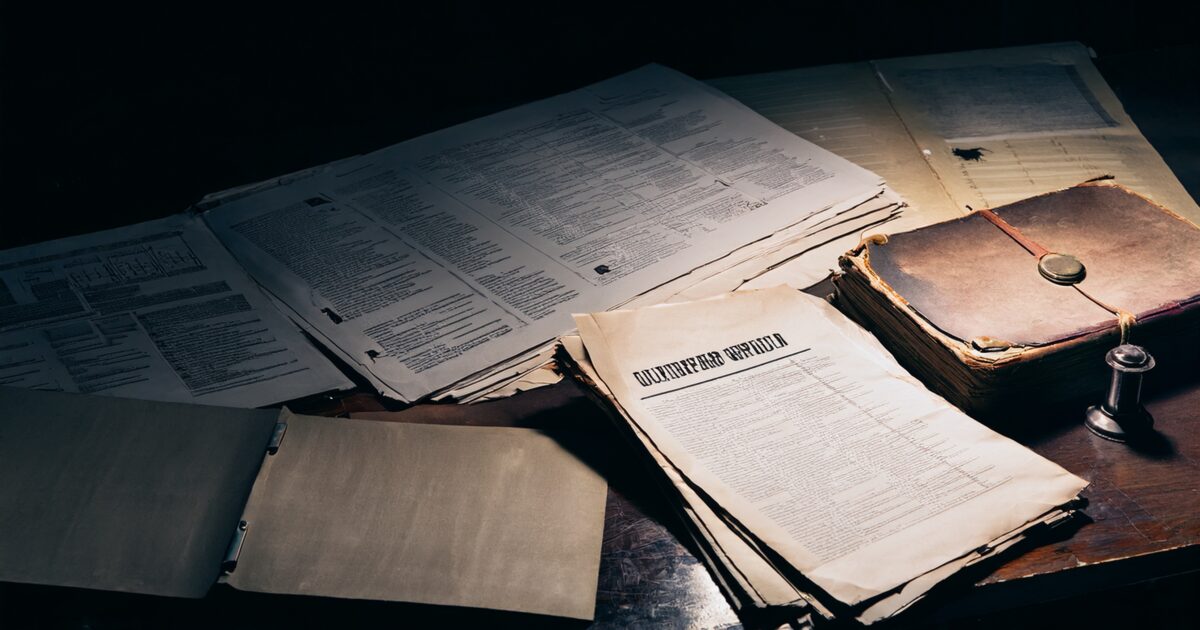
On 2 December 2008, a Las Vegas contractor delivered a project plan to the Defense Intelligence Agency. Its ninth recommendation opened with a premise: “biological material of potentially non-human origin has been recovered.” The plan asked DIA to lobby for samples on the contractor’s behalf. Nearly eighteen years later, that plan is public. It sits in the seventh UAP release, the seventh tranche published today on the Department of Defense’s UFO portal, alongside a 1947 Air Materiel Command memo, a Roswell officer’s sealed affidavit, a 298-page personnel file and a 2026 FBI witness statement. Read together, the 28 files describe one institutional pattern across eight decades: a government that keeps building paper channels for material whose recovery it has never publicly confirmed.
What the seventh tranche contains
The seventh UAP release holds 28 documents in four clusters. The seventh tranche breaks down like this. The largest is the contract file of Bigelow Aerospace Advanced Space Studies (BAASS), the company that ran DIA’s Advanced Aerospace Weapon System Applications Program from 2008 to 2010. A second cluster covers 1947 to 1964 and the Air Force and White House machinery for handling recovered material. A third holds ten Air Force intelligence reports from 1952 to 1957. The last is current: an FBI FD-302 and an All-domain Anomaly Resolution Office (AARO) debrief, both dated 2026.
Two document numbers are missing from the sequence, D165 and D172. The release does not say why.
A 2008 contract plan built around retrieval
BAASS wrote its Project Management Plan under contract HHM402-08-C-0072. A 2010 BAASS report in the same release names the customer as the Defense Warning Office of DIA. STF has covered the program’s Skinwalker Ranch origins before. The plan itself, however, has not been public until now.
The plan lists nine projects. Most are conventional for a threat study: a physics literature review, a case database, outreach to universities. Two are not.
Project Oral History proposed recorded interviews with “highly placed individuals from industry and the military who have had direct knowledge of film evidence, physical material evidence, hardware itself, biological tissue.” Elsewhere the plan says BAASS personnel “have a list of about ten individuals who have worked in various parts or have been affiliated with the programs involving retrieval of advanced aerospace hardware or of associated biological material.” It asked that DIA officials attend the interviews, so the witnesses would “know they won’t get into trouble.”
Project Blue Book Materials claimed that Blue Book case files and trace material “never reached the small ‘official’ investigation office.” According to the plan, those files sit at Los Alamos National Laboratory, and “BAASS affiliated personnel have the precise files numbers and locations.”
The plan goes further on biology. It asks DIA to seek access to samples for review by BAASS forensic staff at the Armed Forces Institute of Pathology, the Army’s Fort Detrick commands including USAMRIID, and Dugway Proving Ground. It also states that “several ‘crashes’ of novel spacecraft have occurred outside of the United States,” which it describes as “substantiated with testimony.”
The tiers here need to stay separate. Documented: a DIA contractor put these requests in a contract deliverable in 2008. Claimed but uncorroborated: the existence of the retrieval programs, the ten individuals, the Los Alamos files and the foreign crashes. Nothing in the release shows DIA acting on any of the requests. Nothing shows it refusing them either.
The plan changes the date on a familiar story. David Grusch put retrieval programs and “non-human biologics” before Congress under oath in July 2023. The same claim sat inside a funded Pentagon intelligence contract fifteen years earlier.
The exhibits: Twining and Roswell
The plan closes with three exhibits. The first is the 23 September 1947 Air Materiel Command memo, “AMC Opinion Concerning ‘Flying Discs,'” signed by Lieutenant General Nathan Twining. Its finding is documented and has been public since 1969: “The phenomenon reported is something real and not visionary or fictitious.” The copy in the release carries handwritten check marks beside that line and two others, and a stamp reading “Research material from” a redacted BAASS analyst.
The second exhibit is a sealed affidavit dated 26 December 2002. The release redacts the name. However, the text matches the affidavit of Walter Haut, the Roswell Army Air Field public information officer who issued the July 1947 “flying disc” press release. Haut’s affidavit was first published in 2007. It describes a staff meeting where “pieces which resembled metal foil, paper thin yet extremely strong” were passed around the table. It also describes an egg-shaped object roughly 12 to 15 feet long inside Building 84, and “a couple of bodies under a canvas tarpaulin.” The affiant concludes: “I am convinced that what I personally observed was some type of craft and its crew from outer space.”
That is a sworn claim by a named participant, made 55 years after the event, and it remains uncorroborated. Its new status is narrower and more concrete. In 2008, a DIA contractor submitted it to the agency as supporting evidence.
The third exhibit is the United Kingdom Ministry of Defence file on an F-86D intercept of 20 May 1957.
The man who ran T-2
The Twining memo says its opinion drew on “preliminary studies by personnel of T-2,” the Air Materiel Command’s intelligence arm. The same release includes the complete Air Force personnel file of Colonel Howard M. McCoy. It shows McCoy served as Deputy Commanding General, Intelligence (T-2), from December 1946, the post that produced those studies. Twining personally rated his performance in October 1947, three weeks after signing the memo.
The file contains something else. In McCoy’s 1954 retirement request, he writes that he managed “a specialized laboratory known as the Science Survey Office” inside the Intelligence Department. Its charter, attached as an exhibit, gives a single-line mission: “Perform the classified functions as prescribed.” According to McCoy, the office “was abolished for unknown reasons shortly after” his August 1949 transfer. He then went to the Central Intelligence Agency, and in March 1951 to the directorship of the new Physical Security Equipment Agency.
McCoy describes the laboratory’s work as “security and investigative equipment.” No document in the release connects the Science Survey Office to flying discs. Even so, the department chose to publish a full personnel file in the seventh tranche, and the only UAP-relevant line in it is his command of T-2.
1963: NASA as the public face
The release’s White House material concerns space debris, which the release titles “Recovery of Foreign Materiel.” Beginning on 2 October 1962, the National Aeronautics and Space Council drafted interagency rules for “fragments, or suspected fragments of space vehicles of all types.” The final guidelines named NASA the public receiver. However, they routed foreign fragments to the Department of Defense first, “to insure prompt analysis for intelligence purposes.”
A 29 May 1963 memo from Council staffer R. W. Hale records NASA international affairs chief Arnold Frutkin’s objections. Two of them stand out. “DOD and AF want to use NASA for a ‘cover’ but have no intention of letting NASA do anything but return some pieces.” NASA would oppose legislation “because of the harmful debate it would touch off.” A 1964 NASA public-affairs directive in the same file states: “Under no circumstances does this agency (government) conjecture on the origin of an object.”
These documents concern Soviet and American rocket debris, and nothing in them mentions anomalous material. Their relevance is structural. They show the government designing a public intake agency while keeping analysis behind it, and discussing that arrangement internally as a cover.
Two federal records of one triangle
The newest documents describe a sighting by federal agents at an observation post in 2026. The location and date are redacted. Two agencies recorded what appears to be the same event, and the records disagree.
| FBI FD-302 (agents’ signed statement) | AARO witness debrief | |
|---|---|---|
| Wingspan | 9 to 15 feet | 13 to 15 feet |
| Total duration | “approximately three seconds” | about 33 seconds: 10 s climb, 20 s hover, 2 to 3 s dash |
| Hover | not mentioned | stable hover, “no observable drift” |
| Description | “delta wing drone,” “unmanned aerial system” | “unidentified craft,” speed compared to a fighter jet |
Both records agree on a matte black, silent triangle with a uniform thermal signature and no visible exhaust. The AARO memo adds a ground search of the canyon the next morning, which found no wreckage. The statement the agents signed is the shorter and plainer of the two. The later debrief is longer and more detailed, and the release does not explain the difference.
Where the filenames outrun the files
The 1950s reports include strong cases. Over Guam on 31 December 1956, an object turned with an F-86D in afterburner and circled it twice. The report concludes that a weather balloon explains it only if the balloon malfunctioned. In January 1957, a B-52 tail gunner on the Strategic Air Command mission the report calls “Operation Powerflight” held a radar contact for five to seven minutes over Saudi Arabia.
The four Catalina Island records are a different matter. The release files them as “Unresolved UAP Report.” Inside, the Air Force’s own evaluations read “probable meteor,” “possibly planets” and “insufficient data for evaluation.” Here the release’s labels claim more than the documents do.
Redaction runs the other direction. The release blacks out the addressee of the Twining memo and the name on the Roswell affidavit, both public for decades. It also redacts the author of a BAASS database proposal as “AAP Person 5.” Yet that author describes compiling the Blue Book punched-card catalogue with his wife and publishing the “Magonia catalogue” of landing reports. Both details match the published record of the computer scientist Jacques Vallée.
What DIA was asked to do
The monthly reports show BAASS growing quickly. It had 45 full-time staff by June 2009. It bought case notifications and physical evidence from the Mutual UFO Network (MUFON), and later cut MUFON’s monthly stipend by $10,000. It asked the FAA to make it the national UAP reporting point in air traffic control manuals, replacing the defunct National Institute for Discovery Science. By March 2009, the FAA had agreed to coordinate that change. In May 2009, BAASS sent a team to Brazil “in a very low key way,” with orders to “mitigate and dampen all media inquiries.” By November 2010 it was modeling the 2004 Nimitz “Tic Tac” event at Mach 10.7 and 75 g, seven years before The New York Times made the program public.
The seventh tranche documents the request in full. It documents BAASS’s activity in detail. What it does not contain is the other half of the exchange: any DIA reply to the list of ten names, any record of an interview conducted, or any finding from Los Alamos. Those records either exist inside DIA or they were never created. Releasing the request while the reply stays unpublished remains a choice the department has not explained. As earlier tranches showed, what a release leaves out shapes the story as much as what it includes.
“It will be of great importance for DIA to contact these individuals and to obtain the maximum information from them. BAASS can supply the names and contact information for each person.”
— BAASS Project Management Plan, contract HHM402-08-C-0072, 2 December 2008
Sources & Further Reading
- Department of Defense UAP file releases, including the seventh tranche (war.gov/UFO)
- Department of Defense release statement on the sixth tranche, 18 September 2026
- National Archives: Project Blue Book records (RG 341)
- House Oversight hearing record, “Unidentified Anomalous Phenomena: Implications on National Security, Public Safety, and Government Transparency,” 26 July 2023 (GPO, Serial No. 118-53)
- The New York Times, “Glowing Auras and ‘Black Money’: The Pentagon’s Mysterious U.F.O. Program,” 16 December 2017
Leave a Reply