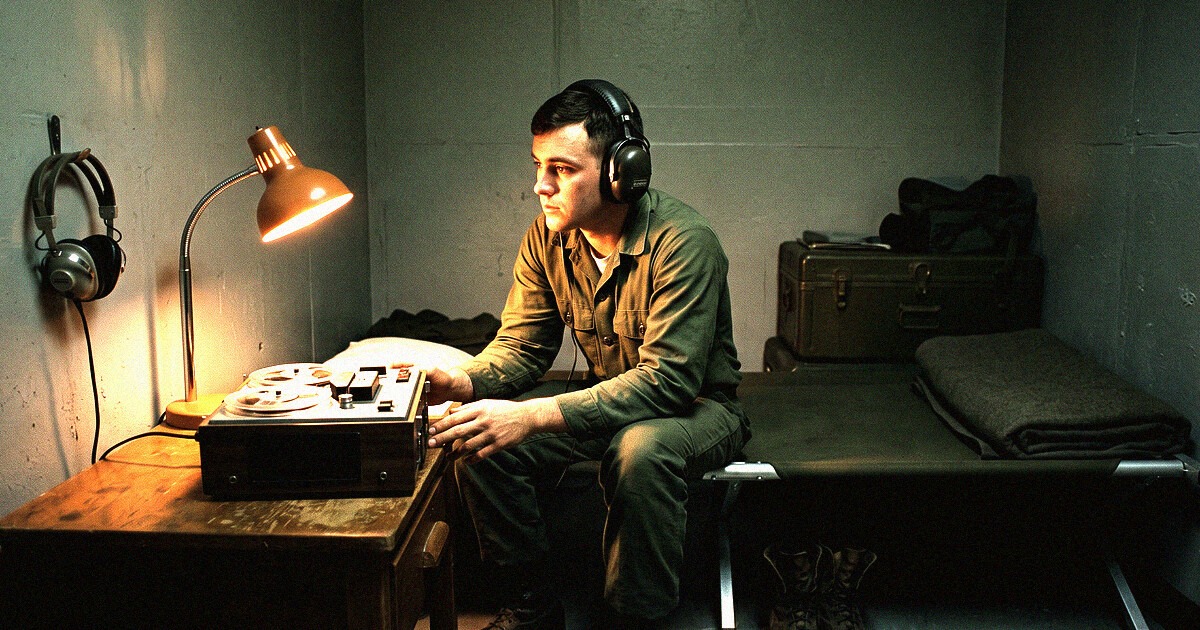
The document everyone means when they say the CIA studied astral projection is a two-page cover memorandum and a twenty-six-page attached paper, dated 9 June 1983, on Department of the Army letterhead. The Gateway Process memo was written at the US Army Operational Group, US Army Intelligence and Security Command, Fort George G. Meade, Maryland. It is addressed to the Commander of that same group. It carries the CIA document identifier CIA-RDP96-00788R001700210016-5 and a release stamp reading “Approved For Release 2003/09/10.”
Its first sentence settles what it is:
You tasked me to provide an assessment of the Gateway Experience in terms of its mechanics and ultimate practicality.
That is an internal tasking from a commander to a subordinate officer, not a commissioned study, not a research program and not an agency finding. The CIA identifier on it reflects where the Army’s remote viewing files ended up in 1995, which is a records custody fact rather than an authorship one.
What the Gateway Process Memo Is
The cover memorandum runs two pages and is signed with a block reading “LTC, MI” over “Commander, Det G.” The signature itself is not legible in the released scan. Secondary coverage identifies the author as Lieutenant Colonel Wayne M. McDonnell, and that attribution is not established by anything in the document’s own text. Readers should know which of those two things they are relying on.
The attached paper is titled “The Gateway Experience: Brain Hemisphere Synchronization in perspective.” It runs thirty-eight numbered paragraphs across twenty-six pages plus a bibliography, and it is continuous prose with hand-drawn exhibits rather than a report with findings and data.
The bibliography is nine items long. It lists Itzhak Bentov’s Stalking the Wild Pendulum, Robert Monroe’s Journeys Out of the Body, Charles Tart’s Altered States of Consciousness, Lee Sannella’s Kundalini: Psychosis or Transcendence, Jill Purce’s The Mystic Spiral, a Monroe Institute in-house monograph by Melissa Jager titled “The Lamp Turn Laser,” an article on Karl Pribram from Human Behavior, an article from Science Digest dated June 1983, and an article from The Mother Earth News dated March and April 1983.
Nine sources, two of them popular magazines published in the months immediately before the memo was written, one of them a publication of the institute whose product is the subject. That is a description of the document’s evidentiary base, not a judgment on its conclusions, and it is the single most checkable fact about the Gateway Process memo that almost never appears alongside the quotations from it.
What the Army Asked
The tasking was “mechanics and ultimate practicality.” The author describes expanding it himself, by his own account out of necessity:
As I set out to fulfill that tasking it soon became clear that in order to assess the validity and practicality of the process I needed to do enough supporting research and analysis to fully understand how and why the process works. Frankly, sir, that proved to be an extremely involved and difficult business. Initially, based on conversations with a physician who took the Gateway training with me, I had recourse to the biomedical models developed by Itzhak Bentov to obtain information concerning the physical aspects of the process. Then I found it necessary to delve into various sources for information concerning quantum mechanics in order to be able to describe the nature and functioning of human consciousness.
Two things in that passage are load-bearing. The author took the Gateway training himself, alongside a physician who took it with him. And the move from assessment into theoretical physics was his own decision, not part of the tasking.
The paper’s purpose is stated in the cover memorandum’s fifth paragraph, and it is the part of the Gateway Process memo that most coverage leaves out:
This study is certainly not designed to be the last word on the subject but I hope that the validity of its basic structure and of the fundamental concepts upon which it is based will make it a useful guide for other USAINSCOM personnel who are required to take the Gateway training or work with Gateway materials.
Personnel who are required to take the Gateway training. The memo is an explainer written for colleagues who had already been signed up for a course, by a man who had already taken it, so that they would have a frame of reference when they got there. It disclaims being authoritative in its own text.
What the Document Argues
The argument runs in one long chain and the paper is explicit that it is a model rather than a result.
It opens by profiling hypnosis, transcendental meditation and biofeedback, attributing the mechanics to “the theories of psychologist Ronald Stone and the biomedical engineering models of Itshak Bentov,” so that the reader has something to compare Gateway against. It then describes the frequency following response and brain hemisphere synchronization, moves to resonance and what it calls energy entrainment, and from there to holograms, the proposition that “the part encodes the whole,” a consciousness matrix, intervening dimensions, subatomic particle behaviour, and an entity it names the Absolute. The later paragraphs describe the Monroe Institute’s Focus 10, Focus 12, Focus 15 and Focus 21 states, the role of REM sleep, and what the paper calls information collection potential.
Its conclusion is a recommendation for a phased training approach, not a claim of demonstrated capability:
There is a sound, rational basis in terms of physical science parameters for considering Gateway to be plausible in terms of its essential objectives. Intuitional insights of not only personal but of a practical and professional nature would seem to be within bounds of reasonable expectations.
“Plausible,” “would seem to be,” “within bounds of reasonable expectations.” The register is a staff officer recommending further work.
The twelve lettered steps that follow include the two passages most often quoted without their context. One proposes a three-person collection method:
Use multi-focus approach to solve problem of distortion in terrestrial information gathering trips. This approach involves the use of three individuals in the out-of-body state, one viewing the target object here, in time-space, one viewing it at Focus 15 as it slips into the immediate past, and one viewing it at Focus 21 as it slips from the immediate future.
The other is a single line among twelve:
Be intellectually prepared to react to possible encounters with intelligent, non-corporal energy forms when time-space boundaries are exceeded.
Whether any of the paper’s physics holds is not a question this article adjudicates, and the paper does not claim to have settled it either. What the document is, as an object, is a recommendation list attached to a theoretical model, written for an audience of about twenty soldiers a session.
The Institute and the Contract
The procurement record exists, it is specific, and it is in the same declassified file as the memo.
A memorandum for record dated 19 July 1983, under the office symbol IAGPA-F-SD, sets out the training sequence. The first phase “began in March 1982, with in-house application of the Discovery Series, produced by the Monroe Institute of Applied Sciences (MIAS), Route 1, Box 175, Faber, VA 22938,” described as “specially designed, commercially available audio tapes.” The second phase “was initiated in July 1982, with the Gateway Program, also from MIAS,” which “involved sending project personnel for resident training at MIAS. Project personnel were scheduled for attendance along with members of the public.”
So soldiers from a special access program were attending a commercial consciousness-training course in Virginia alongside paying members of the public, a year before the Gateway Process memo was written.
The same memorandum proposes the next phase: “that Robert A. Monroe, Founder and Executive Director of MIAS, be paid as a consultant to train CENTER LANE personnel in the use of the patented Hemisync process developed by Monroe.” The training was “expected to last ten weeks,” was to be “specifically tailored and designed to meet the requirements of this office and extend beyond the confines of the public program currently offered at MIAS,” and covered instruction in “nonintrusive bio-monitoring equipment,” “the development of Hemisync tapes, custom made for project sources,” monitoring techniques, “environmentally controlled areas,” and the interpretation of the information reported.
A second memorandum, dated 29 March 1984 and signed by Lieutenant Colonel Brian Buzby as CENTER LANE Project Manager, records what happened:
In July 1983, the CENTER LANE office awarded a personal services contract to Mr. Robert Monroe, Monroe Institute of Applied Science, Faber, VA to examine the use of his technology (HEMI-SYNC) in the psychoenergetic intelligence collection process. The contract was aimed initially at training a seasoned CL source to improve his target resolution via the use of a HEMI-SYNC environment. Better than expected results and personnel changes have now altered that thrust.
The same memorandum names the source: “I am aware that Mr. McMoneagle will retire soon after completion of the training, but I view the continuation of the contract as application development that will have use in the future.” Joseph McMoneagle, the program’s most documented remote viewer, was the seasoned source the Hemi-Sync contract was built around. The Stanford Research Institute experiments covers the research track running in parallel.
These documents carry the markings “WARNING NOTICE: CENTER LANE SPECIAL ACCESS PROGRAM” and “RESTRICT DISSEMINATION TO THOSE WITH VERIFIED ACCESS TO CATEGORY THREE (3),” classified by the Commanding General of INSCOM. A commercial meditation-tape vendor’s training contract was being administered inside a special access program.
The General Who Was Not Convinced
On 1 March 1984, between 1620 and 1810 hours, Colonel Partridge of INSCOM headquarters and Lieutenant Colonel Buzby briefed Lieutenant General Brown on CENTER LANE and on INSCOM’s training relationship with the Monroe Institute. The memorandum recording that briefing was prepared jointly by the two briefers for Major General Stubblebine, the commanding general, and it is the most useful single document in this file because it records the questions rather than the answers.
Brown asked what the program cost. The memorandum records the answer: “$850.00 per person.” The fiscal year 1984 figure was “$60,000; i.e. three sessions remaining with 20 people per session at $850 per person,” with the note that “indications are that for the next contract, current cost of $850 per person may increase.”
He asked whether the institute was an approved facility. The answer: “We told him it was licensed in Virginia, but that FDA had stated FDA approval was not required.”
Then the comments, recorded by the officers who received them:
Stated that he was concerned any time the Army did things involving soldiers minds.
Understood that the program was voluntary but stated that some might feel pressured to participate in view of high level command support for the program.
Asked if some people might feel left out, had heard some “fluttering” that the program might be creating an “in” group or “clique.”
And the summary, in the briefers’ own assessment of how it went:
While LTG Brown acknowledged his understanding of the incident, he appeared skeptical of INSCOM’s involvement with MIAS training and did not appear convinced of the value of that training.
The same memorandum records three further things worth having. Brown was “concerned that since CENTER LANE operated like a ‘black program’ TDY expenses might be paid from a cash account the office maintained,” and the briefers noted that “his questions in this area indicated his concern with the DCSOPS’ investigation.” A brigadier general present told Brown “that MG Stubblebine had asked the OAIG to review certain INSCOM programs to include CENTER LANE.” And when Brown asked whether they had looked at other programs of this kind, the briefers “told him that we had looked at LIFE SPRING and EST but had ruled them out as INSCOM programs.”
The documented picture is not an institution persuaded of anything. It is a small office, with “a project manager, an operations officer, four sources, and two secretaries,” spending sixty thousand dollars a year on commercial training, explaining itself to a lieutenant general who was unconvinced, while the Inspector General had been asked to look at it.
The Page That Is Not in the Release
The released scan has a gap, and it can be verified in the document rather than taken on trust.
Body page 24 ends in the middle of a sentence, partway through paragraph 34, on belief system considerations. The next page of the scan opens at paragraph 37. Paragraphs 35 and 36, and the page carrying them, are not in the release stamped “Approved For Release 2003/09/10.”
The missing page became widely noticed when the Gateway Process memo circulated online, and was reported in April 2021 as having been supplied from the Monroe Institute’s own archive rather than by the CIA. No official explanation for the omission has been located for this piece, and the available accounts disagree about whether the gap was deliberate or a scanning artefact. Both readings are available and neither is established, which is where the matter sits. A single absent page in a 1983 photocopy chain is the sort of thing that has a mundane cause more often than not, and saying so is not the same as establishing it.
What Has Been Layered Onto It Since
The Gateway Process memo is routinely cited for things it does not say. It is attributed to the CIA, when it was written by an Army officer at Fort Meade and is in CIA custody because the records were transferred in 1995. It is described as a research finding, when it is an internally circulated explainer that disclaims being the last word in its own text. It is presented as institutional endorsement, when the briefing record from eight months later shows a general officer unconvinced and an Inspector General review underway.
There is also a name collision worth clearing up, because it has produced a durable conflation. The Gateway Process is the Monroe Institute’s audio technique, taken up by Army INSCOM at Fort Meade in 1982 and 1983. GATE, the Gifted and Talented Education program, is a school-identification and enrichment programme that millions of American children were placed in. Four shared letters, different decade, different agency, different subject, different document trail. The GATE program has its own public paperwork and the two should not be read as one story.
The propagation is itself documentable, and it follows the pattern this site has traced elsewhere: a primary document with a striking phrase in it gets quoted at the phrase and never at the frame.
Why a Staff Paper Became a Proof Text
Because this is a subject where readers tend to collapse the layers, it is worth separating them before the close.
Documented: the memo, its date, its letterhead, its addressee, its tasking sentence, its stated purpose, its length and its bibliography. The Discovery Series from March 1982 and the Gateway Program resident training from July 1982. The personal services contract awarded to Robert A. Monroe in July 1983, its ten-week span and its five instruction elements. The figure of $850 per person and the $60,000 fiscal year 1984 line. The naming of Joseph McMoneagle as the source. The special access program markings. Lieutenant General Brown’s recorded questions and the briefers’ assessment that he was unconvinced. The Inspector General review request. The absence of body page 25 from the release.
Claimed but uncorroborated: everything the paper asserts about consciousness, holograms, the Absolute and out-of-body states, and everything later readers have credited the Gateway Process with establishing. The paper is a model its author put forward, and the file contains no evaluation of whether any of it worked. “Better than expected results” appears once, in a 1984 memorandum, with nothing stated to measure it against.
Structurally corroborated: the United States government did fund and administer structured work on non-ordinary cognition in this period, and that is established independently of this memo by the wider programme record. The existence of a Monroe Institute contract inside a special access program is consistent with that pattern. It is not evidence for the paper’s conclusions, and treating the second as support for the first is the specific error this subject invites.
The Gateway Process memo is a better document than its reputation and a weaker one than its citations. It is genuine, it is unclassified now, it was written by a serving officer who had taken the course, and it sits in a paper trail that includes a contract, a price per head, an annual figure, a named source and a sceptical general. All of that is checkable. None of it requires the memo to be right about physics.
What the record does not contain is any evaluation of whether the training worked. The 29 March 1984 memorandum describes “better than expected results” without saying what they were measured against. The congressionally directed review that eventually examined the wider programme, in 1995, had nothing to say about Hemi-Sync specifically. The Inspector General review that a brigadier general mentioned to Lieutenant General Brown in March 1984 does not appear in the released file at all.
The open question is not whether the Gateway Process works. It is why a document that describes itself as a guide for trainees became the most-cited artefact of the entire programme, while the contract paperwork sitting beside it in the same declassified file, which says who was paid, how much, for what, and who doubted it, goes almost entirely unread. Reading the memo changes what it means. Reading the file around it changes it again.
Sources & Further Reading
All CIA documents are cited by CIA document identifier, which is the citable reference. Links go to the mirror each scan was retrieved from, because the CIA electronic reading room’s own document URLs do not serve a document record to a non-browser client. Any identifier below can be located by searching it at the CIA electronic reading room.
- “Analysis and Assessment of Gateway Process,” US Army Operational Group, US Army Intelligence and Security Command, Fort George G. Meade, 9 June 1983, CIA-RDP96-00788R001700210016-5
- Memorandum for Record, “Advanced Individual Training for CENTER LANE Personnel,” IAGPA-F-SD, 19 July 1983, CIA-RDP96-00788R001700210007-5
- Memorandum for Record, “Continuation of MIAS Advanced Training,” IAGPA-F-SD, 29 March 1984, CIA-RDP96-00788R001700210002-0
- “CENTER LANE/MIAS Briefing for LTG Brown, 1 March 1984,” IAGPA-F-SD, CIA-RDP96-00788R001500030001-3
- Federation of American Scientists, STAR GATE program page
- Stranger Than Fiction, Remote Viewing and the Stanford Research Institute Experiments
- Stranger Than Fiction, David Wilcock and the Conspirituality Closed Loop
Leave a Reply