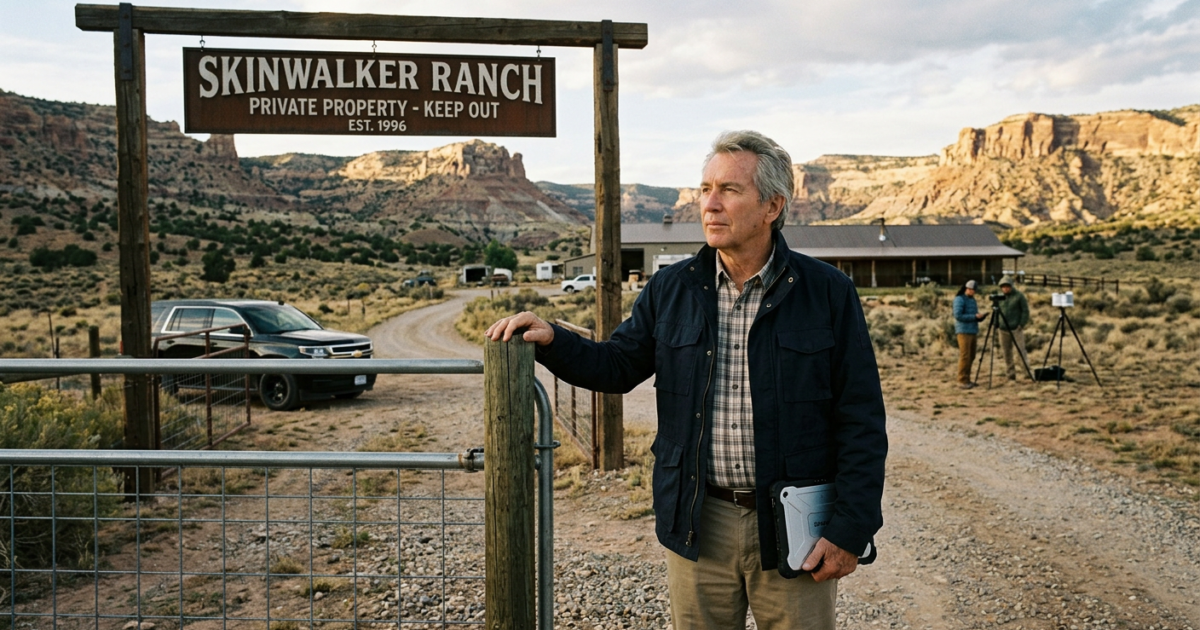
Robert Bigelow is a Las Vegas real estate billionaire who became, through a series of deliberate decisions spanning nearly three decades, the private sector’s most significant financier of UAP and anomalous phenomena research. The AAWSAP Skinwalker Ranch fieldwork he made possible is now described in the Pentagon’s own declassified records, which is a sentence that could not have been written before March 2024. His trajectory from budget hotel chain to classified Pentagon contractor repays careful reconstruction, because the institutions that worked with him, and the programs they built together, form the connective tissue between the UFO research of the 1990s and the congressional hearings of the 2020s.
The NIDS Years
In 1995, Bigelow funded the National Institute for Discovery Science, or NIDS, a privately staffed research organization with credentialed personnel. Colm Kelleher ran it day to day as deputy administrator. John Alexander was recruited out of Los Alamos and assembled a science advisory board of seventeen people drawn from academia, medicine, industry, the Department of Energy, Navy nuclear engineering, and the Apollo astronaut corps. This was not a hobbyist operation, and that matters for where the record ends up.
In 1996 Bigelow purchased a 512-acre property in northeastern Utah specifically because of its documented history of anomalous activity. That property was Skinwalker Ranch.
NIDS researchers reported cattle mutilations with characteristics they said resisted conventional explanation: precision excisions of soft tissue, an absence of blood at the scene, no tracks or other evidence of predator activity, and in some cases signs of localized heat at the excision sites. They also documented UAP sightings on the property, including one incident in which multiple NIDS scientists reported observing a triangular craft at close range.
NIDS was disbanded in October 2004. Kelleher, who later co-authored the 2005 book Hunt for the Skinwalker with the investigative journalist George Knapp, put the organization’s own results plainly afterward: years of focused investigation produced, in his words, “very little physical evidence of anomalous phenomena, at least no physical evidence that could be considered as conclusive proof of anything.” None of the NIDS findings were published in a peer-reviewed scientific journal.
The Harder Category: What NIDS Would Not Formalize
A separate, less-discussed category of incidents at the ranch falls outside conventional UAP reporting entirely: objects moving with no apparent cause, equipment failing selectively and repeatedly in specific locations, and animals reacting to presences that researchers on-site could not see. No instrument record accompanies any of it, which is the reason rather than an incidental detail. A board of seventeen credentialed scientists will attach its name to a tissue sample and a photograph. It will not attach its name to an account of a room going wrong.
Several former NIDS personnel have described this category of experience in interviews conducted years after leaving the organization, after the professional risk of saying so while employed had passed. That timing tells you something about the incentives inside the organization. It tells you nothing about whether the events occurred.
The Chain of Title
Terry and Gwen Sherman bought the property in 1994 to ranch and farm it, and spent the next two years reporting events they could not account for. Bigelow acquired it in 1996 for roughly $200,000. He sold it in 2016 to Adamantium Real Estate LLC, a Delaware-registered entity whose principal remained anonymous until 2020, when the Utah commercial real estate developer Brandon Fugal identified himself as the buyer. The History Channel series built around the property followed.
Travis Taylor, who runs the science side of that series, is the same figure at the center of STF’s reporting on the Redstone Arsenal exotic-materials ecosystem. The overlap is worth noting for scale: the pool of people who cycle through private anomalous-phenomena research, defense contracting, and televised investigation is small enough that the same names recur across unrelated stories.
The Earmark and the Contract
James Lacatski, a propulsion and missile intelligence specialist at the Defense Intelligence Agency, brought the subject to Senator Harry Reid. Reid, then Senate majority leader, recruited Senators Daniel Inouye and Ted Stevens. A $10 million earmark rode into the July 2008 supplemental appropriation to fund a DIA effort on future aerospace threats, and the total appropriation reached $22 million.
The procurement record is specific. Solicitation HHM402-08-R-0211 produced exactly one bid. The resulting contract, HHM402-08-C-0072, began performance on September 22, 2008, and the contractor was Bigelow Aerospace Advanced Space Studies, or BAASS. The program was the Advanced Aerospace Weapon System Applications Program, AAWSAP, the classified predecessor to the later and more publicly known AATIP. Its mandate was substantially broader than its successor’s: it could investigate phenomena in the air, in space, and underwater, and its research brief included consciousness studies, psychic phenomena, and anomalous cognition alongside conventional aerospace threat analysis.
Lacatski wrote the program objectives, structure, and requirements into that contract. He then served as the DIA program manager on it and as the contracting officer’s representative. The person who defined what the government wanted also administered the contract awarded against that definition, and the only company that bid was owned by a man who had spent the previous decade privately funding the same subject and who personally owned the property where a share of the fieldwork would take place.
Sole-source outcomes are routine in defense contracting when a requirement is narrow enough that one vendor can meet it. The arrangement was legal. It is also why the program’s defenders and its critics can point at the same paperwork and both feel vindicated.
What the Contract Bought
The official assignment, in the words of the Defense Intelligence Agency’s own successor office, was “to conduct research into 12 areas of cutting edge science.”
The concrete output was 38 papers designated Defense Intelligence Reference Documents. In January 2018 the DIA sent the list of titles to Senate Armed Services Committee chairman John McCain and ranking member Jack Reed. That July, Knapp published leaked copies. The following January the DIA released the list officially in response to a Freedom of Information Act request filed by Steven Aftergood of the Federation of American Scientists, who characterized many of the titles as “highly conjectural and well beyond the boundaries of current science, engineering, or military intelligence.” By March 2022, all but one had been released.
The titles are real and the authors are named. Hal Puthoff wrote “Advanced Space Propulsion Based on Vacuum (Spacetime Metrics) Engineering.” Eric Davis wrote “Traversable Wormholes, Stargates, and Negative Energy.” The set spans metamaterials, warp metrics, cloaking, biological effects, and directed energy.
Their nature is routinely misdescribed, so it is worth stating precisely. These are literature reviews and theoretical papers commissioned from outside physicists on what the physics might permit. They are not reports of recovered hardware. A commissioned paper on the theory of traversable wormholes establishes that the government paid someone to survey the theory of traversable wormholes.
A leaked ten-month BAASS report describes the contractor’s field operation: a full-spectrum response program with subcontractors working eleven technical areas and deliverables due July 31, 2009. The larger claims about the program’s output come from the people who ran it. That it generated more than 100 technical reports beyond the 38, that it examined the 2004 Nimitz encounter, and that it catalogued intrusions over military installations all trace to Skinwalkers at the Pentagon, published in 2021 by Lacatski, Kelleher, and Knapp. The book was cleared for public release by the Department of Defense, a fact frequently deployed as though it validated the contents. Clearance means a classification review found nothing classified in the manuscript. It is a statement about secrets, not about accuracy.
The AAWSAP Skinwalker Ranch Record in the Pentagon’s Own Report
In March 2024 the Department of Defense released the first volume of AARO’s Historical Record Report, and the institutional account of the AAWSAP Skinwalker Ranch work entered the public record for the first time from the government’s side.
The report confirms what had been denied for years. The contractor team, it states, “and at least one supportive government program manager, also conducted UAP and paranormal research at a property owned by the private sector organization.” On how the program ended, the report offers a single sentence with no cushioning: the DIA “cancelled the program in 2012 due to lack of merit and the utility of the deliverables.”
Two official accounts of the same $22 million now exist. One was written by the men who ran the program and cleared by the Department of Defense. The other was written by the office the Pentagon created to own the subject. They do not agree, and both carry institutional standing.
The dates do not reconcile cleanly either, and the honest approach is to name the document rather than average the range. AARO’s history of the successor effort dates DIA management of the program to 2009 through 2012. The procurement record begins performance in September 2008. Fieldwork at the ranch is generally described as running from 2008 through 2010.
KONA BLUE and the Architecture Built First
The successor effort received the least attention and may be the most revealing part of the record. After the DIA cancelled the program, its supporters proposed that the Department of Homeland Security create and fund a new version under the code name KONA BLUE. In 2011 the DHS Under Secretary for Science and Technology, Tara O’Toole, established it as a prospective special access program. That October she met with Senators Joseph Lieberman and Harry Reid to discuss it. It was terminated on February 10, 2012.
The records became public because DHS provided them to the Department of Defense on February 5, 2024, after which they were declassified and released. The proposal was drafted to protect the retrieval and exploitation of non-human biologics. On what was actually in hand, the released material is unusually direct: the program was never approved or stood up, no data or material was transferred to DHS, and no extraterrestrial craft or bodies were ever collected. AARO’s phrasing is that such material “was only assumed to exist by KONA BLUE advocates and its anticipated contract performers.”
Read in sequence, a protection architecture was designed, briefed to sitting senators, and formally established at a cabinet department, for material the government’s own released records describe as assumed rather than held.
Bigelow’s Public Statements
On May 28, 2017, in an interview with 60 Minutes, Bigelow said it without hedging: “I’m absolutely convinced. That’s all there is to it.” He added that “there has been and is an existing presence, an ET presence,” and that he had probably spent more of his own money on the subject than any other individual in the United States. Those are the statements of a private citizen with three decades invested in the question. They are not, on their own, evidence for the claim, and he did not present them as such.
The Connective Thread
Bigelow funded NIDS when no government program was investigating the subject. He built the institutional and scientific infrastructure that made AAWSAP possible. Researchers who had worked at Skinwalker Ranch under NIDS carried that experience into the classified program. AATIP continued with a narrower military-encounter focus, the UAP Task Force followed in 2020, and AARO stood up in 2022. Each stage required the previous one, and the field protocols and data architecture BAASS built under contract are the ones the later offices inherited.
Which produces a structural oddity worth stating plainly. The office that dismissed AAWSAP as lacking merit is the office that inherited its mission, and it is the same office STF has documented as tasked to investigate programs it cannot access. The same classification architecture that keeps the current disclosure effort incomplete, examined in the DOE and CIA file releases, governs the AAWSAP Skinwalker Ranch material as well.
What Would Move This
Across three decades, two organizations with credentialed scientific staff, and one federal contract, no physical sample or instrument record from that property has gone through ordinary peer review. Four specific things would change the picture: the single Defense Intelligence Reference Document still unreleased, the BAASS deliverables themselves rather than their titles, any DIA or DHS record showing material in custody, and a peer-reviewed publication of sample or sensor data from any of the three ownership eras.
Two readings survive everything currently on the table. Either the program studied something that resists conventional instrumentation, and the cancellation language reflects an institution declining to fund what it could not measure. Or the program drifted, spent $22 million, and the cancellation language means precisely what it says. The insiders wrote books. The government wrote a report. Both are arguing a case, and the work that would settle it has not been done in either direction.
“This material was only assumed to exist by KONA BLUE advocates and its anticipated contract performers.”
— AARO, History and Origin of KONA BLUE
Sources & Further Reading
- AARO Historical Record Report, Volume 1 (Department of Defense, March 2024), full text
- AARO — History and Origin of KONA BLUE (released documents, PDF)
- The Black Vault — AAWSAP documentation archive, including the Defense Intelligence Reference Documents
- 8 News Now — What KONA BLUE was, and how it reached DHS
- NewsNation — The Reid, Inouye, and Stevens origin of the Pentagon program
- Mystery Wire — Thirty years of the National Institute for Discovery Science
- Space.com — Bigelow’s 2017 60 Minutes statements on extraterrestrial visitation
- Scientific American — What happened at the Pentagon’s once-hidden UFO office
Leave a Reply