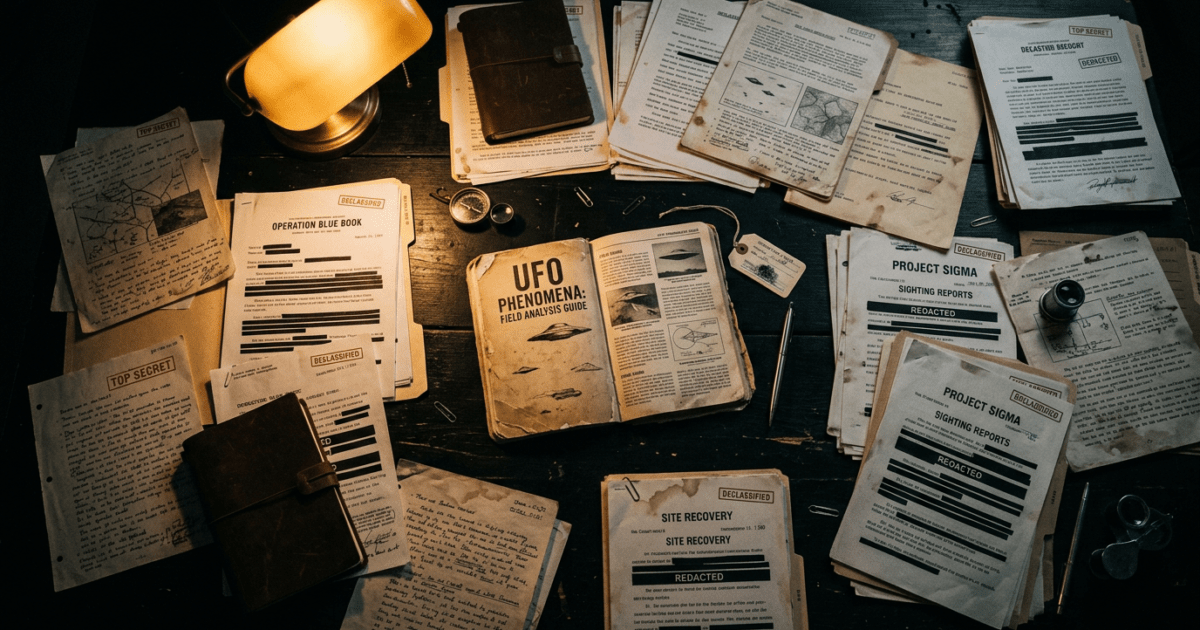
The Pentagon has released 222 UAP files across two PURSUE tranches. The public saw sphere footage, infrared tracking video, a Lake Huron shootdown, submarine transmedium encounters, and an intelligence officer’s first-person account of orbs chasing fighter jets. The disclosure has been real, it has been unprecedented in volume, and it has come almost entirely from one place. The Department of Defense showed its cards. The agencies holding the ones that matter, the Department of Energy and the Central Intelligence Agency, have contributed almost nothing. Understanding why DOE and CIA disclosure remains incomplete requires examining not what was released, but the classification architecture that determines what cannot be.
What PURSUE Contains
The PURSUE initiative, launched May 8, 2026, is coordinated across the White House, ODNI, DOE, AARO, NASA, the FBI, and additional intelligence agencies. The first tranche contained 162 files. The second, released May 22, added 64 more. The contributing agencies are dominated by the Department of Defense (roughly half the total files), the FBI, NASA, and the State Department. DOE and CIA appear in Release 02’s expanded archive, but the independent analysis at WARUFO.com tells the structural story: four agencies account for the overwhelming majority of files, and the two agencies most frequently named in whistleblower testimony about retrieval programs and reverse engineering are barely represented.
The material that has been released is significant. MQ-9 Reaper footage of spheres over the Middle East. Infrared video from U.S. Central Command showing instant acceleration near the Jordan-Syria border. A Coast Guard infrared capture of an object near a commercial aircraft. Apollo-era astronaut transcripts. State Department cables from embassies across five countries. FBI 302 interview forms documenting a senior intelligence officer’s encounter with a “super-hot” orb hovering over the ground in the western United States. The files span 82 years and represent the most comprehensive single-source UAP disclosure in history.
They are also, almost without exception, observational. Sensors recorded something. Witnesses described something. Nobody explained what it was. As former Navy aviator Ryan Graves put it: the public is “left trying to interpret fragments without the information needed to separate mundane explanations from genuinely unresolved cases.” The PURSUE releases document the phenomenon. They do not document the institutional response to the phenomenon. That response sits behind a different classification wall, and it is not the Pentagon’s wall.
The DOE Classification Firewall
The Department of Energy operates under a classification authority that predates and supersedes the executive order system governing every other federal agency. The Atomic Energy Act of 1954 established a category called Restricted Data that covers all information concerning the design, manufacture, or utilization of atomic weapons, the production of special nuclear material, or the use of special nuclear material in energy production. The critical legal feature of Restricted Data is that it is “born classified.” Information meeting the statutory definition is automatically secret from the moment it is created, regardless of who creates it, without any formal classification action required.
This is not how the rest of the federal classification system works. Ordinary classified information is created by executive order. A president can declassify it. Congress can compel its release. FOIA applies to it, however imperfectly. Restricted Data, by contrast, is created by statute. A presidential executive order cannot override a congressional statute. The Atomic Energy Act gives the DOE sole authority to determine what qualifies as Restricted Data and sole authority to declassify it. No other agency, including the White House, can unilaterally force the release of DOE Restricted Data.
The UAP Disclosure Act, in both its 2023 Schumer-Rounds version and the 2025 Burlison reintroduction, explicitly identifies this problem. The legislative findings state that “credible evidence shows UAP records exist that have not been declassified due to Atomic Energy Act exemptions and overbroad interpretations of ‘transclassified foreign nuclear information.'” Congress is saying, on the record, that the DOE has been using the Atomic Energy Act as a blanket classification shield for UAP-related material.
The mechanism is straightforward. If a recovered object emits radiation, or if analysis of its materials involves nuclear processes or exotic energy signatures, the resulting data falls under the statutory definition of Restricted Data. It does not matter that the object is not a nuclear weapon. The legal definition covers “utilization of atomic energy” and “special nuclear material,” and those terms are interpreted by the DOE’s own Office of Classification. Once material enters the Restricted Data category, it is walled off from the executive branch declassification system entirely. The president can order the Pentagon to release its UAP files. He cannot order the DOE to release Restricted Data. Only Congress can change the statute, or the DOE itself can reclassify the material into the Formerly Restricted Data category, which has its own (still restrictive) declassification path.
This is why the AARO structural contradiction matters beyond bureaucratic dysfunction. If retrieval and analysis programs are housed at or funneled through DOE national laboratories (Los Alamos, Sandia, Oak Ridge, Lawrence Livermore, Battelle), the resulting data enters a classification system that AARO cannot access, that the president cannot unilaterally declassify, and that PURSUE cannot compel the release of. The data exists inside a statutory fortress that was built in 1954 to protect nuclear weapons secrets and has been repurposed, according to congressional findings, to protect something else.
The CIA’s Institutional Position
The Central Intelligence Agency’s near-absence from PURSUE is a different kind of silence. The DOE has a statutory excuse. The CIA has an institutional one, and the documentary record supporting it is more concrete than most coverage acknowledges.
The CIA’s Directorate of Science and Technology (DS&T) has been identified by David Grusch as a central administrative node in the legacy program structure. The Kona Blue incident, documented in AARO’s own historical review, shows the mechanism in action: a 2011 proposal by a Lockheed Martin vice president to transfer UAP-related hardware to DIA’s AATIP program was blocked by the CIA’s DS&T. The agency did not merely decline to participate. It exercised veto authority over another agency’s access to material held by a contractor.
That veto authority is not an inference drawn from silence. A 1982 CIA memorandum, available in the agency’s FOIA reading room, shows the DS&T explicitly discussing the use of contractor Independent Research and Development (IRAD) spending at defense firms, including TRW, to support DS&T-specific operational needs. The agency was not passively aware of how contractors allocated research funds. It was directing the allocation. The documentary trail, surfaced by investigative researcher UAP Gerb in his Northrop Grumman/TRW analysis, establishes that the DS&T operated as a coordination layer between classified programs and the contractor infrastructure executing them.
The personnel thread reinforces the structural one. Stephanie O’Sullivan spent 1982 to 1985 at TRW on what her later Battelle Memorial Institute board biography describes only as “a series of sensitive projects.” She moved to the Office of Naval Intelligence, then spent a decade at CIA rising to Deputy Director of the Directorate of Science and Technology. From 2011 to 2017 she served as Principal Deputy Director of National Intelligence under James Clapper, whom Grusch named publicly as having “managed the crash retrieval issue” and placed people in critical roles to handle it. O’Sullivan is now chairman of the Aerospace Corporation, itself a TRW spin-off, and notably the only entity besides the CIA to respond to congressional interrogatories on legacy programs. The briefing the Aerospace Corporation provided was, in Gerb’s assessment, deliberately uninformative.
The CIA contributed to PURSUE Release 02, but the nature of that contribution tells you more about what is being withheld than what is being shared. Historical files. Observational reports. Nothing from the Directorate of Science and Technology. Nothing addressing the retrieval and analysis allegations that credentialed witnesses have made under oath to Congress. Nothing that touches the institutional architecture Grusch described when he testified in July 2023 that he had been “informed in the course of my official duties of a multi-decade UAP crash retrieval and reverse-engineering program.” He provided classified specifics to the Intelligence Community Inspector General, who found his complaint “credible and urgent.” The structural question is whether PURSUE has any mechanism to compel the CIA to produce material from compartmented programs that exist above AARO’s access level. The answer, based on the executive order that established PURSUE, appears to be no.
Why DOE and CIA Still Hold the Disclosure Cards
The PURSUE releases have created a genuine transparency event for Department of Defense observational data. Sensors, sightings, pilot testimony, infrared footage. The Pentagon opened its filing cabinets and showed the public what its operators have been seeing. That is not nothing. For the first time, the raw observational layer is accessible at scale.
However, observational data answers the question “what did we see?” It does not answer the questions that the disclosure community has been asking for decades: “what do we have?” and “what have we learned from it?” Those questions point at two specific institutional addresses. The DOE’s national laboratories, where materials analysis and exotic-energy research would be conducted under Restricted Data classification. And the CIA’s Directorate of Science and Technology, which multiple sources identify as the coordination point for access to retrieval program material.
Neither institution is structurally compelled by PURSUE to produce anything meaningful. The DOE has a statutory shield that outranks executive orders. The CIA has compartmented programs that outrank AARO’s access level. The Schumer-Rounds UAP Disclosure Act was designed to solve exactly these problems by creating an independent review board with eminent domain authority over “technologies of unknown origin.” That bill was gutted in the House in 2023. Its 2025 reintroduction, championed by Burlison, faces the same institutional opposition from defense industry representatives whose facilities would be subject to the review board’s authority.
The architecture is not accidental. The two agencies with the strongest legal and institutional shields against disclosure are the two agencies most consistently named as holding the material that would constitute actual disclosure. The Pentagon can show you what its pilots recorded. The DOE and CIA hold whatever was found, analyzed, and reverse-engineered. The PURSUE portal has a billion hits. The filing cabinets that matter are in a different building, behind a different lock, governed by a different law.
Until Congress passes a statute that overrides the Atomic Energy Act’s classification provisions for UAP-related material and creates an independent body with the authority to access CIA compartmented programs, the disclosure will continue to be real and continue to be incomplete. The volume of PURSUE releases is not the measure of transparency. The measure is whether the agencies holding the substantive material are compelled to participate.
They are not. And they know it.
“Credible evidence shows UAP records exist that have not been declassified due to Atomic Energy Act exemptions and overbroad interpretations of transclassified foreign nuclear information.” — UAP Disclosure Act, Congressional Findings
Sources & Further Reading
- Department of Defense — PURSUE UAP Disclosure Portal (May 2026)
- Congress.gov — UAP Disclosure Act of 2025, Schumer-Rounds-Gillibrand (S.Amdt.3111)
- Department of Energy — Atomic Energy Act and Related Legislation
- DefenseScoop — UAP Research Community Reacts to First PURSUE File Drop (May 2026)
- WARUFO — Independent Analysis of 222 PURSUE Files (Releases 01 & 02)
- Rep. Burlison — UAP Disclosure Act of 2025 Amendment to NDAA (August 2025)
Leave a Reply