On the ninth of September 2025, five men sat at a table in a House Oversight hearing room and the Government Publishing Office printed every word they said. The record has a serial number. Anyone can download it. That session, titled Restoring Public Trust Through UAP Transparency and Whistleblower Protection, produced the most complete public document the subject has generated in years, so the useful question about a UAP whistleblower hearing is not only what the witnesses said. It is who was not at the table.
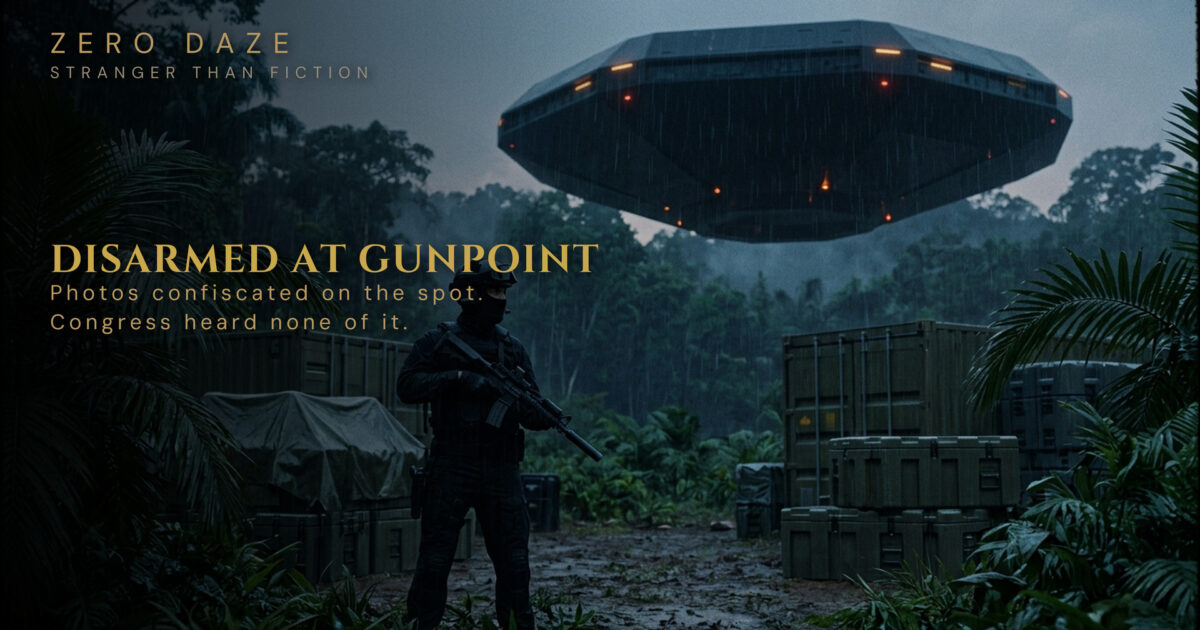
Michael Herrera was not there. Neither was a man known publicly as DC Long. Neither was Steven Digna. All three are enlisted veterans or ground-level contractors. All three describe a craft they were told, or concluded, belonged to a domestic program rather than to anyone from anywhere else. All three describe being confronted and silenced on the spot. And all three reached the public through an advocacy press event, a podcast, or a feature-length documentary.
What follows is the distance between those two rooms. Notably, none of it requires a single craft to be real. Whether an account reaches a printed government record is a question about a process, and a process leaves paper.
The room that was printed
The UAP whistleblower hearing was held by the House Committee on Oversight and Government Reform, under its Task Force on the Declassification of Federal Secrets. Rep. Anna Paulina Luna chaired it. Rep. Jasmine Crockett was ranking member, and Rep. Jared Moskowitz questioned from the dais.
Five witnesses appeared: Jeffrey Nuccetelli, an Air Force military police officer with sixteen years of active duty; Navy senior chief Alexandro Wiggins; the journalist George Knapp; Air Force veteran Dylan Borland; and Joe Spielberger of the Project on Government Oversight.
The printed record carries Serial No. 119-44 and indexes as CHRG-119hhrg61718. Wiggins’s written statement carries a stamp on its face reading “CLEARED For Open Publication, Sep 04, 2025, Department of Defense, OFFICE OF PREPUBLICATION AND SECURITY REVIEW.” A witness account cleared by the department it concerns, five days before he read it into the record, is an unusual object, and it exists because the process that produced it generates documents at every step.
Consider also what the sworn record cost to obtain. Nuccetelli reported what he saw in 2003. He reached that table in 2025. We covered his account in The Vandenberg UAP Incidents Reached Congress Twenty-Two Years Late. Twenty-two years is the documented waiting time for the witnesses who made it.
What the UAP whistleblower hearing was built to produce
The composition of the panel is the argument. Two servicemembers with sighting accounts, one journalist, one veteran, and one oversight-organisation lawyer. That is a table assembled to produce a policy record rather than a spectacle, and Spielberger’s presence is the clearest indicator of what the session was for. An organisation that litigates transparency policy does not get a seat at an event designed to generate footage.
This is consistent with the frame we have applied to the disclosure process throughout, most directly in Disclosure Is Not Accountability. The process is being managed, and the informative part is usually what the managed version leaves out.
The other route
On 12 June 2023, at the National Press Club in Washington, Steven Greer held a press event billed as Disclosure Project 2.0. The date and the venue are matters of public record, corroborated independently of the organiser’s own promotion by the Press Club’s events listing and by contemporaneous wire coverage. Herrera spoke there. Digna gave testimony there.
Roughly five weeks later, the Shawn Ryan Show released episode 66 as a two-part sequence it called the Whistleblower Marathon. Part one, Michael Herrera, appeared on 17 July 2023. Part two, DC Long, appeared on 19 July 2023. So the phrase “the podcast route” is not a figure of speech here. One host packaged and published two of these three men as a single release in one week.
The third venue is the one with the widest reach, and it closes the loop on the first two. On 10 December 2024, Steven Greer released Battle for Disclosure, directed by Blake and Brent Cousins. Greer’s own description says the film “revisits” his June 2023 Disclosure Conference. So it is not a separate route. It is the press event, eighteen months later, re-cut as a feature and carried on Prime Video and Apple TV, and free with advertising on Tubi and Plex. Apple TV and Tubi list it at an hour and forty-one minutes; IMDb and Plex list three hours and twenty-eight, so two cuts appear to circulate.
All three men are in it. Herrera, Long and Digna are three of what the film’s promotional copy calls “four brave U.S. veterans/military contractors whose lives were ruined.” The fourth is Eric Hecker, credited as a former Navy servicemember and Raytheon contractor. Long, the man for whom no unit, no dates and no installation have surfaced, is the first name in the cast list on Apple TV. One reviewer describes Digna as visibly diminished at the time of filming and notes that his segment is preceded by a disclaimer about the toll these accounts have taken. That is the most widely distributed version of any of the three men’s testimony that exists.
Two other names in the cast matter here. Shawn Ryan, whose podcast released Herrera and Long as a two-part “Whistleblower Marathon” in July 2023, appears in the film. And so does Representative Tim Burchett of Tennessee. Congress is present in both rooms in this story, in different capacities: in one it convened a task force and produced a printed record; in the other a member appears as a participant in an advocacy documentary. The podcast host and the congressman sit in the same cast list as the witnesses, which is a fair picture of how this route works. It is one circuit, and everyone on it is a participant.
It is also, structurally, the opposite of the printed hearing. Wiggins’s words went through the Department of Defense’s prepublication office, then a committee, then the Government Publishing Office, and came out with a serial number. Herrera’s, Long’s and Digna’s went through a filmmaker and a distributor. Nobody is obliged to keep a copy, nothing was sworn, and no institution has to answer for a word of it. Reach and record turn out to be different things, and the three men have a great deal of one and none of the other.
There is a further detail about that June press event, and it comes from an account we examined at length in Skywatcher Promised the Data. Then It Went Quiet. Jake Barber says on camera that he attended a whistleblower conference hosted by Greer at the National Press Club, shortly after whistleblower protections were activated, and that his employer sent him there to identify whistleblowers who could be reported to the Federal Bureau of Investigation and arrested. He says that listening to Herrera in that room is what reversed him. That is Barber’s characterisation of his own former job, uncorroborated by any document, and it places a man sent to neutralise this class of witness in the audience while two of them spoke.
This site has covered Herrera before, in a March 2025 item covering his appearance with Jesse Michels.
What the three have in common
Their individual accounts are thin in different ways. What they share is structural, and it is checkable.
Every one of them describes a human-built craft belonging to a domestic black program, explicitly not to a non-human intelligence. Digna names a contractor. Long calls the object human-made. Herrera says he was told the operation was a black program. That is a materially different claim from the one carried by the officers and analysts who dominate the disclosure conversation, and it is almost never separated out from it.
Every one of them is enlisted or a ground-level contractor. None is an officer, an analyst, or a program manager.
Every one of them describes coercion at the scene rather than classification after the fact. Weapons taken. Documents signed on the spot. Threats delivered in person by people who were already there.
And none of them has produced a public document.
A briefing is not a hearing
The tempting version of this article says these men never reached Congress. That version is too strong, and the accurate one is more interesting.
Reporting indicates that Herrera briefed the Senate Select Committee on Intelligence and the Pentagon, and that he submitted material to the All-domain Anomaly Resolution Office. That is not nothing. However, a closed briefing produces no printed transcript, no witness list, no serial number, and nothing a reader can download. Nuccetelli’s words sit in the printed UAP whistleblower hearing record as CHRG-119hhrg61718. Herrera’s are not anywhere a member of the public can cite.
So the asymmetry is not who reached Congress. It is who produced a public document.
On AARO’s position there is a gap worth naming precisely. Secondary summaries of what the office concluded contradict one another, and none of them is sourced to a document. Barber, on camera, gives a firsthand account of the response, saying the incident was presented to AARO under its previous director and written off for lack of evidence. That is a named on-record account rather than an anonymous summary, and it is still not an AARO determination. As of this writing the office has published nothing on the matter that anyone can read, and that absence is itself part of the pattern this article is describing.
One further detail requires care, and stating its provenance is the whole of the handling. The description of what the operatives were loading is not stable across venues. Contemporaneous coverage of the June 2023 press event described weapons and drugs. The podcast released the following month carried human trafficking in its own episode title. A further and graver version, involving trafficked people and an associated recruitment claim, does not come from Herrera’s observation at all; it reaches him through an anonymous source who contacted him afterwards. An anonymous intermediary relaying the most serious available allegation is the weakest provenance in the entire file. The reportable fact is that the characterisation moved, not that any version of it is established.
Critics have raised the absence of physical evidence, since the photographs Herrera describes were confiscated and never released, and operational questions such as a six-man element operating without communications. Those objections are real and they are not answered.
Accounts give Digna’s rank differently and no service record has surfaced to settle it, so this article states his claim without it. Long is thinner still. No full legal name, no unit, no dates and no installation has surfaced for him. Building a profile on that basis would be an error, so we are not building one. His absence from the documentary record is the point rather than a gap in the reporting.
The selection runs both ways
An article about why these witnesses lack a platform must not become an argument that they are therefore telling the truth. It does not follow, and the honest version says so in its own voice.
Selection effects cut in the other direction just as easily. A witness may be absent from a UAP whistleblower hearing record because his account did not survive vetting. Because no corroborating servicemember could be found. Because a staffer checked a deployment date against a service record and the dates did not match. Because the committee had four seats and more than four candidates.
There is a second and duller explanation for part of the asymmetry, and conceding it early makes the piece stronger rather than weaker. Rank and documentation correlate for boring institutional reasons. Officers and program managers accumulate paper because their jobs generate paper. A military police officer at an entry control point generates a blotter entry at most. Some portion of this gap is simply what different jobs leave behind, and only the remainder is available to be explained by filtering.
What would settle it
Two separate questions sit inside this, and they have different answers.
For the individual accounts, the useful requests are narrow. Herrera’s deployment records for the Padang relief operation, which would establish presence. The confiscated photographs, or a record that a confiscation occurred. Any member of the six-man element, named, on the record. An actual AARO determination rather than summaries that disagree. For Digna, a service record and a primary recording with a timestamp. For Long, a full name, a unit, dates and an installation.
For the structural question, which is this article’s actual subject, the material is more accessible than it appears. Witness lists are public. So are hearing programmes, invited-testimony records and committee schedules. Whether any of these three ever submitted to the task force, to AARO, or to an inspector general is answerable, and a submission that went nowhere is still a document. As far as we can establish, nobody has requested one.
Two readings remain open, and this article declines to choose between them. Either a filtering process operates on which accounts reach a UAP whistleblower hearing, and rank, provenance and the absence of prior documents determine who gets a room. Or these three accounts did not survive ordinary vetting, and the record is doing precisely what a record should do. Both are consistent with every documented fact available, and nobody has asked for the one thing that would separate them.
There is a sharper observation underneath all of it. The men in this class all say the technology was ours. That is a claim about a domestic program run by people with names and budgets, not a claim about visitors, and it is the claim least likely to be adjudicated by a body whose remit is anomalous phenomena.
A closed briefing and a printed hearing are both described as cooperation. Only one of them leaves the public something it can read.
— STF Editorial
Sources & Further Reading
- Restoring Public Trust Through UAP Transparency and Whistleblower Protection, Serial No. 119-44, U.S. Government Publishing Office
- Printed hearing record, full PDF (govinfo)
- House Committee on Oversight and Government Reform, hearing page, 9 September 2025
- Shawn Ryan Show #66, Michael Herrera, part one, 17 July 2023
- Shawn Ryan Show #66, DC Long, part two, 19 July 2023
- Battle for Disclosure (2024), dir. Blake Cousins, Apple TV listing
- Battle for Disclosure (2024), Prime Video listing
- Battle for Disclosure (2024), Tubi listing
- Battle for Disclosure trailer and description, drstevengreer.com
- Battle for Disclosure (2024), IMDb
- The Vandenberg UAP Incidents Reached Congress Twenty-Two Years Late, STF
- Disclosure Is Not Accountability: How the Insiders Are Managing Their Own Exit, STF
Leave a Reply