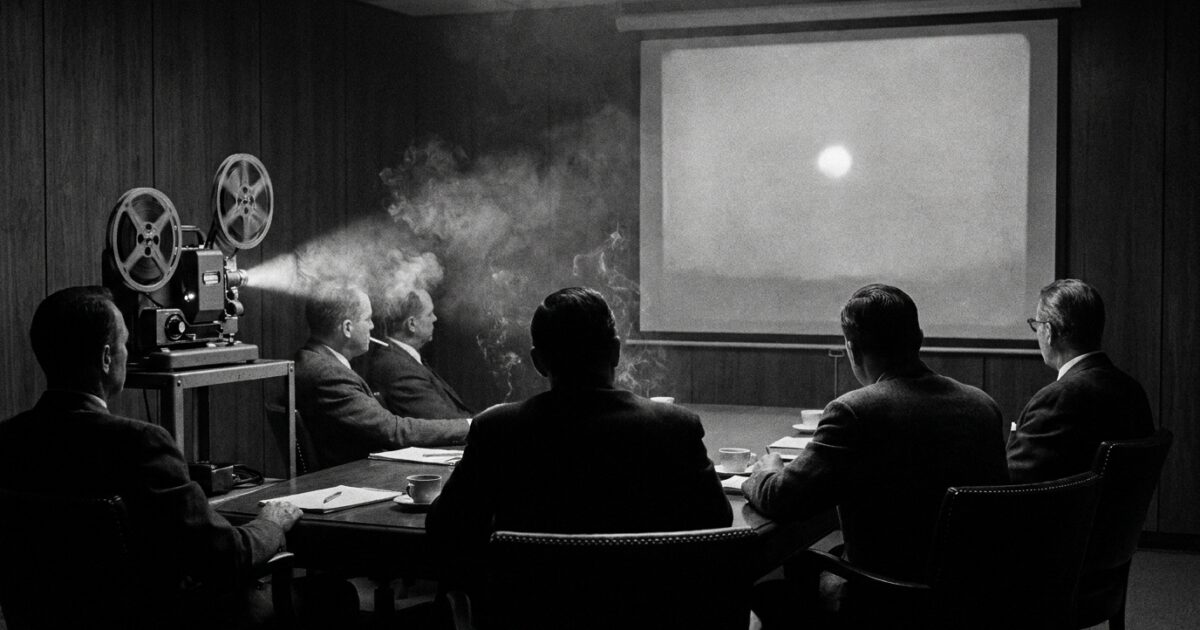
The Robertson Panel was a group of five scientists convened by the Central Intelligence Agency in January 1953 to decide what the United States should do about unidentified flying objects. It sat for four days, reviewed the best cases the Air Force had, and produced a short report. Its conclusion about the objects themselves was that they were not a threat. Almost every recommendation that followed was about the people who kept reporting them.
That inversion is the whole of the panel’s significance, and it is on the record in the panel’s own documents, not in any later interpretation of them.
What the Robertson Panel Was
The panel was assembled by the CIA’s Office of Scientific Intelligence in the months after the summer of 1952, when a wave of radar and visual sightings over Washington, D.C., pushed the subject in front of the National Security Council. H. Marshall Chadwell, the Assistant Director for Scientific Intelligence, and the physicist Howard Percy Robertson of the California Institute of Technology put together what the agency’s own later history calls “a distinguished panel of nonmilitary scientists.” Robertson chaired it. The sessions began on 14 January 1953 and ran across four days.
The members were working physical scientists of standing. Luis Alvarez was a high-energy physicist with a radar background. Lloyd Berkner was a geophysicist and director of Associated Universities. Samuel Goudsmit was at Brookhaven National Laboratory. Thornton Page was an astronomer at the Johns Hopkins Operations Research Office. Two associate members sat with them: the Ohio State astronomer J. Allen Hynek, then the Air Force’s scientific consultant on the question, and Frederick C. Durant, a rocket and guided-missile specialist who wrote the report that carries his name. The Durant memorandum, dated 16 February 1953, is the primary record of what the panel decided and is the document quoted throughout here.
What the Panel Concluded About the Objects
The finding on the national-security question was flat. The report states that the evidence “shows no indication that these phenomena constitute a direct physical threat to national security,” and the panel found nothing in the cases presented to suggest the objects were extraterrestrial. On the question it had been convened to answer, the panel closed the file.
The threat it did identify was not the objects. It was the reporting. The panel held that continued public attention to unidentified sightings could threaten the orderly functioning of government by clogging military reporting channels at a moment of real emergency, and that the resulting climate left the population open to what it framed as possible enemy psychological warfare. The phenomenon was rated harmless. The public interest in it was rated as the problem to be managed.
The Recommendations in the Panel’s Own Words
The panel recommended that the government “take immediate steps to strip the Unidentified Flying Objects of the special status they have been given and the aura of mystery they have unfortunately acquired,” and that it “institute policies on intelligence, training, and public education.”
What that education program was meant to do is set out in the unofficial supplement to Durant’s report, the section the panel judged inappropriate for the formal record. The program, it says,
should have two major aims: training and “debunking.”
The quotation marks around the second word are the panel’s own. The supplement goes on to describe the means. The effort “could be accomplished by mass media such as television, motion pictures, and popular articles.” Psychologists “familiar with mass psychology” should advise on its nature and extent, with Hadley Cantril named among the suggested advisers. Someone “familiar with mass communications techniques, perhaps an advertising expert, would be helpful.” The named channels for reaching a mass audience included the broadcaster Arthur Godfrey, the Jam Handy industrial-film company, and Walt Disney, Inc., for animated cartoons.
A scientific advisory panel, convened to assess a possible threat to the United States, had arrived at a recommendation to run a public-relations program built around television, advertising, and Disney animation. The word it used for one of the two aims of that program was the word this publication refuses to use about any claim, and the panel put it in quotation marks because it knew what it was proposing.
Watching the Civilian Groups
The same supplement turned to the private organizations that collected and publicized sightings. It named two: the Civilian Flying Saucer Investigators of Los Angeles, and the Aerial Phenomena Research Organization. Of such groups the panel wrote that they
should be watched because of their potentially great influence on mass thinking if widespread sightings should occur. The apparent irresponsibility and the possible use of such groups for subversive purposes should be kept in mind.
Two hobbyist research groups, one of them run largely by mail, were placed under a recommendation of surveillance on the stated ground that they might influence mass thinking or be turned to subversive use. The concern, again, was the audience and what it might come to believe, not the objects in the reports.
What the Record Holds and What Gets Added to It
What the panel wrote is fixed and public. Its membership and dates, its convening by the Office of Scientific Intelligence, its finding that the objects posed no direct physical threat, and the recommendations in the Durant report down to the “training and ‘debunking'” language, the mass-media and advertising proposals, and the instruction that named civilian groups be watched are all in the released text. None of it depends on how a later reader chooses to take it.
What gets built on top of that is a different order of claim. The reading that the recommendations became a coordinated, sustained program of public deception, and that every later turn of official skepticism was its planned product, runs ahead of the documents. The Air Force’s public posture did harden in the years that followed, the agency’s involvement with the subject continued for decades by the CIA’s own internal account, the Condon Committee reported in 1968 and 1969 in terms that discouraged further official attention, and Project Blue Book closed soon after. Whether each of those followed from the 1953 recommendations or reflected the same institutional preference arriving by its own route is inference, and the straight causal line from this panel to every later act of discouragement is the part that is asserted rather than shown.
What survives that distinction is the preference itself. An agency treating public belief, rather than the phenomenon, as the thing to manage is visible well beyond this one memo: in the Condon Committee’s framing, in the long reluctance of the agencies to say plainly how much the subject interested them, and in the disclosure-era record of airspace management and official silence that this site has traced in the present. The 1953 panel did not invent that preference. It wrote it down.
Why the Document Still Reads the Way It Does
The Robertson Panel is often cited as proof of a cover-up and almost as often dismissed as a tidy exercise in scientific caution. Neither reading survives the text. The scientists genuinely concluded that the objects were not a threat. They then recommended that the government spend its effort on the population that was looking at the sky, with the explicit aim of reducing what that population believed and reported. Both of those things are in the same report, written by the same people, in the same week.
The open question the document leaves is not whether UFOs are real, which the panel did not resolve and did not claim to. It is why a body convened to assess a possible threat to national security concluded that the threat worth acting on was the public’s attention, and why the founding text of official skepticism about the subject named “debunking” as one of its two goals in its own hand. The modern record, where a UAP whistleblower hearing can be defined as much by who was absent as by what was said, suggests the preference the panel wrote down in 1953 did not leave with it.
Sources & Further Reading
- Report of Meetings of Scientific Advisory Panel on Unidentified Flying Objects (the Durant Report), 14-18 January 1953, transcribed text
- The Robertson Panel Report, 2013 CIA release, scanned PDF, via The Black Vault
- Gerald K. Haines, “A Die-hard Issue: CIA’s Role in the Study of UFOs, 1947-90,” Studies in Intelligence, 1997, Central Intelligence Agency
- Gerald K. Haines, “CIA’s Role in the Study of UFOs, 1947-90,” full text mirror, Federation of American Scientists
- Stranger Than Fiction, Skywatcher, UAP Silence and the Airspace Closures
- Stranger Than Fiction, The UAP Whistleblower Hearing and Who Was Absent
Leave a Reply