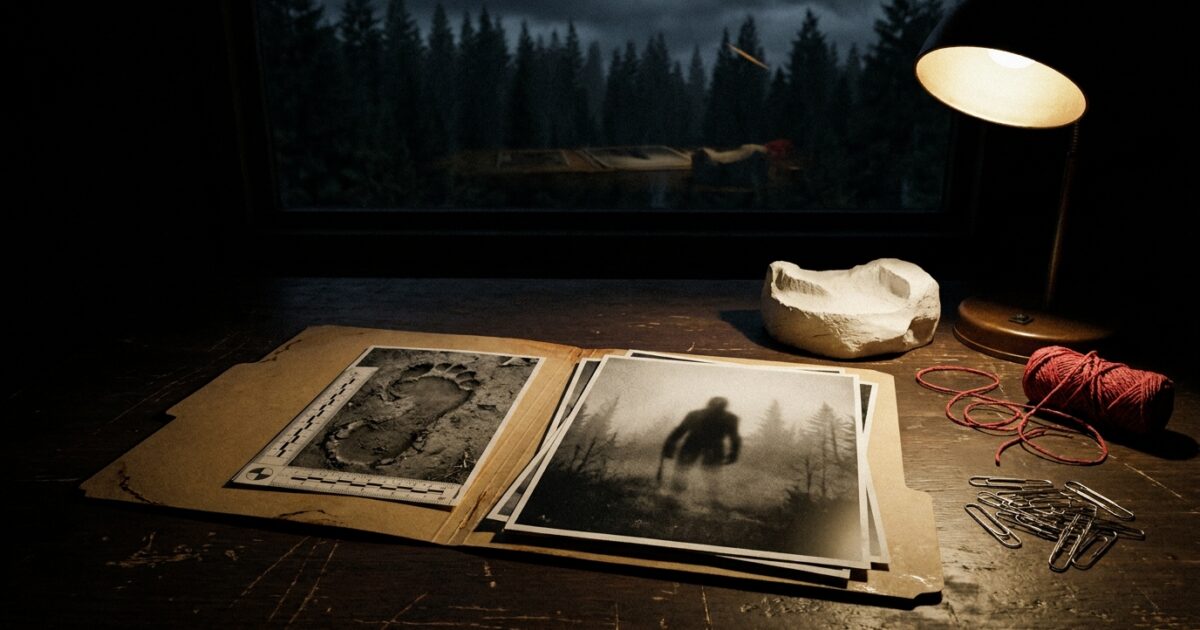
In October 2026 the United States Forest Service added a set of Forest Service Bigfoot records to the reading room on its public records site, three files describing alleged encounters in Montana and Washington going back to the 1940s. The agency gave no reason for posting them. A spokesman said only that the department weighs likely public, media, and academic interest when it decides what to make available. The files were reported first by the Washington Post and carried onward under headlines about a government quietly releasing its secrets, though a posting to a reading room is not a declassification, and nothing in the records was ever secret in that sense.
The more useful way to read the release is next to another one. Six months before the Bigfoot files went up, the same Forest Service reading room received a batch of UFO reports. And the same year, the Department of Defense began posting its own UFO files on a rolling schedule and declining to interpret any of them. Three releases, two agencies with nothing to do with each other, one posture: put the pages in public, say nothing about what they mean. We pulled all three Bigfoot files and read them.
What the Forest Service Bigfoot Records Contain
The release holds three documents. The first is a six-page memorandum from 1982 documenting an official Forest Service investigation of tracks in the Umatilla National Forest, with a second investigator’s memo attached. The second is a January 2003 article from the Clark Fork Valley Press describing tracks found near a sawmill in Sanders County, Montana. The third is a local history of the Petty Creek area west of Missoula, written in 1980, which contains a first-hand account of an encounter in the 1940s.
Two of the three are the kind of material the subject usually travels on, a newspaper write-up and a settler’s recollection. The first is different. It is the government investigating itself, in the field, with casts and cameras, and writing down what it concluded.
The 1982 Umatilla Investigation
On 17 June 1982, a group went into the Mill Creek watershed of the Umatilla National Forest to examine tracks reported in the Low Creek drainage by a watershed patrolman named Paul Freeman. The tracks had already drawn attention, and the agency sent a wildlife biologist, Rodney L. Johnson, to document them. His memo to the resource staff describes three sites, several dozen prints up to fifteen inches long, plaster casts taken of the clearest impressions, and photographs keyed to each location. One photograph places Freeman’s own boot next to a track for scale.
Johnson’s conclusion is stated plainly. In his opinion the tracks at the two sites he examined were made by “something other than a 300 pound plus two footed being,” and he lists eight reasons. The stride did not lengthen downhill or shorten uphill as a walking gait should. The prints did not sink to the bottom of soft mud the investigators themselves sank into. The tracks were isolated, with a clear beginning and end, rather than connected into a trail. The toe impressions were crisp on the parts of a foot that would normally be callused and worn. He adds a line that keeps the memo honest: if the tracks were faked, “someone went to a great deal of trouble and detail,” and a cast of a real foot would likely have been needed to make them.
Attached to Johnson’s memo is a second one, dated 20 July 1982, from Joel Hardin, a tracker with the United States Border Patrol out of Bellingham, Washington. Hardin’s language is harder than Johnson’s. His opinion was that the tracks “were a very clever attempt to perpetrate a hoax, involving your office or agency, in order to lend authenticity or credibility to the general public,” made by someone “with normal access to the area, very knowledgeable and interested in Bigfoot legends and stories.” The document names no hoaxer and offers no proof of one. It records two credentialed investigators, a wildlife biologist and a government tracker, arriving at a skeptical reading of one 1982 case and writing it into the file.
The 2003 and 1940s Accounts
The other two records pull the opposite way, and the release keeps them in the same folder. The 2003 newspaper article describes tracks found after a snowfall near Jim Rohweder’s sawmill on River Road West, first noticed by an eight-year-old and then followed for about two hours by a neighbor, Bob Mesing, a former Kalispell police officer, who measured prints over sixteen inches long and came away persuaded. “I was skeptical,” one witness is quoted, “but here are the tracks in front of me.” The witnesses did not notify any authority and planned to hand a sample to Fish and Game. It is a small-town account of ordinary people convinced by what they saw.
The 1940s account sits inside Leo T. Kinney’s history of Petty Creek, written in 1980 as a record of homesteads, mills, and ranches. In one passage Kinney describes packing out an elk with three others and finding, on their return, only the entrails and “a large set of tracks,” along with a strong odor and a grunting sound from something that walked on its hind legs. The party, he writes, “held a conference and decided that we were not particularly anxious to catch up to whatever it was,” and admitted a “very uneasy feeling” and “chills running up and down our backs.” The following year a neighbor reported the same tracks, odor, and sound in a nearby drainage. Kinney notes that at the time “we had never heard of Bigfoot,” so they let it go. His account is sincere, decades old, and unverifiable, which is most of what the documented record on this subject consists of.
Held together, the three files do not resolve anything. A wildlife biologist and a Border Patrol tracker read one case as a hoax. A former police officer read another as real. A rancher wrote down a memory that still unsettled him forty years later. The Forest Service posted all three without ranking them.
The Agency’s Other Tranche
The Bigfoot files are not the first fringe records the Forest Service has put in this reading room. On 14 April 2026 the same page received six UFO reports drawn from across the national forests, from a 2016 sighting in the Bighorn Mountains to a 1976 report at Wanless Lake. The oldest is the most striking. It documents the Yaak Radar Station in Montana, an early-warning site on the Cold War air-defense line, where on 1 September 1952 two Air Force enlisted men and a radar crew reported two small varicolored lights that became dark silhouettes at dawn and flew erratically for an hour, with the crew describing a “dark, cigar shaped object” at the point the radar had marked. The file ends with a line the agency let stand: “What these people saw is a mystery to this day.”
That 1952 date is worth holding. It is the same year the Central Intelligence Agency, in documents released this month through the Pentagon’s own program, was weighing the psychological-warfare implications of flying-saucer reports and convening the scientific panel that became the Robertson Panel. A radar station in Montana logged its own unexplained sighting in the same window. The Forest Service now posts that report in the same reading room where it later posted the Bigfoot files, under the same silence.
A Pattern of Release Without Assessment
Set the three releases side by side and the shape is clear. The Department of Defense has been posting UFO files since May 2026 and says the public can draw its own conclusions. The Forest Service posted UFO reports in April and Bigfoot records in October, and gives no reading of either. In each case the government is both the keeper of the records and the party that declines to interpret them, which is a particular kind of move. It reads as openness, and in the narrow sense of putting pages in public it is openness. It also hands the entire work of interpretation to the reader while keeping the authority that comes from having held the file in the first place.
The disclosure framing favors the claim. A UFO report posted by a federal land agency carries institutional weight the account did not have as a story. A Bigfoot file in a government reading room looks like official recognition of a question the file does not actually answer. The 1982 memo is the correction built into the record, a reminder that a government folder can hold a careful skeptical finding as easily as an open-ended one. The folder label is not the document. This site has tracked the same gap in the Pentagon’s UAP releases, where the seventh tranche paired striking contractor claims with the agency’s own cooler assessments in the same batch.
Documented, Claimed, and Structurally Corroborated
Documented: that the Forest Service added three Bigfoot records to its FOIA reading room on 15 October 2026 with no stated reason; that one is a 1982 Umatilla National Forest investigation in which a wildlife biologist concluded the tracks were made by something other than a large two-footed being, with an attached Border Patrol tracker’s memo calling them a hoax; that the other two are a 2003 newspaper article and a 1980 local history containing a 1940s account; and that the same reading room received six UFO reports on 14 April 2026, among them a 1952 radar-visual sighting at the Yaak Radar Station.
Claimed but uncorroborated: that any of these encounters involved an unknown animal or craft. The accounts are testimony and investigative description. The 1982 casts and photographs were read toward a hoax by the two investigators who examined them; the 2003 and 1940s accounts were read the other way by the people who lived them. None of the files carries independent, verifiable proof of what left the tracks, and the record preserves the disagreement rather than settling it.
Structurally corroborated: that federal agencies are increasingly handling fringe subjects by releasing documents without interpreting them is corroborated here by three separate releases in a single year, across two unrelated agencies, each following the same posture. The method is consistent even where the subjects are not. Posting the file and declining to assess it has become a recognizable mode of official handling.
Why It Matters
The Forest Service Bigfoot records are being read as a novelty, a land agency letting its folklore out of the drawer. The more interesting reading is that they are the second fringe tranche from the same reading room in a year, released the same way the Pentagon releases its UFO files: in full, with no comment. The content is cryptozoology. The procedure is the thing to watch.
The open question the release leaves is not whether a creature made the tracks, which the files cannot establish and which the investigators who examined them doubted. It is why a federal agency has begun posting its fringe records while declining to say what it thinks they are, what weight a document carries once a government has published it, and why that posture is turning up at agencies that share nothing except the habit. The pages are public. The reading of them has been handed to us, and that handoff is the pattern worth following.
Sources & Further Reading
- U.S. Forest Service FOIA Reading Room, listing the Bigfoot/Sasquatch Records (15 October 2026) and the earlier UFO Reports (14 April 2026)
- Documentation of Investigation into Sighting of “Bigfoot” Tracks in the Mill Creek Watershed, Umatilla National Forest, 18 June 1982 (with the 20 July 1982 U.S. Border Patrol memo attached), U.S. Forest Service reading-room PDF
- Clark Fork Valley Press, “Mysterious tracks discovered,” Sanders County, Montana, January 2003, U.S. Forest Service reading-room PDF
- Leo T. Kinney, “What Do You Know About Petty Creek?” 1980, with the 1940s encounter account, U.S. Forest Service reading-room PDF
- 1952 Yaak Radar Station UFO report, U.S. Forest Service reading-room PDF
- The U.S. Forest Service is quietly releasing its secret Bigfoot files, news coverage of the October 2026 reading-room release
- Stranger Than Fiction, The Seventh UAP Tranche, the BAASS DIA Contract
Leave a Reply