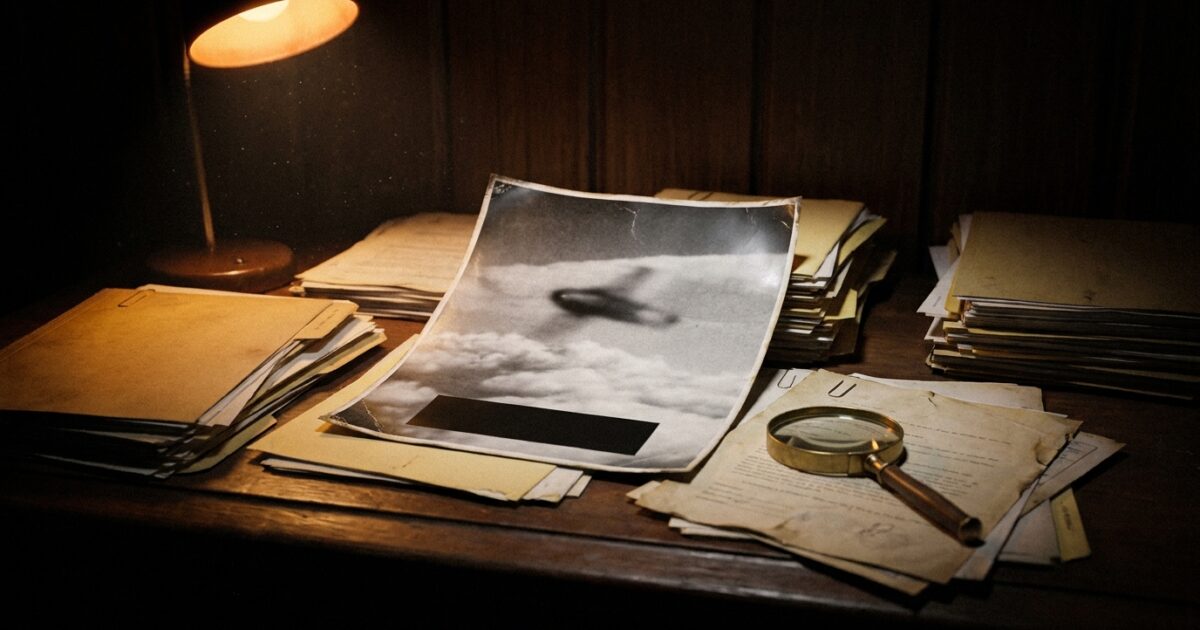
The eighth batch of Pentagon UFO files was posted on 20 November 2026, forty documents and three videos added to the release portal the Department of Defense has been filling since May. We downloaded all forty-three files and read them. Most of the day’s coverage led with a 1952 CIA evaluation of flying-saucer reports. The document that matters more sat a few folders over, and it is not about saucers at all. It is about what a government might do with public belief in them.
What the Eighth Batch of Pentagon UFO Files Contains
The release arrives under the program the Pentagon calls PURSUE, the Presidential Unsealing and Reporting System for UAP Encounters, which has published material on a rolling basis since the first batch in May 2026. Chief Pentagon spokesman Sean Parnell said the collection stays on the department’s portal and that more files will follow. Officials offered no assessment of any individual file, continuing the posture the department set at the first release, that the public can draw its own conclusions.
The forty documents sort into three groups. Six are CIA papers from 1952. Seven trace a defense contract from 2008 to 2010, including a thousand-page field report. The remaining twenty-seven are Air Force intelligence case files on individual sightings, dating from 1949 to 1966, from California and New Mexico to Japan, Iran, and Peru. The three videos are short infrared and electro-optical clips from military platforms, running twenty-one, fourteen, and fifty-five seconds, submitted through U.S. Central Command.
The 1952 CIA Documents and Psychological Warfare
The six CIA files come from the Office of Scientific Intelligence and are stamped for release in 2026. One is the report the wire services quoted, an evaluation noting roughly 1,500 sighting reports since 1947, of which the Air Technical Intelligence Center at Wright Field had left about twenty percent unexplained, with a finding that the saucers did not appear to be a Soviet creation.
The consequential one is a memorandum from Director of Central Intelligence Walter B. Smith to the director of the Psychological Strategy Board. It states that “the problems connected with unidentified flying objects appear to have implications for psychological warfare as well as for intelligence and operations,” and proposes to discuss “the possible offensive or defensive utilization of these phenomena for psychological warfare purposes.” A companion memo from the agency’s assistant director for scientific intelligence proposes convening an ad hoc panel of senior scientists, routed through a university research center, to recommend what should be done. That panel convened in January 1953 and is known as the Robertson Panel, whose report recommended a public program to strip the subject of the “aura of mystery” it had acquired. The 1952 memos are the paper that sits underneath that recommendation. They show the psychological-warfare framing in the government’s own hand, months before the panel met.
The AAWSAP Paper Trail and the Modern Program
The second group documents how the current Pentagon UAP effort was built. A 2008 statement of work shows the Defense Intelligence Agency soliciting studies of advanced aerospace applications “from now through the year 2050” across twelve technical areas, on a five-year contract. A 2010 information memorandum from the DIA director, Lieutenant General Ronald L. Burgess Jr., records that the program was first funded by a ten-million-dollar addition to a 2008 defense appropriation at the request of Senators Harry Reid and Daniel Inouye, and that the contract went to Bigelow Aerospace Advanced Space Studies, the only bidder. That contractor produced twenty-six technical reports by mid-2009.
The trail includes Reid’s own June 2009 letter asking the deputy secretary of defense to wrap parts of the program in a restricted special access program with a limited access list, citing “highly sensitive, unconventional aerospace-related findings.” It also includes the DIA’s November 2009 answer, which found insufficient grounds to classify the program at that level, and a later note that the department judged the reports to be of limited value to the agency and considered transferring the effort elsewhere. The thousand-page field report in the batch describes a contractor operation with a physics division measuring radiation and electromagnetic and acoustic signatures, a biology division studying physiological effects on personnel, and field investigators working a Utah ranch. The request for secrecy, the denial of it, and the internal verdict of limited value all sit in the same release, which is more of the architecture than the program’s public history usually shows at once. It extends the contracting record this site traced through the seventh tranche.
The Sighting Files and the 2023 Radar Track
The twenty-seven case files are Air Force intelligence reports and Project 10073 record cards, the same recordkeeping system that fed Project Blue Book. They are worth reading for what the cards themselves say. One 1953 California card documents a sighting near Agoura reported by Clarence L. Johnson, the chief engineer of Lockheed and the founder of its Skunk Works, together with Lockheed personnel. The card’s listed conclusion is a lenticular cloud. A 1949 California card records two metallic objects and concludes aircraft. The department grouped these under an “unresolved” heading, while several of the cards carry a conventional explanation in their own conclusion line. Reading the primary document and reading the folder label are not the same act.
A separate document covers a 2023 radar event, and it is the clearest illustration in the batch of how to read this material. A civil air-surveillance radar logged eight detections over eighty-four seconds at high altitude. If those detections belonged to one object, the geometry implies a mean ground speed near 1,650 miles per hour, about Mach 2.5. The document then states its own limit: the twelve-second sweep interval “is not sufficient to independently establish that all eight reported detections originated from the same object or represent a continuous track,” and the speed is a bounded estimate drawn from discontinuous points. The striking number and the caveat that undercuts it arrive in the same government file.
A Release the Government Declines to Interpret
The defining feature of the Pentagon UFO files is not any one document. It is that the department publishes them and declines to say what they mean. That stance reads as transparency, and in the narrow sense of putting pages in public it is. It also transfers the entire work of interpretation to the reader while retaining the authority that comes from having been the original keeper of the records. A striking radar number travels further than the caveat printed beneath it. A folder labeled unresolved carries weight that the Lockheed card’s own conclusion does not support.
Documented, Claimed, and Structurally Corroborated
Documented: that the eighth batch was released on 20 November 2026 with forty documents and three videos under the PURSUE program; that six 1952 CIA Office of Scientific Intelligence files are included, among them a memo proposing study of the psychological-warfare implications of unidentified objects and a proposal for the scientific panel that met in January 1953; that a 2008 to 2010 contract trail documents the DIA program funded at Reid and Inouye’s request, awarded to a single bidder, its special-access request made and denied, its reports internally judged of limited value; and that the sighting files are Project 10073 and Air Force intelligence cards, several carrying conventional conclusions on the card.
Claimed but uncorroborated: that the sightings and signatures in these files represent non-human craft or recovered technology. The contractor’s own reports describe measurements and investigations; they are testimony and analysis, not demonstration. The 2023 radar track describes apparent kinematics its author says the data cannot pin to a single object.
Structurally corroborated: that official handling of the subject has long been shaped by managing public perception rather than resolving the phenomenon is corroborated here by the government’s own 1952 words, which frame unidentified objects as an instrument of psychological warfare, and by a 2026 release that distributes documents while refusing to interpret them. The distance between those two dates is the structure. The posture changed form and kept its function.
Why It Matters
The eighth batch of Pentagon UFO files is being read as the latest installment of disclosure, the government steadily opening its vaults. The files support a narrower and more interesting reading. In 1952 the agency charged with the subject considered how belief in it might be used. In 2026 the department charged with it hands over the pages and says nothing about them. Both are acts of information management, seventy-four years apart, and the release contains the evidence for that continuity inside itself.
The open question the batch leaves is not whether any single file proves a craft, which none of them do, but why a government that once weighed the psychological-warfare value of the subject now releases its records while declining to assess them, and what a transparency that withholds interpretation is actually for. The documents are public. The reading of them has been handed to us, and that handoff is the part worth watching.
Sources & Further Reading
- Presidential Unsealing and Reporting System for UAP Encounters (PURSUE), the Department of Defense release portal hosting the eighth batch, war.gov/UFO (official; may require a browser to load)
- Pentagon releases eighth batch of declassified UFO files including a 1952 CIA flying saucer evaluation report, Associated Press via FOX 5 Atlanta, 20 November 2026
- Pentagon begins releasing new files on UFOs and says the public can draw its own conclusions, PBS NewsHour, 8 May 2026 (program origin and legal basis)
- Stranger Than Fiction, The Seventh UAP Tranche, the BAASS DIA Contract
Leave a Reply