On November 24, 1952, Andrija Puharich — born Henry Karel Puharich, then a thirty-four-year-old physician — presented a paper at a closed meeting at the Pentagon. The paper was titled “An Evaluation of the Possible Uses of Extrasensory Perception in Psychological Warfare.” The audience was the Office of the Chief of Psychological Warfare, U.S. Army. The paper argued that telepathy, clairvoyance, and related phenomena were operationally exploitable, that the Soviet Union was already exploiting them, and that the United States needed a coordinated research program.
Three months later, on February 26, 1953, Puharich was sworn in as a Captain in the U.S. Army Medical Corps. His assignment was the Army Chemical Center at Edgewood Arsenal, Maryland — the same facility that would, over the next two decades, host human pharmacological experiments on roughly 7,000 enlisted personnel. His direct supervisor at Edgewood was Sidney Gottlieb. Puharich and his family lived on the base.
Six weeks after Puharich’s commissioning, on April 13, 1953, CIA Director Allen Dulles signed the authorization establishing MKULTRA.
The chronology is not coincidence. Puharich’s Pentagon presentation, his recall to active duty under Gottlieb, and the formal authorization of MKULTRA happened in a six-month window, in that order. The man who would later be remembered as the “father of the New Age movement” — the man who introduced Uri Geller to Hal Puthoff, who hosted Aldous Huxley at his Maine estate, who developed the cosmology of the Council of Nine that runs through fifty years of channeled-entity literature — was MKULTRA-adjacent from the day MKULTRA was authorized. He worked directly under the program’s chief. He understood the program’s research direction not as a researcher reading the published literature but as a participant designing the work.
This article is the bridge between the named perpetrators of the previous six articles and the world that comes next: consciousness research, parapsychology, the Stargate Program, electrogravitics, the contactee movement, the modern UFO community. The argument the article makes is that this world did not develop adjacent to MKULTRA. It developed continuous with MKULTRA. The methodology, the funding networks, the institutional support — they did not stop in 1973 when Sidney Gottlieb watched the records burn. They moved into different buildings under different funding lines. The man who carried them across the threshold was Andrija Puharich.
The Round Table Foundation
Puharich was born in Chicago on February 19, 1918, to Croatian immigrants. He completed his bachelor’s degree at Northwestern University in 1942 and his medical degree at Northwestern Medical School in 1947. After a residency at Permanente Foundation Hospital in Oakland, he relocated to Camden, Maine in December 1947. By 1948, he had established the Round Table Foundation at the Warrenton estate in Glen Cove, a forty-five-room mansion overlooking the wooded inlet of the same name.
The funding sources for the Foundation are the first signal. They included Henry A. Wallace — Vice President under Franklin Roosevelt and the 1948 Progressive Party presidential candidate, whose Theosophical interests are documented in his correspondence — and the Bollingen Foundation, the Mellon-funded body that had also financed Carl Jung, Joseph Campbell, and the Eranos lectures. They also, according to research by Round Table chronicler Terry Milner, included the Armed Forces Special Weapons Project, the U.S. military body principally concerned with the operational deployment of nuclear weapons, and direct contracts from the Army Chemical Center at Edgewood. The Borden Dairy heir Joyce Borden Balokovic was an early patron. The Astor family scion Alice Bouverie hosted the New York gathering at which Puharich met Aldous Huxley in spring 1955.
The composition of the funding network establishes what the Foundation actually was. It was not an isolated parapsychology lab pursuing fringe science on philanthropic grants. It was a node in a larger institutional architecture that included the U.S. military’s chemical and radiological warfare apparatus, the foundations associated with the postwar mystical-elite synthesis the Bollingen money was funding, and the personal patronage networks of the Northeastern aristocracy. Aldous Huxley spent days at Glen Cove in 1955 and described the household in correspondence: “Harry, the Dutch sculptor, who goes into trances in the Faraday cages and produces automatic scripts in Egyptian hieroglyphics; Narodny, the cockroach man, who is preparing experiments to test the effects of human telepathy on insects.”
The “Harry” was Harry Stone, a Dutch-born sculptor whose mediumship sessions in 1954 and 1955 produced channeled material attributed to an Egyptian priest named Ra Ho Tep and to a non-human source called the Council of Nine. The Nine cosmology — a group of disembodied intelligences ostensibly transmitting from a position outside ordinary space-time, which Puharich would refine through subsequent psychic operators over the following four decades — originated at the Round Table Foundation in this period. The first Nine contact, channeled through the Hindu scholar D.G. Vinod, occurred on December 31, 1952, eight weeks before Puharich’s Edgewood commissioning. The Nine cosmology and the MKULTRA period are the same cosmology and the same period. They are not parallel developments. They are the same development.
Edgewood, 1953-1955
Puharich’s two years of active service at the Army Chemical Center are the period for which the documentary record is thinnest. He was a commissioned officer working at a classified facility under Gottlieb’s direct supervision during the most active dosing period of MKULTRA. The records of what he did there were almost entirely included in the 1973 destruction. What survives is fragmentary: a 1953 lecture he delivered to Army Chemical Center staff titled “Biological Foundations of Extrasensory Perception”; a parallel Air Force lecture on telepathy the same year; correspondence indicating he continued operating the Round Table Foundation in Maine through proxies during his Edgewood tour; and the family-maintained account that he lived on base with his wife and daughter throughout the assignment.
The structural fact that the surviving record cannot avoid is this: Andrija Puharich, in 1953-1955, was not studying parapsychology. He was developing parapsychology as an applied capability for the U.S. Army and the CIA’s principal chemistry shop. Whatever was happening at the Round Table Foundation in those years — the Faraday cage work, the Harry Stone sessions, the Amanita muscaria mushroom research that became Puharich’s 1959 book The Sacred Mushroom — was happening on Edgewood’s clock with Edgewood’s institutional knowledge.
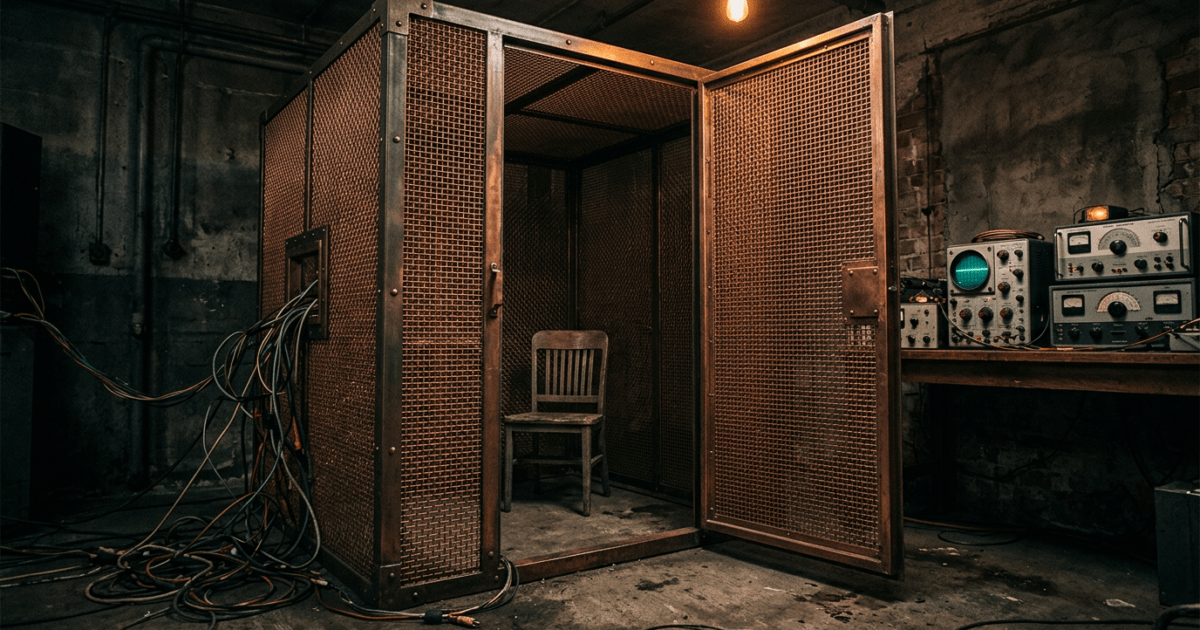
The Faraday cage work is the most operationally significant of the surviving threads. Puharich’s hypothesis was that telepathic transmission occurred at extremely low frequencies — what would later be designated as ELF — and that ordinary electromagnetic noise interfered with the signal. The copper-sheathed Faraday cages at Glen Cove were instruments designed to filter the noise so the signal could be measured. The methodology is identical to what would, two decades later, be developed at SRI under the Stargate program. Puharich was running early-version Stargate at the same desk where he was running MKULTRA-adjacent classified work.
Arigó, Geller, and the Talent-Scout Pattern
After Edgewood, Puharich’s career assumes a recognizable pattern. He identifies a psychic operator. He develops the operator. He delivers the operator into a research environment with U.S. intelligence community access.
The first major operator was José Arigó, a Brazilian psychic surgeon who, between 1963 and 1968, performed roughly two hundred surgeries that Puharich filmed and documented. Arigó died in a car accident in January 1971. The investigation into the accident did not exclude foul play, though no formal allegation has been substantiated. Puharich began, almost immediately, looking for a successor.
The successor was Uri Geller, a twenty-five-year-old Israeli stage performer whose spoon-bending and psychokinetic demonstrations had attracted regional attention. Puharich traveled to Israel in August 1971, conducted preliminary sessions with Geller, and arranged Geller’s relocation to the United States. By November 1972, Geller was at the Stanford Research Institute being tested by Hal Puthoff and Russell Targ under what would shortly become the Stargate Program — the U.S. intelligence community’s longest-running classified parapsychology research effort, eventually housed at SRI and Fort Meade and operating under various code names through 1995.
The Geller-to-Puthoff handoff is the cleanest documented line between MKULTRA’s institutional environment and the consciousness-research apparatus that would, over the following two decades, produce the documented Stargate program, the Monroe Institute, the Institute of Noetic Sciences, and the broader infrastructure of the modern U.S. parapsychology and remote-viewing communities. The pattern that handoff established — psychic operator identified by Puharich, developed by Puharich, delivered to Puthoff at SRI — is the same pattern documented in Chris Bledsoe’s 2024 account of being taken to a Zanesville, Ohio machine shop by an alleged intelligence-community operator named Tim Taylor, where Bledsoe was shown what Bledsoe described as glowing UFO debris. The methodology is consistent across decades. The actors change. The institutional architecture does not.
Thread One: Robert Monroe
Robert Allen Monroe was a successful radio-broadcasting executive in Charlottesville, Virginia. He had no parapsychology background. In 1958, while experimenting with sleep-learning audio techniques in his home, he began experiencing what he later described as out-of-body episodes. He kept written notes. He suffered a heart attack and was hospitalized in 1959. During the hospitalization, his wife — concerned about the contents of the notes — copied them and sent them to Andrija Puharich.
Puharich’s response was disastrous for Monroe. In a subsequent published account, Puharich misinterpreted Monroe’s experiences as the products of glue-sniffing addiction. The account used a pseudonym for Monroe, but his identity was identifiable to readers in his professional circle, and his reputation suffered accordingly. Whether the misinterpretation was genuine or was operational — a discrediting of Monroe’s experiences within the parapsychology community while preserving Monroe as a future research asset — is a question the surviving record does not resolve.
What the record does establish is what happened next. In the mid-1960s, Puharich introduced Monroe to Charles Tart, the parapsychologist who had recently completed his PhD at the University of North Carolina and who was beginning the academic career that would make him the leading academic researcher on altered states of consciousness in the United States. Tart conducted the first formal scientific testing of Monroe’s out-of-body capabilities. The Tart sessions, conducted at the University of California Davis, are the methodological basis on which Monroe built the rest of his career.
Monroe founded the Monroe Institute of Applied Sciences in Faber, Virginia in 1974. He filed his first Hemi-Sync patent — a binaural-beat audio technology designed to induce specific brainwave states associated with altered consciousness — in 1975. The Monroe Institute developed, over the following decade, the Gateway Voyage program, a multi-day residential workshop using Hemi-Sync to guide participants through what the Institute called Focus Levels, a graduated series of consciousness states extending from deep relaxation through documented out-of-body experience and ultimately, in the Institute’s published cosmology, to merger with cosmic wholeness at Focus Levels 42 to 44.
The U.S. Army’s interest in the Monroe Institute is documented. The 1983 Army Intelligence and Security Command memorandum titled “Analysis and Assessment of Gateway Process,” which has been declassified and is available through the National Archives, evaluates the Monroe Institute methodology and concludes that it produces measurable effects consistent with the Institute’s claims. The Army’s interest was not academic. The Monroe Institute trained Army intelligence personnel — including, by some accounts, members of the Stargate remote-viewing teams — under what was at the time an active classified relationship.
The line connecting Puharich and Monroe is therefore: Puharich receives Monroe’s notes in 1959, mishandles them publicly, then delivers Monroe to Tart for academic legitimization. Tart’s work makes Monroe research-credible. Monroe builds an institute that becomes a training site for the same intelligence community that funded Puharich at Edgewood. The methodology Monroe developed — sound-induced consciousness modification — is the next-generation refinement of what Puharich had been doing in the Faraday cages at Glen Cove with electromagnetic frequency control. The continuity is operational, not aesthetic.
Thread Two: Itzhak Bentov
The Bentov thread is the cleanest documented evidence for the argument this article is making. It runs through three institutional positions, two countries, and one declassified U.S. Army intelligence document. It establishes that the research program Puharich was conducting at Edgewood under Gottlieb did not stop in 1955 when Puharich left Edgewood, did not stop in 1973 when Helms ordered the records destroyed, and did not stop in 1995 when Puharich died. It became the methodology that the U.S. Army formally evaluated as a candidate for operational deployment in 1983.
The figure who carried the methodology across the threshold was Itzhak Bentov.
Bentov was born Emerich Tobiás in Humenné, Czechoslovakia on August 9, 1923. His parents and siblings were killed in Nazi concentration camps. He escaped to British Palestine alone, lived on a kibbutz in the Negev, and joined the Israeli Science Corps, known by the Hebrew acronym HEMED, when David Ben-Gurion incorporated it into the Israeli Defense Forces one month before Israeli statehood in May 1948. Bentov had no formal education beyond high school. He had what John Abele, his subsequent business partner at Medi-Tech, would later call “raw mechanical intuition.” Working in improvised shops under an international arms embargo, he designed Israel’s first rocket. The rocket was used in the 1948 War of Independence. HEMED, which Bentov helped staff at its founding, was the institutional ancestor of RAFAEL, Israel’s state-of-the-art rocketry development corporation, currently responsible for the Iron Dome and the David’s Sling missile system.
This is the biographical detail the conventional Bentov literature consistently underweights. Bentov was not, in the standard New Age framing, a self-taught Czech mystic who happened to invent the cardiac catheter. He was the founding member of the Israeli military’s research and development apparatus. He emigrated to the United States in 1954 carrying that institutional history. He became a naturalized U.S. citizen in 1962. The cardiac-catheter work, which produced Medi-Tech in 1969 and ultimately Boston Scientific, was the commercial face of his American career. The other face was consciousness research.
The connection to Puharich is documented. Puharich’s 1974 biography of Uri Geller, Uri: A Journal of the Mystery of Uri Geller, published by Doubleday, credits Bentov as one of the principal researchers who investigated Geller’s claimed abilities alongside Puharich. Puharich’s own account in that book goes further: Geller was not simply a case Bentov reviewed after the fact, he was a subject the two men investigated together from the outset. Bentov was, between 1971 and his 1979 death, an active participant in the research operation that delivered Geller to Hal Puthoff at Stanford Research Institute and that became the empirical foundation of the Stargate Program. He was not a parallel figure with overlapping interests. He was inside the operation.
The 1977 Mind Over Matter conference at Penn State, organized by Ira Einhorn, is the documented public meeting at which the Puharich research network presented as a coherent group: Bentov, Tom Bearden, Christopher Bird, and Puharich himself. The conference is on the record. The presentations are on the record. The framing the conference used was the framing Bentov had codified that same year in Stalking the Wild Pendulum: human consciousness as a frequency-modulated oscillator, the body as a transducer, meditation as a methodology for tuning the brain to access information not available through ordinary sensory channels. The model was theoretical. It was also operational. It was, specifically, what Puharich had been measuring in the Faraday cages at Glen Cove twenty-five years earlier.
What Bentov added was mathematics. Puharich’s Edgewood-era work was empirical: measurements of ELF interference, observations of subject performance under shielded versus unshielded conditions, qualitative descriptions of altered states. Bentov produced the engineering model. He calculated the resonance frequency of the human body during meditation. He measured aortic-cycle entrainment with brain-wave activity. He published the seven-hertz figure with mathematical derivation. The model was empirically testable in a way Puharich’s qualitative work had never been. It was, in the language of the technical-research community, a deliverable.
The 1983 declassified document confirms what the deliverable was for. On June 9, 1983, Lieutenant Colonel Wayne McDonnell of the U.S. Army Intelligence and Security Command at Fort Meade submitted a thirty-page report titled “Analysis and Assessment of Gateway Process.” The document was classified Confidential at submission and declassified in 2003. It evaluated Robert Monroe’s Hemi-Sync methodology, the binaural-beat consciousness-modification technology that Monroe had patented beginning in 1975. The document concluded that the methodology was operationally viable. It also documented the theoretical framework on which the Army was evaluating the methodology.
The framework was Bentov’s. McDonnell’s report cites Bentov by name, draws on the resonance model from Stalking the Wild Pendulum, and uses Bentov’s mathematics to argue that the Hemi-Sync audio technology produces measurable hemispheric synchronization at the frequencies Bentov had identified as consciousness-relevant. The U.S. Army’s formal 1983 evaluation of consciousness-modification technology, the document that became, after declassification, the most-discussed open-source artifact of the Stargate research program, was structurally a Bentov document. The Czech-born Israeli rocket scientist who had collaborated with Puharich on Geller research was the theoretical foundation on which the post-MKULTRA U.S. intelligence community was evaluating its next-generation consciousness-research methodology.
The chain is therefore complete. Puharich at Edgewood (1953-1955) under Gottlieb. Puharich and Bentov on Geller (1971-1979). Bentov publishing the engineering model (1977). Bentov dead on AA 191 (May 25, 1979). Robert Monroe filing Hemi-Sync patents using the same model (1975 and forward). The Army formally evaluating the Monroe Institute methodology using Bentov’s framework (1983). The Monroe Institute training Stargate-era intelligence personnel (1983 onward). Stargate continuing under various code names through 1995. The methodology surviving every program closure and every records destruction.
Bentov is the bridge inside the bridge. Puharich connected MKULTRA to the consciousness-research world. Bentov connected the consciousness-research world to the Army intelligence apparatus that funded its operational evaluation. The death on AA 191 does not require any conspiratorial reading to be structurally significant. It is sufficient to note that the loss of the figure who had produced the operational-grade theoretical framework occurred at the moment the framework was being adopted by the U.S. military, that the figure was Israeli-military-trained, and that the post-1979 development of the same research direction proceeded without the mechanical-engineering rigor Bentov had brought to it. STF readers familiar with the previously published Frequency Line coverage will recognize the Bentov model as the source layer for the meditation-and-resonance framework that has saturated the contemporary New Age, biohacking, and consciousness-research communities. The provenance the popular-culture version of the model rarely acknowledges is what this section has documented: the model was developed in collaboration with an MKULTRA-era CIA-affiliated research operator, was adopted as the theoretical framework for a U.S. Army intelligence evaluation of operational consciousness-modification technology, and survived every institutional closure that was supposed to have ended that line of research.
Thread Three: Thomas Townsend Brown
Thomas Townsend Brown was born in Zanesville, Ohio on March 18, 1905. As a teenager working in a laboratory his parents had set up in their home, he discovered that a Coolidge X-ray tube exhibited apparent thrust when energized — an observation that, refined under the mentorship of Denison University physicist Paul Biefeld, became the Biefeld-Brown Effect. Brown spent the rest of his life developing the practical applications of the effect, which he called electrogravitics.
The Biefeld-Brown Effect is real. It is also, in mainstream physics, attributed to electrohydrodynamic ion drift rather than to any genuine modification of the gravitational field. The contested element of Brown’s career is whether his observations included genuine effects beyond ion drift — effects that, if real, would imply a previously unrecognized coupling between electromagnetic and gravitational fields. The classified-research community took the question seriously enough to pursue it through the 1950s. The 1956 Aviation Studies Ltd. reports “Electrogravitics Systems” and “The Gravitics Situation” documented active electrogravitics programs at Convair, Lear, Sperry, Glenn L. Martin, and other major aerospace contractors. The published literature on electrogravitics went effectively dark in 1957. The classified literature, if it exists, has not been declassified.
The connection between Brown and the Puharich nexus is institutional. In October 1956, Brown founded the National Investigations Committee on Aerial Phenomena — NICAP — incorporated as a Washington-based nonprofit on October 24. The founding board included retired Rear Admiral Delmer Fahrney, the former director of the Navy’s guided missile program. Within months, the board added Major Donald Keyhoe and former CIA Director Roscoe Hillenkoetter. Hillenkoetter — the first Director of Central Intelligence under the 1947 National Security Act — joined NICAP’s board in 1957 and served until 1962.
The Hillenkoetter membership is the institutional fact that the conventional UFO-history account does not adequately address. The first DCI of the United States joined the principal civilian UFO research organization in the same window that the electrogravitics literature went dark and that Puharich’s MKULTRA-era work at Edgewood was concluding. NICAP, in its early years, was not a fringe civilian organization. It was an organization with formal connections to the highest levels of the U.S. intelligence community.
Brown himself was forced out of NICAP’s directorship in January 1957 — three months after the organization’s founding — over allegations that he was diverting funds to his electrogravitics research. The allegations are documented but not definitively substantiated. What the record establishes is that Brown’s primary research interest was incompatible with NICAP’s stated mission, and that the same intelligence-community network that joined NICAP after Brown’s removal was the network that subsequently moved the electrogravitics research into classified channels.
The connection to Puharich is the connection to the broader research program. Brown’s electrogravitics — the study of electromagnetic-gravitational coupling — and Puharich’s ELF-mediated consciousness research — the study of electromagnetic-biological coupling — were complementary research directions within the same institutional architecture. Both were taken seriously by the U.S. Navy and Air Force in the 1950s. Both were moved out of public visibility around the same time. Both are recognizable in contemporary fringe-science literature without their historical context.
The Chris Bledsoe account documented in Symphony in the Dark describes Bledsoe being taken by Tim Taylor to a Zanesville, Ohio machine shop where he was shown glowing UFO metal. Zanesville is Brown’s birthplace. The Bledsoe account also describes a Nassau-period “time travel group” that, according to the account, claimed Brown as president. Both elements of Bledsoe’s account are unverified — they exist as claims at the speculative end of the documentation spectrum. They are, however, consistent with the structural pattern the documented record establishes: that Brown, Puharich, and the consciousness-research and UFO-research communities they helped organize were nodes in a single research architecture, and that the architecture has continued to operate through the period in which its public-facing documentation was suppressed.
The Nine, the Lab, and the Late Career
The Council of Nine cosmology that Puharich developed beginning with the 1952 D.G. Vinod sessions became, over the following four decades, the central organizing framework of his channeled-entity research. The Nine subsequently spoke through Phyllis Schlemmer, James Hurtak (whose 1973 Keys of Enoch drew heavily on the Nine framework), and other operators in Puharich’s network.
Lab Nine, Puharich’s research facility in Ossining, New York, operated from 1972 to 1978. It hosted continuing Nine sessions, Geller research, and what Puharich described as the “Space Kids” — a group of young people, primarily teenagers, who Puharich claimed exhibited paranormal abilities. The network around Lab Nine included Arthur M. Young, the Bell Helicopter inventor whose marriage to Ruth Forbes Paine connects, through the Forbes-Paine family genealogy, to Ruth Hyde Paine — the woman who hosted Marina Oswald in Texas in November 1963. The connection is genealogical rather than operational. It is, however, the kind of detail that the Puharich nexus consistently produces and that the conventional history consistently does not account for.
In 1978, Lab Nine burned in what Puharich described as an arson attack. Puharich left the United States and spent several years in Mexico and Europe before returning to North Carolina in the late 1980s. He claimed to have been the target of four CIA assassination attempts. He died in Dobson, North Carolina on January 3, 1995.
What This Sequence Has Established
The MKULTRA program, in its formal documented existence, ran from 1953 to 1973. The named perpetrators — Sidney Gottlieb, Ewen Cameron, Harris Isbell, George Hunter White, Louis Jolyon West — operated within institutional positions that have been, to varying degrees, exposed and eulogized in the conventional history. They died in their beds. The MKULTRA records were destroyed in 1973 on Helms’s order with Gottlieb’s hands-on supervision. The 1975 Church Committee and the 1977 Senate hearings produced the partial documentation on which the public record relies.
The argument this sequence has made is that the conventional account is structurally incomplete. The destruction of records did not end the program. The program’s research directions — pharmacological consciousness modification, electromagnetic consciousness modification, unwitting-subject behavioral research, intelligence-community development of psychic operators — were continued through institutional channels that the 1977 hearings did not investigate and that the conventional academic history has not adequately reconstructed.
Andrija Puharich is the bridge figure who makes the continuity visible. He was operationally present at the founding of MKULTRA. He worked directly under Gottlieb at Edgewood. He maintained the Round Table Foundation as an Army-contracted research site through the early MKULTRA period. He developed the methodology that became the consciousness-research community in the 1960s and 1970s. He delivered Uri Geller to the Stanford Research Institute, where Hal Puthoff would build the Stargate Program. He collaborated with Itzhak Bentov on the consciousness-frequency hypothesis that became the theoretical backbone of the modern New Age movement. He operated within the same intelligence-community institutional environment that produced NICAP, Townsend Brown’s electrogravitics work, and the broader civilian-research-as-intelligence-cover architecture that the contemporary UFO disclosure community is, slowly, beginning to recognize.
The Congressional MKULTRA hearing held June 30, 2026, before the House Oversight Committee’s Task Force on the Declassification of Federal Secrets, did not resolve what MKULTRA actually was, and it was never positioned to. Investigative journalist Tom O’Neill, historian Stephen Kinzer, and former NIH program director Elizabeth Ginexi testified to the documented record rather than adding to it. No new MKULTRA-era document entered the record. No subpoena was issued. The documented record remains the surviving fragment of what survived the 1973 destruction, and that destroyed record contained, among other things, the operational documentation on figures like Puharich whose continuity work made the program effectively immortal. The hearing did not have access to that documentation. Neither, in any complete sense, did the May 8, 2026 launch of PURSUE — the Department of Defense disclosure portal at war.gov/UFO that opened with the FBI’s headquarters UFO file and a tranche of cases the government itself classifies as unresolved.
What the hearing established was the public framework within which the next phase of the inquiry occurs. The argument this sequence has made is that the next phase has to include figures like Puharich. The conventional MKULTRA story ends in 1973. The actual MKULTRA story does not end in 1973. It changes addresses. It becomes consciousness research. It becomes parapsychology. It becomes the contactee literature. It becomes the institutional environment from which the contemporary UFO disclosure community emerged.
The man who walked the methodology across the threshold was Andrija Puharich. The Pentagon presentation was on November 24, 1952. The Nine cosmology started on December 31, 1952. The Edgewood commission was on February 26, 1953. MKULTRA was authorized on April 13, 1953. The dates are not coincidence. The dates are the timeline of a single integrated program whose visible portion was MKULTRA and whose invisible portion is, at this writing, still operating.
“Puharich is a lively bird, and I look forward to seeing what he does when he gets out of the army.” — Aldous Huxley, in correspondence after his August 1955 visit to the Round Table Foundation, three months after Puharich’s discharge from the Army Chemical Center at Edgewood
Sources & Further Reading
- Society for Psychical Research — Andrija Puharich Biography
- Andrija Puharich — Comprehensive Biographical Record
- Down East Magazine — “Psych-Out: When a Shadowy Maine Estate Was a Psychic Epicenter”
- Society for Psychical Research — Robert Monroe Biography
- Itzhak Bentov — Biographical Record
- Thomas Townsend Brown — Biographical Record
- CIA FOIA Reading Room — Army Intelligence “Analysis and Assessment of Gateway Process” (1983)
- Stranger Than Fiction — The Frequency Line: Itzhak Bentov
- Andrija Puharich, Uri: A Journal of the Mystery of Uri Geller (Doubleday, 1974)
- Andrija Puharich, The Sacred Mushroom: Key to the Door of Eternity (Doubleday, 1959)
- Itzhak Bentov, Stalking the Wild Pendulum: On the Mechanics of Consciousness (Dutton, 1977)
- Jim Schnabel, Remote Viewers: The Secret History of America’s Psychic Spies (Dell, 1997)
Leave a Reply