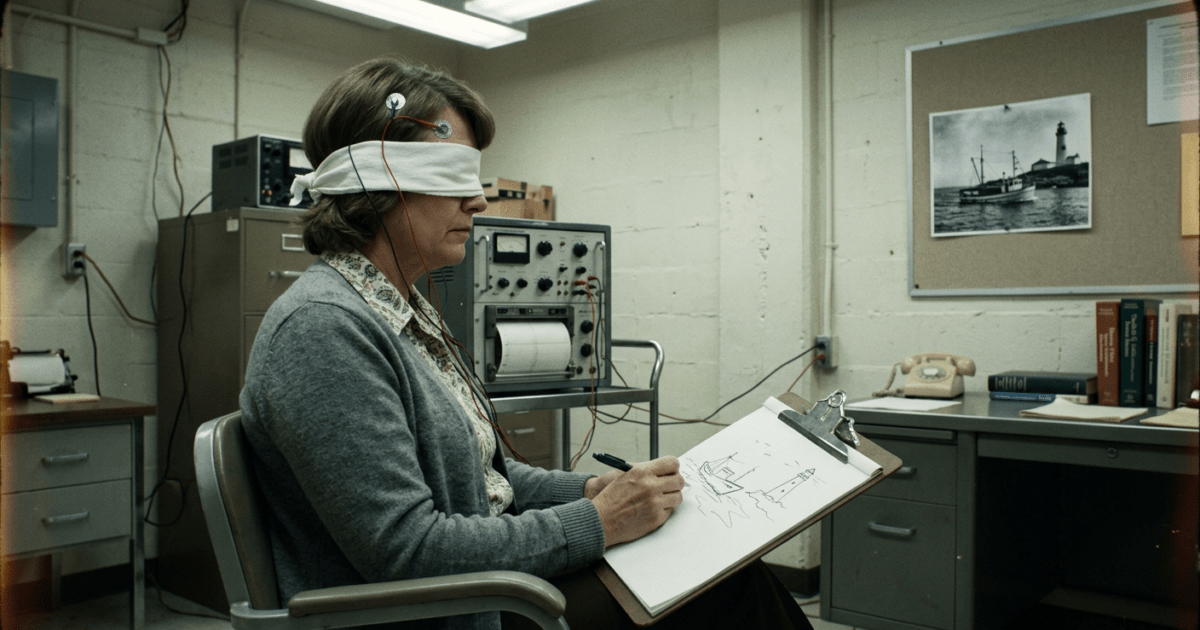
Between 1972 and 1995, the United States government funded a program to investigate whether human beings could perceive information about distant or hidden targets through means not explicable by known sensory mechanisms. The program operated under multiple code names — SCANATE, GONDOLA WISH, GRILL FLAME, CENTER LANE, SUN STREAK, and finally STARGATE. It was funded by the CIA, the Defense Intelligence Agency, and other agencies. Its primary laboratory work was conducted at Stanford Research Institute International in Menlo Park, California, under the direction of physicists Harold Puthoff and Russell Targ. Over twenty-three years, the program produced thousands of experimental trials and operational intelligence applications.
Then the CIA commissioned a review. The reviewers concluded the phenomenon was real. The program was shut down anyway.
The Experimental Record
Puthoff and Targ’s initial experiments followed a straightforward protocol. A “beacon” person would travel to a randomly selected location unknown to the remote viewer, who would then attempt to describe the target site from a separate, controlled environment. Descriptions were recorded and later evaluated by independent judges who attempted to match them against the set of possible target locations. The statistical results across hundreds of trials showed matching rates significantly above chance — a finding replicated across multiple experimenters and subject pools.
The most-cited experimental subject was Ingo Swann, a New York artist who demonstrated the ability to describe target locations with sufficient accuracy that his results caught the attention of CIA officials. Swann subsequently helped develop “coordinate remote viewing,” a more structured protocol in which the viewer was given geographic coordinates and asked to describe what was at that location. Joe McMoneagle, a former Army intelligence officer, participated in over 450 operational sessions and was awarded the Legion of Merit — a military decoration — in part for his contributions to the program.
The experimental work was not without methodological criticism. Skeptics, including psychologist Ray Hyman, identified concerns about sensory leakage, inadequate randomization, subjective judging criteria, and the file-drawer problem — the possibility that unsuccessful trials were not reported. These criticisms were legitimate and drove successive rounds of protocol refinement. Later experiments at SRI and at Princeton’s PEAR laboratory introduced increasingly rigorous controls, including computer-generated target selection, automated judging, and double-blind protocols.
The CIA’s Own Assessment
In 1995, the CIA commissioned the American Institutes for Research to conduct a retrospective evaluation of the entire Stargate program. The evaluation panel included statistician Jessica Utts of UC Davis and psychologist Ray Hyman, a longtime skeptic of parapsychological claims.
Utts’s analysis concluded that the statistical evidence for an anomalous information transfer effect was robust and had been replicated across multiple laboratories: “Using the standards applied to any other area of science, it is concluded that psychic functioning has been well established. The statistical results of the studies examined are far beyond what is expected by chance.”
Hyman, while not contesting the statistical anomaly, argued that methodological concerns had not been fully resolved and that the results did not constitute proof of a psychic mechanism. He concluded: “I agree with Jessica Utts that the effect sizes reported in the SAIC experiments and in the recent ganzfeld studies probably cannot be dismissed as due to chance. I also agree that the SAIC experiments are well-designed and that I cannot provide suitable candidates for a conventional explanation.”
Despite this — two reviewers agreeing that the statistical results exceeded chance, with disagreement only about the interpretation — the CIA terminated the program. The stated rationale was that remote viewing had not demonstrated sufficient operational utility to justify continued funding, even if an anomalous effect existed.
The Operational Applications
The program was not purely academic. Declassified documents confirm that remote viewing was used in operational intelligence contexts. Applications included attempts to locate hostages, describe foreign military installations, and identify the locations of individuals of interest. The DIA used remote viewers as one input among multiple intelligence sources, not as a standalone capability.
The most publicly documented operational result involved McMoneagle’s 1979 session in which he described a large submarine under construction at a Soviet naval facility. Satellite imagery subsequently confirmed the construction of the Typhoon-class submarine at the described location. The intelligence community’s evaluation of this and similar sessions remains classified, but the program’s continuous funding across four administrations and five code names — spanning twenty-three years — suggests that someone with budgetary authority found the results sufficiently useful to continue paying for them.
What the Record Shows
The Stargate program is frequently invoked in two ways, both of which misrepresent the evidence. Believers cite it as proof of psychic ability. Skeptics cite its termination as proof that it produced nothing of value. Neither characterization is accurate.
What the record shows is that a controlled experimental program, run by credentialed physicists, funded by multiple intelligence agencies, and reviewed by mainstream statisticians, produced results that exceeded chance at levels that would be considered significant in any other field. That the responsible mechanism remains unknown is a scientific problem, not a reason to dismiss the data. That the program was terminated despite positive statistical findings is an institutional decision, not a scientific conclusion.
The question the Stargate program raises is not whether psychic functioning is “real” in the colloquial sense. The question is whether the U.S. intelligence community spent twenty-three years and millions of dollars investigating a phenomenon that produced statistically anomalous results — and then chose to treat those results as if they did not exist. The data is in the declassified record. The interpretation is still open.
“Using the standards applied to any other area of science, it is concluded that psychic functioning has been well established.” — Jessica Utts, Professor of Statistics, UC Davis, 1995
Leave a Reply