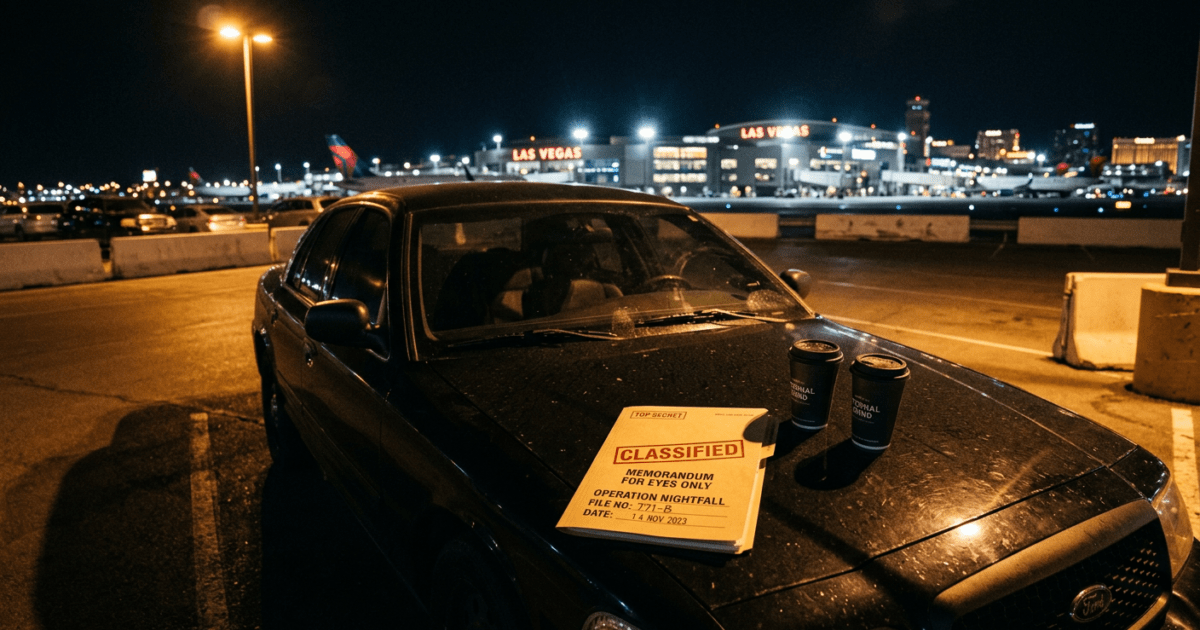
A fifteen-page document of disputed provenance, apparently written by physicist Eric Davis, describes a meeting that allegedly took place on October 16, 2002 in a parking lot near the old EG&G terminal at McCarran International Airport in Las Vegas. The other participant was Admiral Thomas Ray Wilson, former Director of the Defense Intelligence Agency and former Vice Director of the Joint Staff — at the time of the alleged meeting, recently retired from active service. The document claims Wilson confirmed the existence of a UAP crash retrieval and reverse-engineering program — and that he, a three-star admiral with one of the highest security clearances in the Department of Defense, had been denied access to it.
The document is known as the Wilson-Davis memo. Its authenticity is contested. Its contents, if accurate, describe the single most detailed alleged insider account of how UAP-related programs are hidden from institutional oversight. Congressman Matt Gaetz entered it into the congressional record during a 2022 hearing. It has never been officially authenticated or debunked by the U.S. government.
Who Eric Davis Is
Eric W. Davis holds a Ph.D. in astrophysics and has held multiple security clearances across defense and intelligence work. He served as Chief Science Officer at EarthTech International, the research arm of the Institute for Advanced Studies at Austin, both founded by physicist Hal Puthoff. Davis has published extensively on advanced propulsion concepts, including work funded by the Air Force Research Laboratory and NASA. He was a member of the scientific advisory board for Robert Bigelow’s National Institute for Discovery Science and later worked on the AAWSAP program — the Pentagon’s investigation into anomalous phenomena at Skinwalker Ranch.
In 2020, the New York Times reported that Davis had given classified briefings to the Department of Defense and to congressional staff about “off-world vehicles not made on this earth.” Davis has neither confirmed nor denied the contents of the memo publicly. When asked about its provenance, he stated the documents were “leaked out of Ed Mitchell’s estate” and that he was “not at liberty to discuss it.”
What the Memo Claims
According to the document, Wilson told Davis that in 1997 — while serving as Vice Director of the Joint Staff — he attempted to locate a classified program related to UAP reverse engineering after being informed of its possible existence by other officials. Wilson allegedly identified the program, contacted its security director, and was told he did not have a “need to know” despite holding the appropriate clearance level. When Wilson pushed back through official channels, he was reportedly warned that pursuing access further would jeopardize his career.
The memo describes Wilson as confirming that the program was run by a defense contractor, operated under a Special Access Program designation, and involved materials of non-terrestrial origin. The program’s security structure reportedly existed outside normal oversight channels — meaning that even senior military officials with relevant clearances could not access it without being specifically “read in” by the program’s gatekeepers.
These claims, if accurate, describe a constitutional crisis: a classified program funded with taxpayer dollars, concealed from the Director of the DIA, and operated by a private contractor with effective veto authority over military access.
The Provenance Problem
Admiral Wilson has publicly denied the meeting took place. In statements to journalist Billy Cox, Wilson said the documents are “bogus” and that Davis “never interviewed him.” These denials are unambiguous. They are also, in the assessment of some researchers, precisely what one would expect from a retired flag officer still bound by classification obligations regarding the existence or non-existence of programs at or above the SAP level.
Several points complicate a straightforward dismissal. UFO researcher Richard Dolan has stated he saw pages from the document as early as 2006 — thirteen years before its public leak. Apollo 14 astronaut Edgar Mitchell, in whose estate the documents were reportedly stored, expressed “shock” at Wilson’s denials in a 2008 message to journalist Billy Cox. Hal Puthoff, when asked about the document’s authenticity, declined to comment, citing active security clearances — a response that neither confirms nor denies but is notably different from Wilson’s flat denial. Investigative journalist George Knapp has stated publicly and repeatedly that the meeting occurred and that the memo accurately reflects what was discussed.
The document was entered into the congressional record during the November 2022 UAP hearing. No member of Congress who has reviewed it has publicly stated that it is fabricated.
What the Memo Implies
The Wilson-Davis memo matters less as a standalone document than as a structural claim about how UAP programs are allegedly concealed. The mechanism it describes — contractor-managed SAPs with security protocols that override military rank — is not science fiction. It is a known feature of the Special Access Program architecture. What would be novel is if such a program existed specifically to manage recovered non-human technology, and if its gatekeepers had the authority to deny access to the Director of the Defense Intelligence Agency.
This structural claim resonates with subsequent disclosures. David Grusch’s 2023 testimony described being denied access to a crash retrieval program during his official duties. The Schumer-Rounds UAP Disclosure Act included eminent domain provisions specifically designed to recover “technologies of unknown origin” from private contractors — language that presumes the existence of exactly the scenario the Wilson-Davis memo describes. Multiple senators, including Marco Rubio and Kirsten Gillibrand, have indicated that witnesses with “first-hand knowledge” have provided information consistent with the memo’s account.
The memo has not been authenticated. The meeting it describes has been denied by one of its alleged participants. Its contents have not been independently verified. And yet no official process has been established to determine, under oath, whether the structural arrangement it describes — a contractor-run program concealed from Congress and military leadership — exists. That absence of process is itself a finding.
“With regard to authenticity, we have no comment on the documents recently being circulated. As some of us still retain USG security clearances and remain bound by the secrecy oaths we have taken, we believe it is in the best interest of all concerned to refrain from making any public statements.” — Hal Puthoff, 2019
Leave a Reply