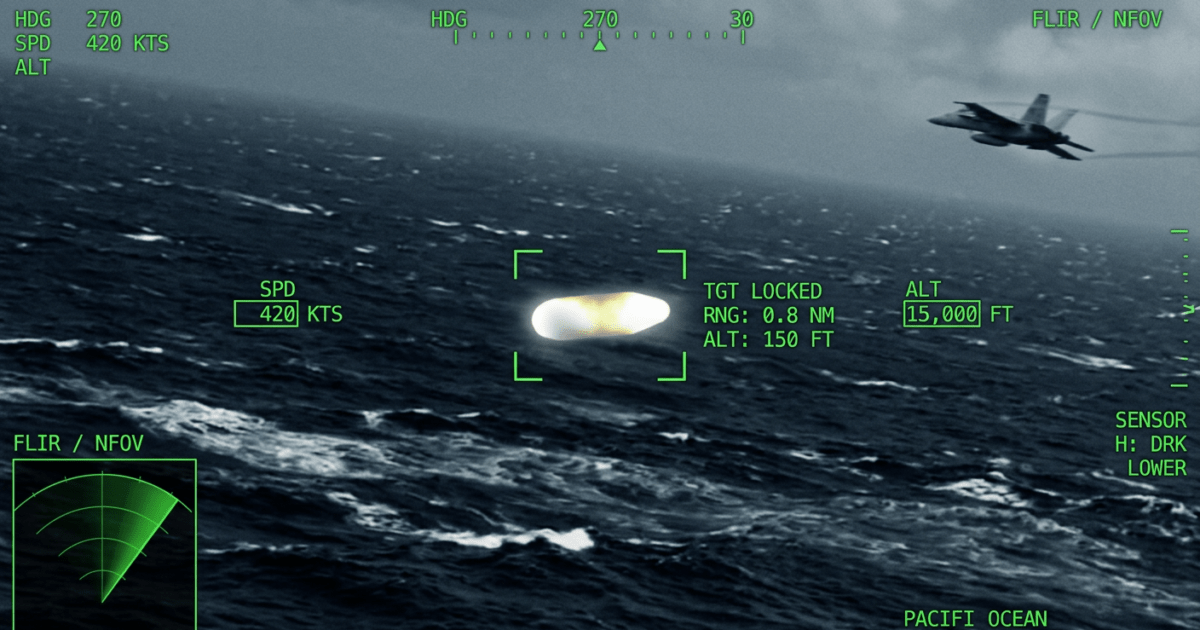
On November 14, 2004, two F/A-18F Super Hornets from the aircraft carrier USS Nimitz were redirected from a routine training exercise off the coast of Southern California. The guided-missile cruiser USS Princeton had been tracking anomalous radar returns for days — objects appearing at 80,000 feet, descending rapidly to 20,000 feet, then hovering. Now the operators wanted eyes on target. What the pilots found would take thirteen years to reach the public. When it did, it became known as the Tic Tac Encounter, one of the 144 incidents later reviewed in the Pentagon’s 2021 UAP disclosures, and the most discussed military UAP case in modern history.
The Radar Problem
The encounters did not begin on November 14. For approximately two weeks prior, the Princeton’s SPY-1B radar — part of the Aegis combat system, one of the most advanced naval tracking platforms in existence — had been detecting groups of objects exhibiting flight characteristics that defied conventional explanation. Senior Chief Operations Specialist Kevin Day, who supervised the radar team, later described objects that appeared at extremely high altitudes before dropping to near sea level in seconds. The radar returns were consistent and repeatable. They were not artifacts, weather, or system glitches. Day reported the contacts up the chain.
This detail is significant because it establishes that the Nimitz encounter was not a single anomalous sighting. It was a multi-day, multi-sensor tracking event observed by trained radar operators on a billion-dollar combat system designed specifically to identify and classify airborne targets.
What the Pilots Saw During the Tic Tac Encounter
Commander David Fravor and Lieutenant Commander Alex Dietrich were vectored to the contact area. Neither aircraft carried the Advanced Targeting Forward-Looking Infrared pod — their F/A-18s were brand-new and equipped with APG-73 radar but no FLIR. Neither radar system picked up the object that Princeton was tracking. Despite this, Princeton directed them to the coordinates for a visual inspection.
Fravor, descending from 20,000 feet, observed a disturbance on the ocean surface — a cross-shaped churning pattern, as if something large were just beneath the water. Above it, approximately 50 feet over the surface, a white, oblong object roughly 40 feet long hovered with no visible wings, rotors, exhaust, or control surfaces. Four witnesses across two aircraft observed the object for approximately five minutes.
When Fravor spiraled down to investigate, the object reacted. It ascended to meet his trajectory, mirroring his descent angle before accelerating away and disappearing. Moments later, the Princeton reported that the object had reappeared at Fravor’s pre-planned CAP point — a set of coordinates known only to the Navy — approximately 60 miles away. The transit time implied a speed that no known aircraft can achieve.
Fravor, an 18-year Navy pilot, later testified before the House Oversight Committee under oath: “The technology that we faced was far superior than anything that we had.”
The FLIR Footage
A second sortie launched shortly after Fravor’s encounter. Lieutenant Commander Chad Underwood — the pilot who coined the term “Tic Tac” — located the object and recorded approximately 90 seconds of infrared footage using his jet’s ATFLIR targeting pod. The video, later designated FLIR1, shows a small oblong heat source tracked against the sky. Underwood reported that the object jammed his radar while he was observing it — an assertion that, if accurate, implies the object was carrying active electronic warfare capabilities.
The FLIR1 footage does not capture the close-range visual encounter Fravor and Dietrich described. It captures a subsequent tracking event by a different pilot. This distinction matters: the video alone is ambiguous. Combined with the radar data, the visual testimony of four witnesses, and the Princeton’s multi-day tracking history, it becomes one component of a convergent evidence set that no single explanation has fully accounted for.
The Data That Disappeared
Several Nimitz personnel have made claims about what happened to the sensor data after the event. Gary Voorhis, a fire controlman on the Princeton, and Patrick “PJ” Hughes, a technician on the Nimitz, have separately stated that individuals arrived shortly after the incident and collected data recordings. These claims remain unverified by official sources. The chain of custody for the FLIR1 video became its own controversy — the footage circulated in defense and intelligence circles for years before Christopher Mellon, former Deputy Assistant Secretary of Defense for Intelligence, provided it to the New York Times.
On December 16, 2017, the Times published the story — by Leslie Kean, Ralph Blumenthal, and Helene Cooper — that brought the Nimitz encounter into public view. The article simultaneously revealed the existence of the Advanced Aerospace Threat Identification Program. The Department of Defense formally released the FLIR1 video in April 2020, stating: “The aerial phenomena observed in the videos remain characterized as ‘unidentified.'”
What the Evidence Establishes
The Tic Tac UFO encounter stands apart from most UAP reports because of the convergence of independent data streams: shipborne Aegis radar tracking over multiple days, trained military pilots making visual contact, infrared footage from a targeting pod, and consistent testimony from multiple witnesses who did not coordinate their accounts publicly for over a decade.
Proposed explanations have included atmospheric phenomena, sensor artifacts, parallax illusions, and classified U.S. technology. None of these accounts for the full evidence set. Atmospheric phenomena do not produce consistent radar returns over two weeks. Parallax does not explain an object observed visually by four people at close range. Classified U.S. technology does not explain why the Navy would scramble its own fighters to intercept its own assets during a training exercise — or why, two decades later, no program has been acknowledged.
The Nimitz encounter does not prove that the object was of non-human origin. It proves that something was there, that it was tracked by multiple sensor systems, that it performed maneuvers inconsistent with known aerospace capabilities, and that the United States military has not publicly explained what it was.
That gap — between what was documented and what has been disclosed — is the actual story.
“I was more concerned with tracking it, making sure that the videotape was good, so that the intelligence department could do what they do.” — Lieutenant Commander Chad Underwood, 2019
Leave a Reply