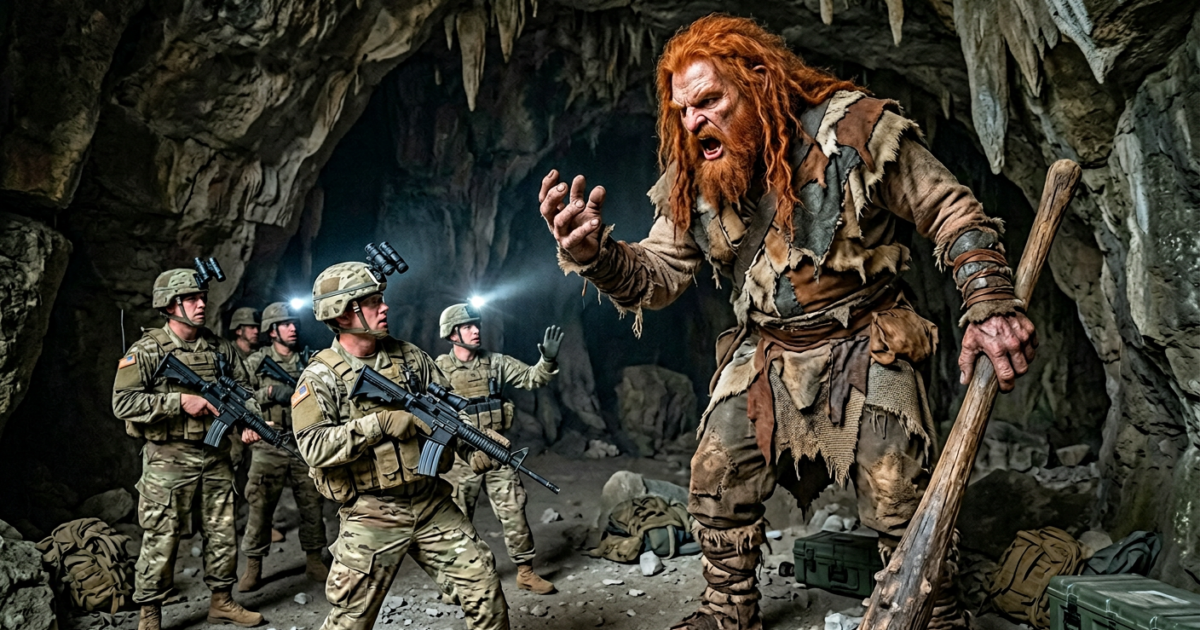
The story is specific in the way that credible accounts are specific. A Special Forces ODA, deployed to the mountains outside Kandahar in 2002, is sent to locate a missing patrol. They find scattered kit, expended brass, and bones. A cave. Then, from inside it, something emerges that is not human — or not human in the way a modern soldier is human. Thirteen feet tall. Red hair. Six fingers. Two rows of teeth. It kills a soldier named Dan with a spear. The unit engages and kills it. A helicopter lifts the giant body out in a cargo net. Everyone signs NDAs. Nobody talks for years.
There is no verified evidence any of this happened. The Department of Defense has found no record of the incident. The only “Dan” who died in Kandahar in 2002 was killed in an explosives-disposal accident alongside three others — no spear, no cave, no giant. The primary source is an anonymous individual, identified only as “Mr. K,” interviewed at an undisclosed location on an unknown date by L.A. Marzulli, a filmmaker whose stated purpose is connecting modern events to biblical prophecy. The account has no corroboration, no documentation, and no named witnesses.
This is the part of the article where most analysis stops. It shouldn’t.
Why the Story Exists at All
Legends do not arise randomly. They emerge from specific cultural and psychological conditions, and their persistence tells you something about those conditions. The Kandahar Giant story first circulated through Steve Quayle’s radio appearances in the mid-2000s and gained broader traction in 2016 through Marzulli’s video series. It spread through veteran communities, conspiracy forums, and cryptid blogs. It has been featured in military publications, treated seriously in podcasts, and accumulated a following that includes people who served in Afghanistan and find the story credible.
The conditions that produced it are worth naming. The Global War on Terror generated a class of combat veterans with experiences that were genuinely strange — remote mountain terrain, extended isolation, encounters with populations whose worldview and relationship to the supernatural differed radically from Western frameworks. Military folklore has always produced stories that process the inexplicable. The Kandahar Giant is, in one reading, a contemporary form of what soldiers in every prolonged conflict have produced: a narrative that gives shape to the formless strangeness of war in an alien landscape.
The Nephilim Thread
Marzulli’s framing connects the Kandahar Giant to the Nephilim — the beings described in Genesis 6 as offspring of the “sons of God” and human women, characterized in Numbers 13 and elsewhere as people of great size who inhabited Canaan at the time of the Israelite conquest. The Nephilim tradition is ancient and geographically widespread. Giants appear in the foundational mythologies of cultures across the Near East, Mediterranean, and pre-Columbian Americas with a consistency that is, at minimum, interesting. The Paiute oral tradition describes a race of red-haired cannibalistic giants called the Si-Te-Cah who occupied the Great Basin region. Early 20th-century excavations at Lovelock Cave in Nevada produced mummified remains and unusually large artifacts consistent with some aspects of that tradition.
None of this constitutes evidence for the Kandahar story specifically. Furthermore, it does demonstrate that the broad cultural substrate from which the legend draws — the idea of archaic giant hominids persisting in remote mountain environments — is not an invention of internet-era conspiracy culture. It is a very old idea with roots in multiple independent traditions. Whether those traditions reflect historical encounters with tall but anatomically modern humans, misidentified megafauna, or something else entirely is a genuine open question in anthropology that sits uncomfortably between mainstream dismissal and fringe overclaiming.
The Secrecy Framework Argument
Proponents of the Kandahar story typically invoke the same concealment framework applied to UAP disclosures: the military knows, the NDAs are real, and the silence is enforced rather than voluntary. This argument is structurally identical to claims made about UAP that have subsequently received partial institutional confirmation. The framework is not, therefore, inherently implausible — institutions do classify genuinely anomalous material, NDAs are real instruments, and the absence of official acknowledgment is not evidence of absence. However, the absence of any corroborating material — no satellite imagery, no personnel records, no deathbed testimony, no leaked document — after more than two decades and across dozens of claimed witnesses is a meaningful evidentiary gap that the UAP cases do not share to the same degree.
What Remains Genuinely Interesting
The Kandahar Giant story, evaluated as a claim about a specific 2002 incident, does not survive basic scrutiny. Evaluated as a cultural phenomenon, it is considerably more interesting. It connects a body of soldier testimony from the Afghan theater — multiple independent accounts of anomalously large humanoid heat signatures observed through thermal equipment, reported separately from the Marzulli story — to a deep tradition of giant lore with legitimate anthropological dimensions. Moreover, it circulates in communities where trust in official denials has been substantially eroded by documented historical deceptions, which means the institutional denial of the story functions, for its audience, as weak evidence against it rather than strong evidence.
The honest position is this: the specific 2002 Kandahar incident as described almost certainly did not happen as described. The broader category of questions the story raises — about archaic human variants, about what soldiers encounter in remote terrain that they do not report officially, about the relationship between ancient mythological traditions and unresolved anthropological data — those questions are not answered by debunking the legend. They predate it, and they will outlast it.
A story without evidence can still be a signal. The question is what it’s pointing at.— STF Editorial
Sources & Further Reading
- Snopes — “Did U.S. Special Forces Kill a Giant in Kandahar?” — fact-check and DoD response (2016)
- Soldier of Fortune — “The Deadly Giants of Afghanistan: Mystery Tales From the GWOT” — soldier accounts
- JSTOR — Nephilim in Ancient Near Eastern Context — scholarly analysis
- University of Nevada — Lovelock Cave Archaeological Report (1912)
- Nick Orton — Tales from the Grid Square: Military Encounters with the Unexplained
Leave a Reply