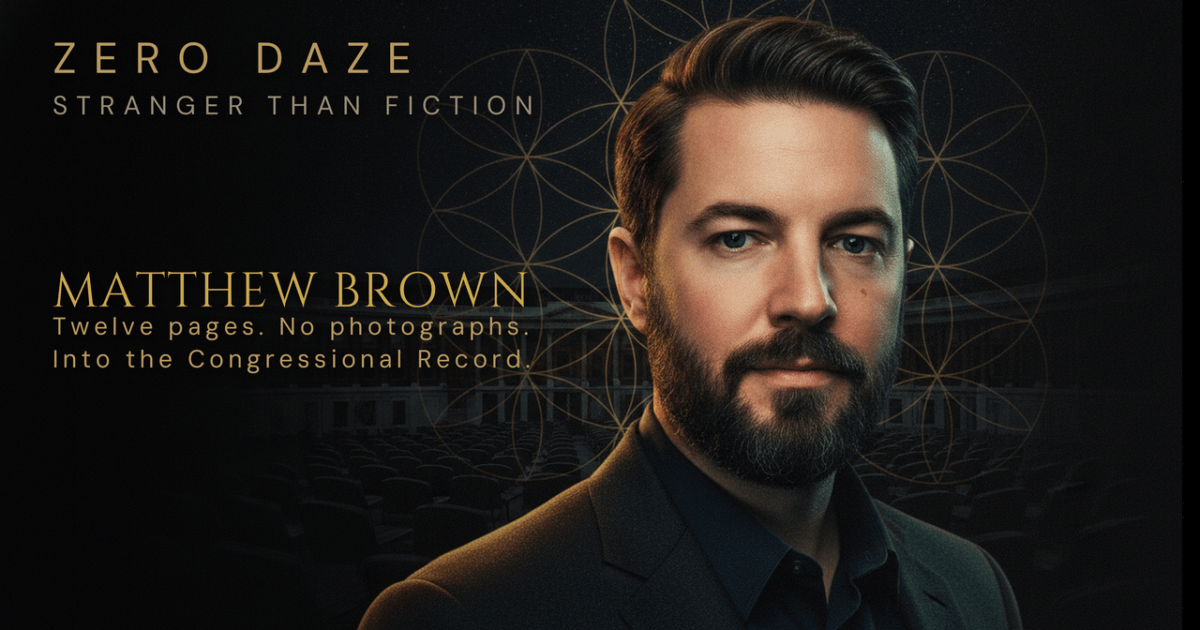
Matthew Brown did not set out to be a whistleblower. He was a former Department of Defense and State Department analyst working as a Pentagon intelligence contractor, the kind of role that involves access to classified servers, not public attention. Over time, what he encountered in that role pushed him toward a decision point that he documented in a twelve-page report. On November 13, 2024, the journalist Michael Shellenberger handed that report to a House Oversight subcommittee during the hearing itself, and it entered the Congressional Record that day. Brown did not confirm authorship publicly until April 2025. That document became known as the Immaculate Constellation Report.
The report alleged the existence of an unacknowledged special access program — codenamed Immaculate Constellation — that had been systematically collecting images and video footage of UAP encounters pulled from classified military servers. Brown described a program sitting on thousands of photographs and videos of objects of unknown origin, operating outside congressional awareness, and actively suppressing internal attempts to flag it through proper channels.
What Brown Says He Found
According to Brown’s account, relayed through interviews with investigative journalists Jeremy Corbell and George Knapp, Immaculate Constellation functioned as an aggregation program — pulling UAP-related imagery from intelligence community and military sensor networks and consolidating it in a repository that existed outside the normal reporting chain. The material reportedly included footage of orbs emerging from the ocean near Kuwait, triangular craft photographed above Russian naval vessels, and a disc-shaped object that appeared to register the presence of a camera and maneuver to avoid it.
Brown says that when he identified this program and reported it to his superiors, the response was not investigation. It was instruction. He was told to delete the files. That response — treat sensitive material as a problem to be eliminated rather than reported — is itself a data point. It describes not a bureaucratic oversight but an active decision to suppress internal disclosure.
The Proper Channel Problem
Brown’s case illustrates a structural failure that runs through the UAP disclosure landscape: the proper channels do not function. He reported what he found. He was ignored, or worse, directed to destroy evidence. He went to Congress. The classified briefing that followed frustrated lawmakers who said they received no substantive new information. He then went public — not as a first resort, but as a last one, after exhausting the options the system provides for exactly this kind of situation.
Journalist Jeremy Corbell, who interviewed Brown extensively, described the situation plainly: “Congress has made a show of this, that they want whistleblowers to come forward. Well, here you go.” The implication is pointed. The oversight architecture that was rebuilt after the Church Committee hearings, designed specifically to create safe pathways for internal dissent, is either not functioning in the UAP space or is being actively circumvented.
The Classification Architecture Behind It
Brown’s broader claims extend beyond the existence of a specific program. In public statements, he alleged that multiple independent sources had informed him of classified executive orders and agreements — sometimes described as treaties — signed by previous presidents without congressional knowledge or approval. These arrangements, he claimed, were specifically designed to prevent elected officials, including the sitting president, from exercising authority over UAP-related programs and materials.
If accurate, this describes a governance structure in which the most significant secret in human history — or at minimum, what certain parties have represented as such — has been removed from democratic accountability not through negligence but through deliberate legal architecture spanning multiple administrations. The constitutional implications are not subtle.
What Distinguishes Brown From Grusch
David Grusch’s disclosures, covered separately on this site, were based on secondhand testimony — information provided to him by individuals with direct knowledge. Brown’s claims, by contrast, are based on direct observation during his role within the national security enterprise. He says he saw classified imagery. He says he read the files. He says he reported it and was told to delete the evidence. That distinction matters analytically. It is also the reason his account is harder for institutional denials to dismiss cleanly — his claim is not about what others told him, but about what he personally encountered in a role that gave him legitimate access.
Neither account has been independently verified through public documentary evidence. Both have been corroborated, at least in part, by the institutional responses they generated — responses that, in both cases, took the form of suppression rather than investigation.
The Pattern
Grusch. Brown. The Skinwalker Ranch AAWSAP investigation. The UAPTF report. AARO’s establishment with a mandate that includes underwater and space domains. The UAP Disclosure Act. These are not isolated events. They are sequential escalations in the visibility of a subject that the institutional apparatus has been managing downward for decades. The fact that each escalation produces more institutional resistance rather than more transparency is itself informative. Systems that have nothing to hide do not respond to inquiry with suppression. They respond with disclosure.
He followed the process. The process told him to delete the files. That tells you something about the process.— STF Editorial
Sources & Further Reading
- NewsNation — “Agency Ignored UAP Whistleblower, Corbell Says” (May 2025)
- NewsNation — Alleged Secret UFO Program Has Photographic and Video Evidence (2025)
- Cybernews — Matthew Brown: Holding Past Presidents Accountable for UAP Secrecy (2025)
- Matthew Brown — Invisible Frontiers Substack (primary source)
- The Debrief — AAWSAP: What It Was and What It Wasn’t
Leave a Reply