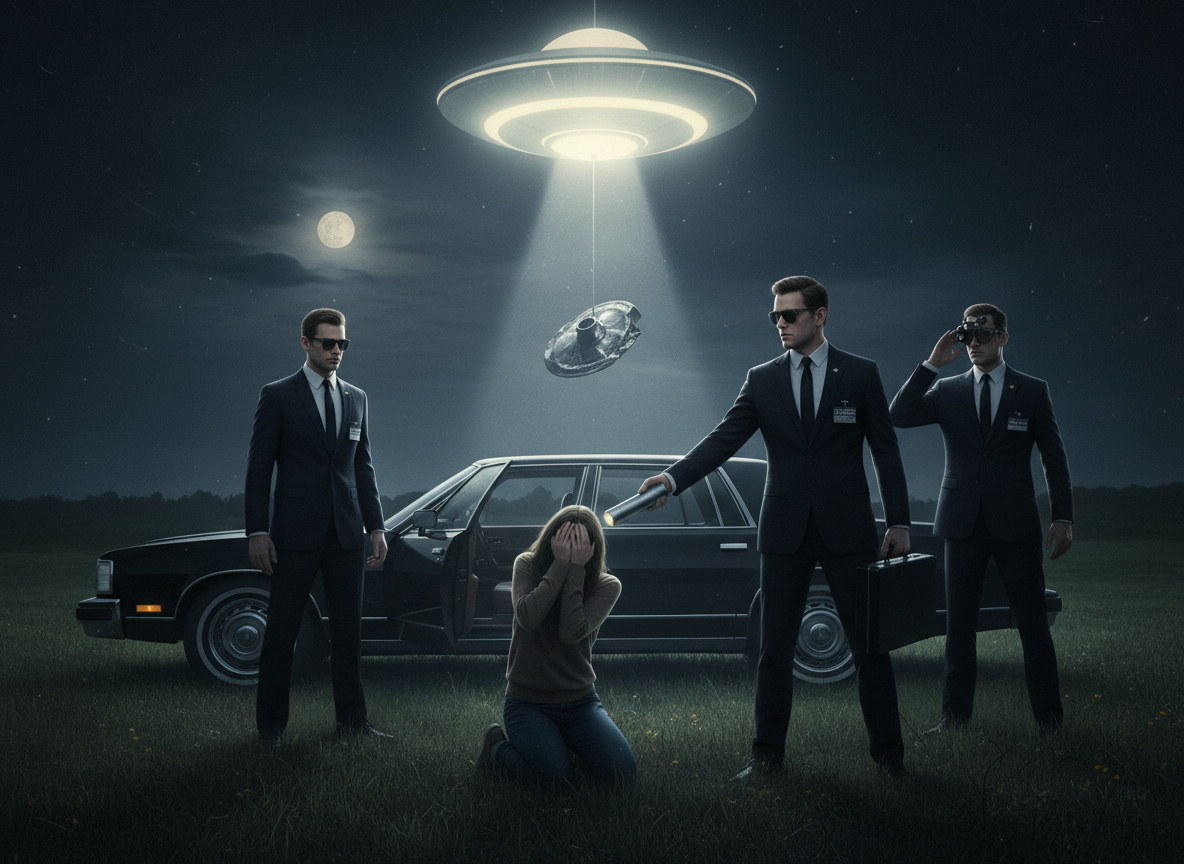
On July 26, 2023, Major David Grusch — a 14-year Air Force intelligence veteran, decorated combat officer, and former National Reconnaissance Office representative to the Pentagon’s UAP Task Force — sat before the House Oversight Committee’s national security subcommittee and testified, under oath, that the United States government has been operating a covert multi-decade program to retrieve and reverse-engineer craft of non-human origin. Furthermore, he stated that non-human biological material had been recovered from some of those craft, based on testimony from over 40 credentialed intelligence and military personnel he interviewed during his official duties.
The response from mainstream media lasted approximately 72 hours. Then the story largely evaporated. That disappearance is as significant as anything Grusch said.
Who Grusch Is
The instinct when evaluating extraordinary claims is to begin with the credibility of the person making them. In Grusch’s case, that analysis does not produce a convenient dismissal. He held Top Secret/SCI clearance. He served as a combat officer in Afghanistan. He was the NRO’s representative to two successive UAP task forces — the UAPTF and its successor AARO — and co-led UAP analysis for the National Geospatial-Intelligence Agency from late 2021 to July 2022. His statements were cleared for open publication by the relevant authorities on April 4 and 6, 2023. Karl Nell, a recently retired Army Colonel who served as the Army’s liaison to the UAP Task Force and worked directly with Grusch, described him publicly as “beyond reproach.”
This is not the profile of a fringe figure. Moreover, Grusch filed a formal whistleblower complaint with the Intelligence Community Inspector General under PPD-19 procedures before going public — meaning he used exactly the channels that oversight frameworks exist to provide. The ICIG found his complaint “credible and urgent” and referred it to Congress.
What He Said and Did Not Say
Precision matters here. Grusch did not claim to have personally seen non-human craft or biological material. His testimony was explicitly secondhand: based on information provided to him by individuals with direct knowledge, supported in some cases by photography, official documentation, and classified oral testimony. He named no program publicly. He offered to provide details in a Sensitive Compartmented Information Facility — a SCIF — which is the legally appropriate venue for classified disclosure.
What he did say, on the record and under oath before Congress, was that he “was informed in the course of his official duties of a multi-decade UAP crash retrieval and reverse-engineering program” to which he was denied access when he requested it. He also accused the military of misappropriating congressional funds to shield these operations from oversight — a claim that, if true, would constitute a serious federal crime independent of any UAP-related content.
The Institutional Response
The Department of Defense issued a statement saying it had found no “verifiable information” to substantiate claims about UAP possession or reverse-engineering programs. AARO’s then-director Sean Kirkpatrick wrote publicly that Grusch had “refused to speak with AARO” — a claim Grusch’s supporters disputed, arguing that AARO lacked the clearance level necessary to receive the relevant information.
That dispute is itself revealing. If the official body tasked with investigating UAP claims does not have clearance to access the programs allegedly involved, then AARO’s denials are not evidence of absence — they are evidence of a compartmentalization structure that places the relevant programs outside AARO’s investigative reach. The denial and the structure it implies are not in contradiction. They are, in a specific sense, consistent with each other.
Meanwhile, Senator Marco Rubio, vice-chair of the Senate Select Committee on Intelligence, stated publicly that multiple individuals had come forward to share information with the committee, some of whom had “first-hand knowledge” and were “potentially some of the same people” referred to by Grusch. Senator Kirsten Gillibrand separately indicated she intended to investigate whether “rogue SAP programs” existed outside congressional oversight.
The Retaliation Question
Grusch testified that he suffered retaliation for his whistleblower disclosures — a claim he filed formally in 2021. He told the committee that he had “definitely” feared for his life. When asked whether people had been harmed or killed to protect UAP program secrecy, he answered yes, but said he could not elaborate in an open hearing.
In August 2023, The Intercept reported on two personal mental health incidents from 2014 and 2018 involving Grusch. His response, posted publicly, acknowledged those struggles and framed them as personal history — separate from the substance of his claims and the testimony of the 40-plus individuals whose accounts formed the basis of his disclosures. The publication of that personal history in the context of his testimony followed a pattern that intelligence community observers noted was consistent with the kind of character-based discrediting documented in the Church Committee era.
What the Evidence Does and Does Not Establish
What the Grusch testimony establishes with certainty is narrow but significant. A credentialed intelligence officer with appropriate clearances, having used proper whistleblower channels, testified under oath before Congress that a covert UAP retrieval program exists. The ICIG found his complaint credible. Senior senators corroborated that other witnesses with direct knowledge had come forward to their committees. None of this confirms the existence of non-human craft. It does confirm, beyond reasonable dispute, that something is being actively concealed from Congress at classification levels that prevent even authorized oversight bodies from accessing it.
That is a constitutional problem regardless of what is being concealed. If the concealed material involves non-human technology, the implications are obvious. If it involves advanced domestic or adversarial technology misrepresented to Congress as of non-human origin, the implications are different but equally serious. Either way, the answer is not currently available to the people whose institutional role is to demand it.
The question isn’t whether you believe Grusch. The question is why the system designed to answer that question has been prevented from doing so.— STF Editorial
Sources & Further Reading
- David Grusch — Full Opening Statement to House Oversight Committee, July 26, 2023
- The Debrief — “Intelligence Officials Say U.S. Has Retrieved Craft of Non-Human Origin” (Kean & Blumenthal, June 2023)
- The Intercept — “UFO Whistleblower Kept Security Clearance After Psychiatric Detention” (August 2023)
- U.S. Congress — UAP Disclosure Act 2023 (Schumer-Rounds Amendment)
- DoD — AARO Establishment and Mandate
Leave a Reply