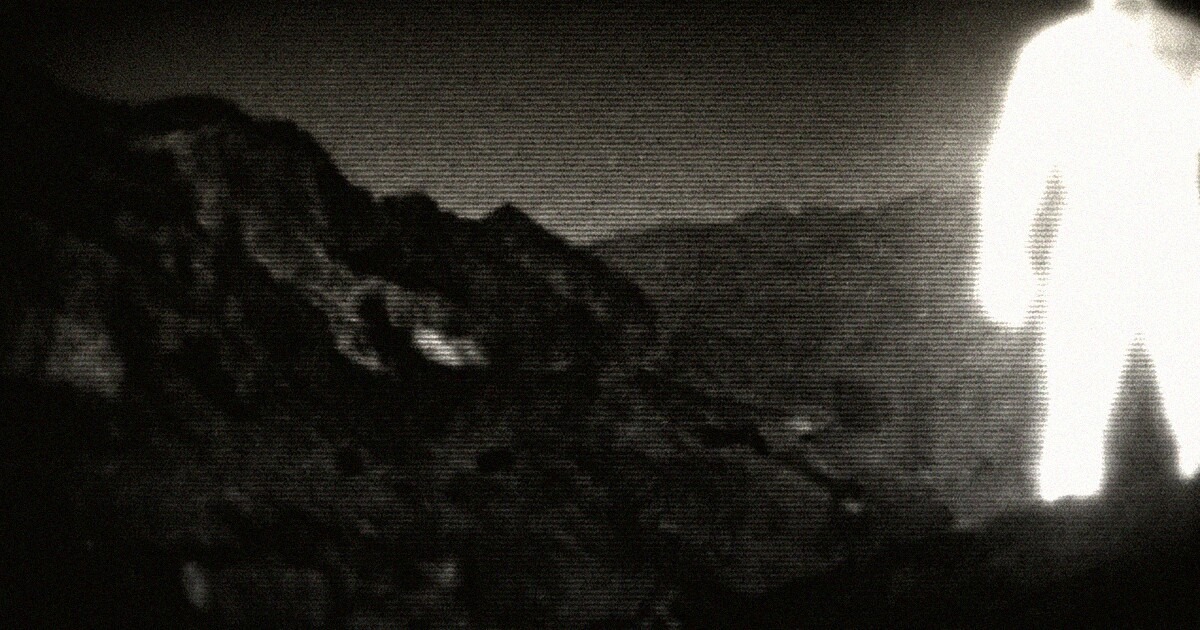
The story everyone knows is the cave. Kandahar, 2002: a Special Forces team sent to find a missing patrol, scattered gear and bones at the mouth of a cave, and a figure thirteen feet tall with red hair and six fingers that killed a soldier with a spear before the team shot it down and a helicopter lifted the body out in a cargo net. We examined that legend in The Giant of Kandahar: What the Legend Reveals Even If the Story Is False. This article is about what came after it, because the Afghanistan giant sightings that surfaced a decade and a half later are a different kind of claim, and the difference is the instrument.
Four servicemembers, from two countries and three services, across roughly ten years of the war, describe seeing something very large in the mountains. None of them was looking with their own eyes. Each was looking through a sensor, and one of them took a range.
Where the Kandahar story came from
The earliest traceable version aired on the overnight radio programme Coast to Coast AM in November 2005, when the author Steve Quayle described an email he said had come from an Air Force officer. In December 2008 the story returned to the same programme with more detail: an anonymous caller identifying himself as a pilot said he had helped fly the body out, put it at about twelve feet and eleven hundred pounds, and added six fingers and crude canvas shoes. In August 2016 the filmmaker L.A. Marzulli posted an interview with a man he called “Mr. K,” who said he had been present. That is the version with the cave, the spear, and a soldier named Dan. The video has since been removed.
Asked about it in 2016, Pentagon officials said they had no record of any such incident. That is the whole documented layer of the Kandahar story: three tellings across eleven years, every source anonymous, and no name, unit, date or photograph attached to any of them.
There is one record from Kandahar in 2002 that does exist, and it deserves to be stated plainly. On 15 April 2002, four American soldiers were killed near Kandahar in an explosion while destroying captured 107mm rockets. One of them was Sgt. 1st Class Daniel A. Romero, a Special Forces communications chief with the Colorado Army National Guard. Their deaths are documented by the Army’s own special operations history office. No cave, no spear, and no giant appear in that record, and nothing in this article should be read as connecting them to one.
A different door
In 2021 a serving Army soldier started an Instagram account called Tales From the Grid Square, writing under the name Nick Orton. He collects strange stories from people in uniform. By 2022 the account had 126,000 followers and had become two books. He describes himself as “just a regular, normal, conventional dude” and says explicitly that he is “not some Special Forces guy or Ranger.” He also says he throws out submissions when the details do not add up, citing the example of “a unit’s deployment timeframe not matching with historical records.”
Among the submissions were giants. Not the Kandahar giant; other ones. In November 2022 Military Times, a mainstream military trade publication, ran a feature on them. The Havok Journal, a veteran-run outlet, published a longer treatment in October 2025. What follows draws on both.
Four Afghanistan giant sightings, and what each was looking through
Kunar Province, 2008 to 2009. An Army infantry team leader on a thermal scope picked up a heat signature among trees he estimated at ten to twelve feet tall. In his words, “all of the sudden, the heat signature stood up as one being.” He described it as at least as tall as the trees, if not taller, moving in a way he called “slow and relaxed” yet at “incredible speed,” before it disappeared over a ridge.
Northern Afghanistan, date not given. An Air Force sensor operator on a Reaper drone, watching in mid-wave infrared at night, says he observed three figures for about ten minutes. He says the camera’s ruler tool put them at roughly twelve feet, and he gives the line that has followed the story around since: “The goats looked like cats next to them.”
Uruzgan Province, date not given. An Australian Army lieutenant on sentry duty, using the thermal sight on an armoured vehicle, saw a lanky figure at long range. He put a laser rangefinder on it and got 1,800 metres. From that distance he estimated the figure at twelve to fourteen feet and watched it for about five minutes.
Northeast of the Korengal Valley, between 2012 and 2018. An Air Force full-motion video analyst, monitoring an infrared feed, watched a figure approach a mud hut and bend down to get through the door. He estimated it at eight to nine feet.
Every one of these witnesses is anonymous. That is by the collector’s design, to encourage people still serving to come forward, and it is also the single largest weakness in the material. None of the four has been named, and no image from any of the four has been released.
What a thermal image can and cannot tell you
This is where the accounts cut in both directions at once, and both directions need stating.
A thermal image does not show an object. It shows heat: a warm shape against a cooler background. A warm shape on its own has no size. A person nearby and a much larger figure far away can occupy exactly the same fraction of the screen, and without a known range or a reference object of known size beside it, the picture cannot tell you how tall anything is. Infrared also blooms; a warm body against cold rock can read larger than it is. Thermal optics are precisely the instrument on which you would expect a size estimate to go wrong, and three of these four accounts come from tired people on watch at night.
That is the case for caution, and it is strong. But look at which of the accounts carry a reference. The Kunar team leader had trees of a height he knew. The drone operator had goats in frame and a measuring tool on the camera. And the Australian lieutenant did the one thing that turns an impression into arithmetic: he took a range. If you know how far away something is and how much of the sight it fills, its height stops being a guess and becomes a calculation.
None of that makes the numbers right. A rangefinder can return the slope behind a figure rather than the figure. A ruler tool can be misread. Goats come in sizes. But it does make these a different class of claim from the cave. The Kandahar story asks you to believe a person’s memory. These ask you to believe a reading, and readings can be checked in ways memories cannot.
Documented, claimed, and the thing nobody has asked for
Documented: the broadcast history of the Kandahar story and the Pentagon’s statement that it has no record of the incident. The four soldiers killed near Kandahar on 15 April 2002. The existence of the Tales From the Grid Square project, its collector’s stated screening practice, and the Military Times and Havok Journal coverage. The physics of thermal imaging.
Claimed but uncorroborated: every sighting in this article. Four anonymous witnesses, four instruments, zero released frames.
There is no structurally corroborated tier here, and the honest version of this piece says so. Four accounts that resemble one another are not corroboration; they may share a source, a subculture, or a story everyone had already heard. The resemblance is interesting. It is not evidence.
What separates the Afghanistan giant sightings from the cave is that they are answerable. The Kandahar story was always going to be a memory of a day underground. The thermal accounts happened in front of sensors, and at least one of those sensors, a Reaper’s camera, feeds a system that records. If a sensor operator watched three twelve-foot figures for ten minutes and used a ruler tool on them, that footage existed at some point on a drive somewhere. Whether it still does, whether it was ever flagged, and whether anyone has filed a request for it are questions with answers. As far as we can find, nobody has asked.
The question was never whether soldiers saw giants. It is simpler than that: where are the frames.
— STF Editorial
Sources & Further Reading
- Here be giants: outlandish tales of the military and the Afghan colossi, Military Times, 1 November 2022
- Enemy Unknown: High Strangeness in the Shadow of the Afghan War, The Havok Journal, 31 October 2025
- Meet the soldier behind Tales From the Grid Square, Task & Purpose
- ARSOF Fallen: Sergeant First Class Daniel A. Romero, U.S. Army Special Operations History Office
- SSG Brian T. Craig, EOD Warrior Foundation virtual memorial
- Steve Quayle, guest page, Coast to Coast AM
- The Giant of Kandahar: What the Legend Reveals Even If the Story Is False, STF
Leave a Reply