George Hunter White wrote a retirement letter to Sidney Gottlieb in 1965, after thirteen years of running CIA safehouses where unwitting Americans were dosed with LSD and observed through one-way mirrors. The letter is one of the documents that survived the 1973 destruction. It contains the most-quoted single sentence in the entire MKULTRA record:
“Where else could a red-blooded American boy lie, kill, cheat, steal, rape, and pillage with the sanction and blessing of the All-Highest?”
That is what the man who ran Operation MIDNIGHT CLIMAX wrote to the chief of MKULTRA when he was retiring. He was not being ironic. He had spent the previous decade and a half doing exactly what the sentence describes, with sanction, with blessing, on government salary, in CIA-funded apartments in San Francisco and New York. He died ten years later in Stinson Beach, California, at age sixty-seven, never charged with any crime, his diaries donated to a community college museum in Los Altos by his widow.
The other man whose name belongs in the same article is Frank Olson, a U.S. Army biochemist who worked under Gottlieb’s supervision until his death on November 28, 1953. Olson and White never met. They occupied opposite ends of the same operation. White was the man who dosed strangers and watched what happened. Olson was the colleague who got dosed at a CIA retreat, became a problem the program could not contain, and went out a thirteenth-floor hotel window nine days later. The investigation into Olson’s death was conducted partly by White’s CIA-affiliated network at the Statler Hotel.
This article covers both. The point of pairing them is the symmetry. The same operational architecture that allowed White to operate brothels for two decades is the architecture that produced the chain of custody on the night Frank Olson died. The same Federal Bureau of Narcotics network. The same one-way mirrors. The same CIA cover. The same culture of impunity, applied to strangers in San Francisco and to one of the program’s own scientists in a Manhattan hotel room.
The Recruitment
George Hunter White was born in Los Angeles on June 22, 1908. He was a federal narcotics agent before he was anything else. He joined the Federal Bureau of Narcotics in 1934, working under Commissioner Harry Anslinger on cases that took him from San Francisco’s Chinatown to organized crime networks in Montana and Florida. He was, by Anslinger’s standards, a star: physically imposing at 250 pounds, willing to operate undercover in dangerous environments, with a tolerance for violence that Anslinger found useful. He participated in the operation that captured Lucky Luciano. He was, in the language of his colleagues, a “rock-em sock-em cop.”
During World War II, White trained operatives for the Office of Strategic Services in counterespionage techniques. He worked under Stanley Lovell, the OSS scientist whose Research and Analysis branch was developing the early generation of truth serum compounds — primarily concentrated cannabis extract, used experimentally on captured prisoners. White’s wartime work brought him into contact with the same compounds and the same questions that would later define MKULTRA. The connection was institutional. Lovell’s R&A branch became, after the war and the dissolution of the OSS, the institutional ancestor of the CIA’s Technical Services Staff. Sidney Gottlieb inherited Lovell’s notes when he took over the Chemical Division in 1951.
White’s name was in those notes. Gottlieb went looking for him. In 1952, Gottlieb met with White and proposed a continuation of the wartime drug-testing work, this time with LSD as the primary compound and unwitting Americans as the subjects. White agreed. Anslinger was consulted and authorized White’s CIA consultancy while preserving his FBN cover. The arrangement was financially elegant: White continued drawing his federal narcotics salary, the CIA paid him separately as a consultant, and his FBN credentials provided the operational cover that allowed him to interact with the criminal and prostitute networks the program needed.
The Bedford Street Apartment
The first safehouse was at 81 Bedford Street in Greenwich Village. White operated it under the alias Morgan Hall. The apartment was outfitted with one-way mirrors, hidden microphones disguised as wall outlets, and recording equipment connected to an adjoining observation post. White hosted parties beginning in the fall of 1953 and continuing through the spring of 1954. Guests at these parties — friends, acquaintances, contacts White had cultivated through his FBN work — were dosed with sodium pentothal, Nembutal, and LSD without their knowledge.
The Bedford Street operation was the prototype. The methodology, the equipment, the operational profile — all were established in Greenwich Village before the program scaled up. By 1955, Gottlieb and White had decided that the New York operation needed a parallel site, and that the parallel site should use a different recruitment mechanism. The New York apartment relied on White’s own social network. The next iteration would use prostitutes.
225 Chestnut Street
The main San Francisco safehouse was at 225 Chestnut Street on Telegraph Hill. It was an L-shaped apartment with sweeping views of San Francisco Bay, located within walking distance of the North Beach bars where the program’s targets would be recruited. It operated from 1955 to 1965. A second San Francisco safehouse was established later in Marin County. The expansion was rapid and the operational tempo was substantial: by the early 1960s, White’s network was running multiple sessions per week.
The recruitment mechanism was straightforward. The CIA paid prostitutes $100 per night — substantial money in the 1950s and 1960s — to identify men in North Beach bars and lure them back to the Chestnut Street apartment. The men received drinks. The drinks were laced with LSD. The men did not know they had been dosed. They went to the bedroom with the prostitute. Behind the one-way mirror in the bedroom, federal agents — White himself when he was in town, his subordinates when he was not — observed and recorded what happened.
The operational rationale, as Gottlieb described it in his 1977 Senate testimony, was the development of “a documented sound movie, you might say, so that we would know something about the behavior of people when they were administered these drugs.” The reality was less clinical. The walls of the Chestnut Street apartment were decorated with photographs of women in bondage and provocative posters by Toulouse-Lautrec. White stocked the refrigerator with chilled martinis. According to his diaries, he frequently observed the sessions while sitting on a portable toilet in the observation post, drinking continuously, taking handwritten notes that the CIA later reviewed for analytical content.
Subjects were not always released cleanly. Some, in the diary record White kept and later donated to Foothill Junior College, committed crimes while still under the influence — armed robberies, assaults — and were arrested and prosecuted as if they had been operating on their own. The CIA did not intervene to inform the courts that the defendants had been involuntarily dosed. The institutional position was that the safehouse program could not be acknowledged. The defendants were sentenced as ordinary criminals.
What the Program Studied
The conventional account of MIDNIGHT CLIMAX, as it appeared in the 1975 and 1977 hearings, describes the program as a study of LSD’s behavioral effects on unwitting subjects. That description is incomplete. The psychiatrist Colin Ross, who reviewed the surviving CIA documents in detail, identified a memo indicating an additional purpose: the program was also testing the prostitutes. Specifically, the program was evaluating whether the women could be developed as field operatives capable of seducing foreign targets and extracting intelligence from them.
Under this reading, the johns at Chestnut Street served a dual function. They were the subjects of the LSD dosing experiments, and they were the live training environment in which the prostitutes’ operational capabilities could be assessed. The two-way mirror was not just a research tool. It was a performance evaluation.
The Ross interpretation is contested. The surviving documentary record does not unambiguously confirm it. What it does establish is that the operational architecture of MIDNIGHT CLIMAX — the safehouses, the prostitutes on retainer, the surveillance equipment, the chain of command running through White to Gottlieb to Helms — was an asset that the Agency would have been operationally negligent not to have used for purposes beyond the stated research mission. Whether the secondary uses were formalized in the documentation Helms ordered destroyed in 1973 is a question the surviving records do not answer.
The Earman Report
In 1963, the CIA’s Inspector General John Earman conducted a comprehensive review of MKULTRA. The report he produced was the most damning internal assessment the Agency would ever generate of its own behavior control program. Earman identified the safehouse program specifically as the program element that exposed the Agency to the most catastrophic legal and political risk.
Earman’s recommendation was to terminate the unwitting testing. He noted that the program had violated U.S. criminal statutes and that exposure would produce, in his words, “a most damaging effect on Agency reputation.” The recommendation went to John McCone, the Director of Central Intelligence. McCone accepted the recommendation. The unwitting testing was officially scaled back. Gottlieb resisted. The actual termination of the safehouse program took an additional two years, with the New York operation closing in 1966.
Earman’s report is one of the documents that survived the 1973 destruction. The reason is bureaucratic: the report had been distributed widely enough within the Agency that complete recall and destruction was impossible. It is the principal source on which the Church Committee built its account of the program’s later years.
The Frank Olson Case: What Is Documented
Frank Olson was born July 17, 1910, in Hurley, Wisconsin, to Swedish immigrant parents. He earned a Ph.D. in bacteriology from the University of Wisconsin in 1938. He joined the U.S. Army in 1943 and was assigned to Camp Detrick in Maryland — later renamed Fort Detrick — where he became a senior scientist in the Special Operations Division working on biological weapons delivery systems. By 1953 he was acting chief of the SOD, a CIA-affiliated unit operating inside the Army’s biological warfare facility.
In summer 1953, Olson traveled to Britain and Germany to observe interrogations being conducted using LSD and other compounds developed under the ARTICHOKE program. According to his son Eric’s later research, Olson witnessed sessions in which subjects — described in the program documentation as “expendable” — died during interrogation. He returned to the United States visibly disturbed by what he had seen. According to multiple accounts from family members and colleagues, he told his wife Alice that he had decided to leave the program.
On November 19, 1953, Gottlieb hosted a retreat at Deep Creek Lake in western Maryland for senior MKULTRA personnel and Special Operations Division scientists. Olson attended. After dinner, Robert Lashbrook — Gottlieb’s deputy — served Cointreau that had been dosed with LSD. The dosing was not disclosed until twenty minutes after consumption. Olson was among the seven people who drank the dosed Cointreau.
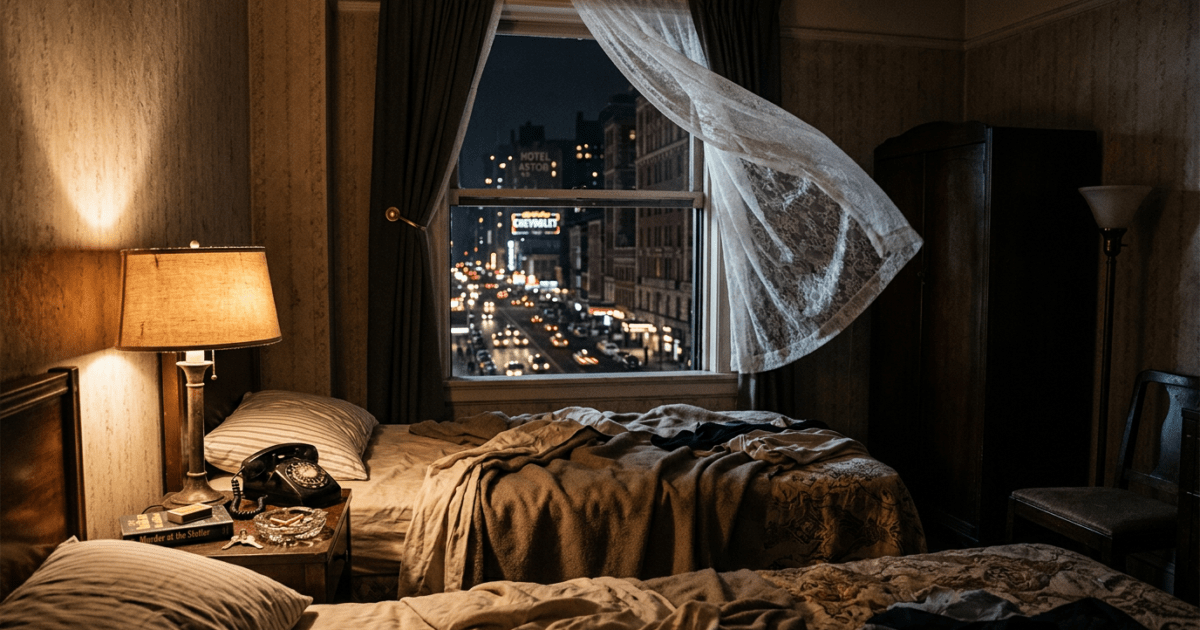
Over the following days, Olson exhibited what colleagues described as paranoia and depression. On November 24, Lashbrook took him to New York City to see Harold Abramson — the same New York psychiatrist who had introduced Gottlieb to LSD and who served as the CIA’s preferred provider for psychiatric care of compromised personnel. Olson and Lashbrook checked into the Hotel Statler at 33rd Street and Seventh Avenue. They shared room 1018A on what was nominally the tenth floor and effectively the thirteenth, since the building had three unnumbered floors at its base.
On Thanksgiving evening, November 26, Olson appeared to be improving. He ate dinner with Lashbrook at a Horn & Hardart automat. He called his wife Alice and told her he was looking forward to coming home the next day. He returned to the hotel room with Lashbrook.
At approximately 2 a.m. on November 28, the night manager Armond Pastore, working in the lobby, heard glass break high above Seventh Avenue. He looked up and saw a curtain flapping out of an open window. He ran outside and found Olson on the sidewalk, still alive, attempting to speak. Olson died before the ambulance arrived. He was forty-three.
What the 1953 Investigation Did Not Examine
The New York Police Department investigation that followed Olson’s death was abbreviated. No autopsy was ordered. The body was returned to the family with instructions that it was too disfigured for viewing — a claim that prevented Alice Olson from seeing what had been done to her husband. The death was ruled either suicide or accident, depending on which document is consulted, and the case was closed within days.
The hotel switchboard operator told investigators that she had connected a call from room 1018A immediately after the incident. The call was to a number registered to Harold Abramson. The operator overheard the substance of the call. The voice from 1018A — Lashbrook’s voice — said: “Well, he’s gone.” The voice on the other end — Abramson’s voice — said: “Well, that’s too bad.”
That exchange is the only documented contemporaneous response by anyone involved in the program to Frank Olson’s death. It contains no surprise, no alarm, no professional concern from the psychiatrist who had been treating Olson for nine days. The conversation lasted approximately twenty seconds. Abramson did not come to the hotel. The police were not notified by the program until after the body had been on the sidewalk for some time.
Police entered room 1018A and found Lashbrook sitting on the toilet in the bathroom, head in his hands. He told them he had been asleep and was awakened by the sound of breaking glass. The room had two beds. Lashbrook would have had to either remain in his bed during whatever happened or move to the bathroom afterward without disturbing any of the room’s contents. The dimensions of the room — confirmed during the 1994 reconstruction — make it physically difficult to develop the running velocity Lashbrook’s account requires for Olson to dive through a closed window blocked by a radiator. Pastore, the night manager, told the family in 1978: “In all my years in the hotel business, I never encountered a case where someone got up in the middle of the night, ran across a dark room in his underwear, avoiding two beds, and dove through a closed window with the shade and curtains drawn.”
What the Hotel Was
The Statler Hotel was not a randomly selected location. According to research conducted by H.P. Albarelli Jr. and corroborated in part by White’s diaries, the night of Olson’s death involved at least one additional figure: a CIA contract employee operating under the name Pierre Lafitte. Lafitte’s actual identity was Jacques Voignier, a high-ranking member of the Union Corse who had been integrated into the FBN’s network. He was working at the Statler the night Olson died.
White’s diaries indicate that he himself had been assigned to oversee the Statler operation that week but had been called away to attend to his mother. He left “stewardship of the room” — Albarelli’s phrasing, drawn from White’s own contemporaneous notation — to Voignier. Whether Voignier’s presence at the hotel was operational or coincidental is the question the surviving record cannot definitively answer. What it can establish is that the night Frank Olson went out the window, the man supervising the hotel arrangements on behalf of the FBN/CIA network was a French organized crime figure with documented ties to the Union Corse, and that George Hunter White had personally arranged the assignment.
The 1994 Exhumation
Eric Olson, Frank’s son, was nine years old when his father died. He spent the next four decades trying to understand what had happened. The family received a settlement from the CIA in 1976 after the Rockefeller Commission disclosed the dosing, but the settlement carried no acknowledgment that the death was anything other than suicide.
In 1994, Eric Olson had his father’s body exhumed for reburial alongside his mother, who had died the previous year. The family commissioned a second autopsy. The forensic team was led by James Starrs of George Washington University Law School, an expert in the forensic re-examination of historical deaths.
The Starrs team’s findings, published in 1994 and elaborated in subsequent technical reports, documented two specific anatomical observations. First, a hematoma above Olson’s left eye that did not appear in the original 1953 medical examiner’s report. Second, a chest laceration the team concluded was inconsistent with injuries from the fall. Starrs’s published conclusion was that the evidence was, in his phrasing, “rankly and starkly suggestive of homicide.”
In 1996, Eric Olson presented the findings to the Manhattan District Attorney’s office. Stephen Saracco and Daniel Bibb of the cold case unit reviewed the material and conducted preliminary interviews, including a deposition of Lashbrook. They concluded that the evidence was insufficient to bring before a grand jury. The case has never been formally reopened.
The Pattern
The connecting tissue between George Hunter White and Frank Olson is the operational culture they shared. White ran a program in which unwitting Americans were dosed and surveilled, and in which subjects who committed crimes under the influence were prosecuted without disclosure. Olson was a witness to a program in which suspected enemy agents were interrogated under LSD and some died. The two operations were administratively separate. They were operationally identical.
What happened to Olson when he became a security liability — when he indicated he was leaving the program after seeing what was being done in Europe — was the same operational logic White’s safehouses had been built on. The Agency’s operating posture, in cases where the program’s exposure became a higher risk than the subject’s continued participation, was to neutralize the risk. White did this with strangers in San Francisco. Whether someone — Lashbrook, Voignier, or another operative — did it with Olson at the Statler is a question the destroyed records cannot answer.
The available evidence is consistent with both interpretations. Olson may have jumped through a closed window, in his underwear, after running across a dark room past two beds, without making sufficient noise to wake the man sleeping in the other bed. The dimensions of the room and the configuration of the window make this scenario implausible but not impossible. Or someone may have struck him in the head, opened the window, and pushed him through it, then sat down in the bathroom and called Harold Abramson. The hematoma the original medical examiner did not note is consistent with the second scenario. So is the absence of any contemporaneous expression of professional alarm in the Lashbrook-Abramson phone call.
Both scenarios produce the same outcome: a witness to MKULTRA’s worst-documented operations dies, the New York Police Department investigation is closed within forty-eight hours, the family is told the body cannot be viewed, and the program continues for another twenty years. The institutional response to Olson’s death — whatever its proximate cause — was indistinguishable from a cover-up.
The Operators
White retired from federal service in 1965. He moved to Stinson Beach, California. He died there on October 23, 1975, age sixty-seven, two months before the Church Committee began investigating the program he had run. His widow donated his diaries to Foothill Junior College, where they were discovered by reporters in 1977 and provided most of what we know about the safehouse operations.
Lashbrook gave testimony to congressional investigators in 1975 and to the Manhattan DA’s cold case unit in 1996. He never acknowledged anything beyond what the surviving documents already established. He died in 2002.
Abramson continued to practice psychiatry on Long Island until his death in 1980. He never publicly addressed his role in Olson’s care or the contents of the November 28, 1953 phone call.
Gottlieb died in 1999, having retired in 1973 and never having faced charges.
The man on the sidewalk on Seventh Avenue at 2 a.m. on November 28, 1953, was a forty-three-year-old Army biochemist who had decided he could not continue working for a program that killed expendable subjects in European interrogation rooms. The men responsible for what happened to him died in their beds at advanced ages, decorated, eulogized, and never compelled to answer the question of why he was in that room with Robert Lashbrook on Thanksgiving night, or what was in the bathroom that Lashbrook’s account asks us to believe he was sitting on when his colleague went through the closed window.
“In all my years in the hotel business, I never encountered a case where someone got up in the middle of the night, ran across a dark room in his underwear, avoiding two beds, and dove through a closed window with the shade and curtains drawn.” — Armond Pastore, night manager of the Statler Hotel, 1953, in a 1978 letter to the Olson family
Sources & Further Reading
- The Frank Olson Project — Comprehensive documentation of the case
- Frank Olson — Biographical Record
- George Hunter White — Biographical Record
- Washington Post — “The Diaries of a CIA Operative” (September 1977)
- National Security Archive — CIA Behavior Control Experiments Document Collection
- H.P. Albarelli Jr., A Terrible Mistake: The Murder of Frank Olson and the CIA’s Secret Cold War Experiments (Trine Day, 2009)
- John Marks, The Search for the Manchurian Candidate: The CIA and Mind Control (Times Books, 1979)
Leave a Reply