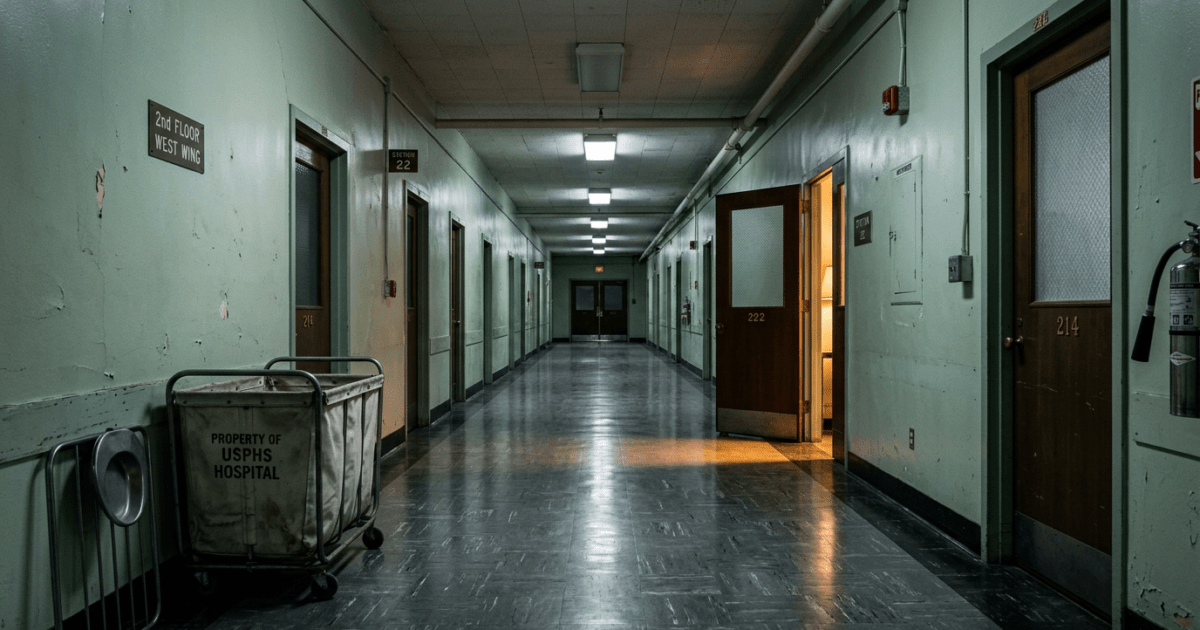
The U.S. Public Health Service Hospital at Lexington, Kentucky — where pharmacologist Harris Isbell ran the Addiction Research Center from 1945 to 1963 — was the largest narcotics treatment facility in the country. It opened in 1935 and operated as a hybrid institution: part federal prison, part addiction hospital. Inmates were referred to euphemistically as “patients.” Most had been arrested under federal narcotics laws and were serving sentences that combined incarceration with mandatory treatment. The treatment, in theory, was withdrawal followed by rehabilitation. Many patients went voluntarily, hoping for help. Many others were sent there by the courts. Either way, leaving was not an option until the institution decided they could leave.
Isbell was a credentialed federal scientist with a faculty appointment at the University of Kentucky. He published prolifically in mainstream medical journals throughout his tenure. He served on the FDA’s Advisory Committee on the Abuse of Depressant and Stimulant Drugs while simultaneously running the experiments described in this article. He died in 1994, age eighty-four, in retirement. He was never charged. He was never publicly identified by his subjects, because his subjects, in most cases, never knew his name.
The MKULTRA contractor whose work most resembles Nazi medical experimentation in its racial composition, its use of incarcerated subjects, and its systematic deception is not Sidney Gottlieb. Gottlieb directed the program. Harris Isbell was the man who actually conducted the experiments on the largest scale, with the most consistent racial pattern, on subjects with the least possible capacity to refuse.
The Setup
The Addiction Research Center at Lexington was, by the early 1950s, the federal government’s primary clearinghouse for research on addiction pharmacology. The Center had a captive subject population: inmates who, in many cases, were physically dependent on opiates and going through withdrawal. The standard treatment protocol was supposed to be supervised detoxification followed by rehabilitation. Isbell’s laboratory operated under a different premise.
The arrangement was straightforward. Inmates who participated in Isbell’s experiments were compensated with the drug of their choice. For most subjects, the drug of choice was heroin or morphine — the same drugs they were ostensibly being treated to abstain from. Subjects who completed an experimental protocol received their compensation in the form of a controlled re-administration of the substance they had been incarcerated for using.
The ethical structure was a closed loop. The federal government incarcerated Black men for heroin possession at disproportionate rates. The federal government then sent them to a federal facility for treatment. The federal facility’s research director offered them heroin in exchange for participation in experiments. The experiments studied the effects of compounds the men had no medical reason to take. After the experiments, the men were released back into the general population having been re-addicted by the institution that was supposed to be treating their addiction.
This is what is meant by the phrase “people who could not fight back” — the description used by an unnamed CIA officer to characterize Operation MIDNIGHT CLIMAX subjects. At Lexington the description was operationally precise. The subjects were federally incarcerated. They were physically dependent on a controlled substance the institution controlled. The compensation structure created a coercive incentive that made the appearance of consent meaningless.
The 800 Compounds
Sidney Gottlieb shipped over 800 distinct chemical compounds from MKULTRA’s procurement chain to Isbell’s laboratory in Lexington. The compounds came primarily from Sandoz, Eli Lilly, and a handful of academic pharmacology departments contracted by the Agency. Most were not identified to Isbell beyond a code number and a basic pharmacological category.
Isbell’s job was to administer the compounds to subjects, observe and record the effects, and report back to Gottlieb’s office. The reporting protocol allowed Isbell to publish his findings in mainstream pharmacology and addiction journals — the academic record of his work fills several shelves of bound volumes — while concealing the funding source and operational purpose of the research.
The compounds tested at Lexington included LSD, mescaline, psilocybin (which Sandoz had synthesized after Albert Hofmann’s work on psilocybin mushrooms), scopolamine, sodium pentothal, harmaline, ibogaine, methamphetamine, dimethyltryptamine in synthetic form, and substances that did not have publicly known names because they had been synthesized for the program and were not yet documented in the pharmacological literature. The diversity of the testing made Lexington one of the most active sites in the program.
Isbell’s experimental protocols generally involved establishing a tolerance baseline, then escalating dosages to determine the upper limits of human tolerance. The escalation phase is what produced the most damaging exposures.
The 77-Day Experiment
The most documented and most cited single experiment in Isbell’s career was the LSD tolerance study he conducted in the mid-1950s on seven incarcerated subjects. All seven were Black men. The protocol called for daily oral administration of LSD over a continuous period.
The subjects developed tolerance, as Isbell had expected. Tolerance to LSD occurs rapidly, with subjects often requiring substantially increased doses within the first week of repeated administration to produce comparable effects. The experimental design accommodated this: when a dose stopped producing the measured threshold response, Isbell increased it. The doses were doubled. Then tripled. Then quadrupled. By the end of the protocol, the subjects were receiving, in Isbell’s published description, “quadruple the normal dosages” and continuing to function with measurable but diminished effect.
The experiment ran for seventy-seven consecutive days.
The cumulative LSD exposure these seven men received over those eleven weeks exceeded any documented human exposure to the compound before or since. The state they would have inhabited continuously across that period — depending on the exact dosing schedule, which Isbell’s papers describe in some detail — would have been one of sustained, weeks-long, escalating dissociation. When subjects fell asleep during the protocol, Isbell, according to subsequent accounts including Jim Keith’s Mass Control: Engineering Human Consciousness, used electroshock to wake them and continue the dosing schedule.
Isbell published the results. The paper described the men’s apparent tolerance to remarkable doses of LSD as a notable finding. The paper did not describe what happened to the men after the experiment ended. It did not describe their psychological state. It did not describe their long-term outcomes. The men’s names were never published. The university researchers who later attempted to track them down found no records of their post-release fates.
The Racial Pattern
The University of Ottawa documented the racial composition of Isbell’s MKULTRA-related experiments in a 2017 study cited by The Nation in a 2022 piece on the program. The findings are documentary. Black participants in Isbell’s LSD studies received chronic administration for periods of up to eighty-five days. White participants in comparable studies received exposures of up to eight days. Black participants in some studies received doses more than twice as high as the doses given to white participants in parallel studies.
The pattern is not universal across all of Isbell’s work. The 1950 barbiturate study he conducted, which produced comparably extreme exposures, used five white male subjects. The pattern in the LSD work specifically — the work funded by MKULTRA — was racial in a way the broader pharmacology research was not.
The institutional explanation, when one was offered, was that Black inmates constituted the majority of the heroin-addicted population at Lexington and were therefore overrepresented in any study that used the addiction-treatment compensation structure. That explanation does not account for the dose differentials between racial groups in parallel studies. It does not account for the duration differentials. It does not account for why the most extreme exposures — the 77-day LSD protocol, the studies escalating to quadruple normal doses — were administered exclusively to Black subjects.
The most defensible reading of the evidence is that Isbell selected his most aggressive protocols for the subject population the institution treated as most expendable. The Black inmate population at Lexington occupied the lowest rung of the federal prison system’s social hierarchy. Their absence after the studies, whether through release, transfer, or death, would attract the least institutional attention. They were, in operational terms, the safest subjects on whom to test the drugs that might destroy them.
The Other Subjects
Not all of Isbell’s subjects were Black. Not all were drug-dependent at admission. The most fully documented case of a non-Black, non-addicted Lexington subject is W. Henry Wall Sr., a Georgia physician and former state senator who developed a Demerol dependence after dental surgery in the early 1950s. He was sent to Lexington for treatment. He never came home as the man his family had known.
His son, William Henry Wall Jr., an oral surgeon, published From Healing to Hell in 2011 documenting his father’s case. The elder Wall was kept at Lexington beyond the standard treatment period. His family was given limited information about why. He returned home with permanent cognitive damage. He could not resume his medical practice. He could not function as a state senator. The family eventually pieced together, through the partial declassifications of the 1970s and the Senate hearings, that Wall Sr. had been one of Isbell’s experimental subjects.
The Wall case is significant because it is the most fully documented non-Black case from Lexington and because the family had the resources to pursue what had happened. Most of Isbell’s subjects did not have those resources. Most of Isbell’s subjects’ families never learned what had been done to them. The institutional records were destroyed in 1973 along with the rest of MKULTRA. What remains in the public record is what Isbell himself published, which describes the protocols without naming the people.
The FDA Position
While Isbell was running the experiments described above, he also held an appointment to the U.S. Food and Drug Administration’s Advisory Committee on the Abuse of Depressant and Stimulant Drugs. The position made him one of the federal officials responsible for setting national standards on the responsible use of psychoactive pharmaceuticals.
The contradiction is structural rather than personal. Isbell was, simultaneously, the federal government’s leading expert on addiction pharmacology and the federal employee conducting the most aggressive experimental drug administration on prisoners in the country. The credentials enabled the work. The work would not have been credible without the credentials.
The same pattern appears with Cameron at the Allan Memorial Institute, with Louis Jolyon West at UCLA, and with the academic researchers across the eighty institutions that participated in MKULTRA. The credentials of the perpetrators were the institutional architecture that made the program possible. Eliminate the credentials, and the program could not have run. Discredit the credentials retroactively, and the profession had no choice but to confront its own complicity.
The profession has, by and large, declined to confront it. Isbell’s papers remain in the published academic literature. They are still cited in pharmacology research. The Addiction Research Center at Lexington was renamed and reorganized after his retirement, but the institutional continuity remained. The federal drug research apparatus that grew out of his program — including the National Institute on Drug Abuse, founded in 1974 — operates today on a methodological foundation that Isbell helped build.
The End
Harris Isbell retired from Lexington in 1963. He took a faculty position at the University of Kentucky College of Medicine, where he taught and continued to consult on pharmacology research until the late 1970s. He was never identified to the Church Committee or the Rockefeller Commission as one of the named MKULTRA contractors, although his role at Lexington was acknowledged in passing in the surviving financial records.
He gave no public testimony. He published no retrospective. He did not write the apology letter that some MKULTRA contractors eventually produced in their final years. He died on December 23, 1994, in Lexington, Kentucky, age eighty-four.
The men he experimented on — the seven Black subjects of the 77-day LSD protocol, the unnumbered subjects of the 800-compound testing program, the Black inmates who entered Lexington for narcotics treatment and left having been used as test subjects for substances they had never agreed to receive — were never named in any public record. They received no compensation. They were not parties to any lawsuit. The class of MKULTRA victims with the strongest moral claim to redress is the class with the weakest documented identity.
This is the pattern. The most damaged subjects of the program were the subjects the institutions deemed least likely to be missed. The institutions were correct. They were not missed. The program left them in the same condition it found them — federally incarcerated, drug-dependent, racially marginalized — and the public record of what was done to them survives only in the published papers of the man who did it, sanitized into the language of academic pharmacology.
The 2026 hearings will not resolve this. The records that would identify the subjects do not exist. The institutional incentive to acknowledge the racial pattern has not improved since 1975. The descendants of the men who spent eleven weeks on escalating doses of LSD at the Lexington narcotics farm are, almost certainly, alive somewhere in the United States today. They do not know that this is part of their family history. They never will.
“The deal was pretty simple. The CIA needed a place to test dangerous and possibly addictive drugs; Isbell had a large number of drug users in no position to complain.” — Dominic Streatfeild, Brainwash: The Secret History of Mind Control, 2007
Sources & Further Reading
- The Nation — “The Secret Black History of LSD” (March 2022)
- Harris Isbell — Biographical Record
- Arcadia University Scholar Works — Academic Analysis of Isbell’s LSD Experiments
- Nancy D. Campbell, Discovering Addiction: The Science and Politics of Substance Abuse Research (University of Michigan Press, 2007)
- Dominic Streatfeild, Brainwash: The Secret History of Mind Control (Hodder & Stoughton, 2006)
- W. Henry Wall Jr., From Healing to Hell (NewSouth Books, 2011)
Leave a Reply