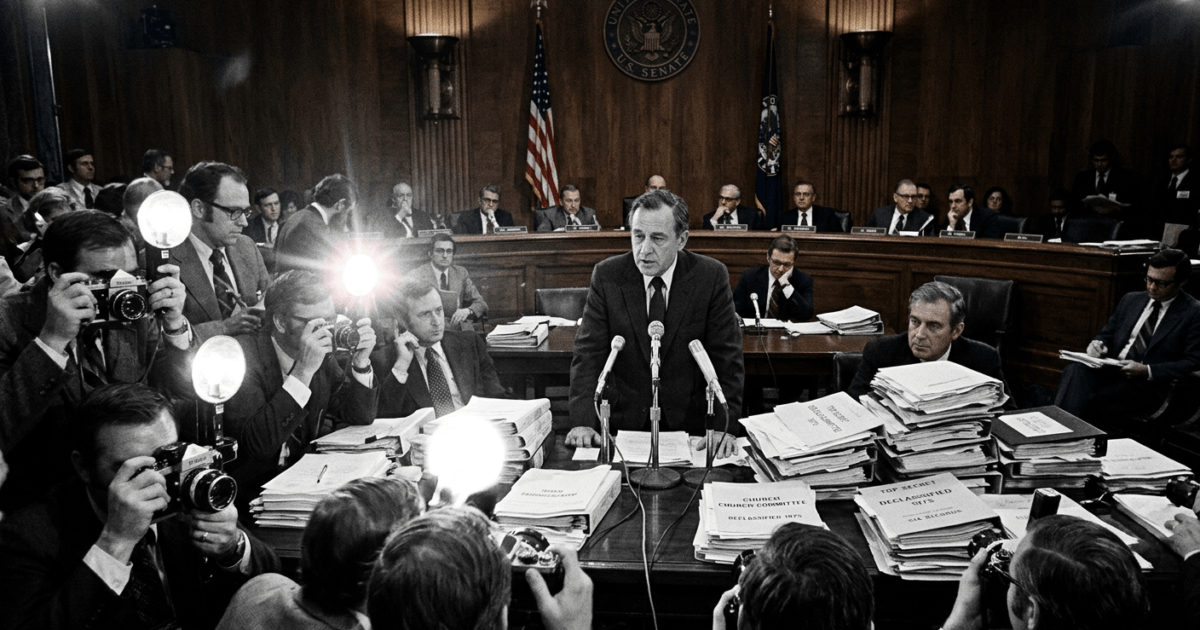
In 1975, a Senate committee chaired by Frank Church of Idaho conducted the most extensive review of U.S. intelligence activities ever made available to the American public. Over sixteen months, the committee examined 110,000 documents, interviewed more than 800 witnesses, and held 126 full committee hearings. What it found was not a government that occasionally overreached. It was a government that had built, funded, and operated a parallel infrastructure of domestic surveillance, political sabotage, assassination planning, and illegal experimentation on its own citizens — continuously, for decades, with the knowledge of senior officials at every level.
The Church Committee’s findings were published across fourteen reports totaling nearly 700 pages. They were covered extensively at the time. Then the country largely forgot about them. The programs they exposed were not aberrations. They were institutional practice. Understanding what the committee actually documented — and what happened to its recommendations — is essential context for evaluating any claim about what the U.S. government is or is not capable of concealing.
What the Committee Found
The FBI’s COINTELPRO, active from 1956 to 1971, was a series of covert operations designed to infiltrate, discredit, and disrupt domestic political organizations the Bureau deemed “subversive.” Targets included the civil rights movement, the Southern Christian Leadership Conference, the American Indian Movement, feminist organizations, anti-Vietnam War groups, and the Communist Party USA. Techniques included planting informants, manufacturing internal conflicts, sending anonymous threatening letters, leaking derogatory personal information to employers and media, and in some cases facilitating violent confrontations between rival groups. The FBI wiretapped Martin Luther King Jr. and sent him an anonymous letter that his associates interpreted as an encouragement to commit suicide.
The CIA’s Operation MKULTRA, running from 1953 through at least 1973, involved the administration of LSD and other drugs to unwitting subjects — including American citizens — as part of research into interrogation techniques and mind control. At least one subject, Army biochemist Frank Olson, died after being dosed with LSD without his knowledge. When the program was exposed, CIA Director Richard Helms ordered the destruction of all MKULTRA files. Twenty thousand documents survived only because they had been misfiled in a financial records office.
The CIA’s mail-opening program, HTLINGUAL, intercepted, opened, and photographed more than 215,000 pieces of domestic mail between the 1950s and 1973. Agents moved mail to private rooms or stuffed envelopes into briefcases to avoid detection by postal workers. Two former Postmasters General testified to the committee that they did not consider these activities wrong — even when confronted with the evidence.
The NSA’s Project SHAMROCK, in operation from 1945 to the early 1970s, involved every major telecommunications company in the United States handing over copies of international telegraph traffic to the NSA for analysis. Project MINARET used SHAMROCK data to monitor the communications of specific Americans placed on a “Watch List” — a list that included Senator Church himself, along with fellow committee members Walter Mondale and Howard Baker, as well as Muhammad Ali.
The committee also documented CIA assassination plots against at least five foreign leaders, including Fidel Castro — targeted with poisoned cigars, exploding seashells, and contaminated diving suits — Patrice Lumumba of Congo, Rafael Trujillo of the Dominican Republic, Ngo Dinh Diem of South Vietnam, and General René Schneider of Chile.
What Changed — and What Didn’t
The committee’s work produced concrete reforms. Executive Order 12036 established guidelines for intelligence operations. The Foreign Intelligence Surveillance Act of 1978 created a legal framework — the FISA court — requiring judicial review for domestic surveillance warrants. Congress established permanent intelligence oversight committees in both chambers. The FBI director’s term was capped at ten years to prevent another Hoover-style accumulation of power.
These were significant structural changes. They were also, in retrospect, insufficient. The FISA court approved 99.97% of surveillance applications in its first decades of operation, earning the characterization of a “rubber stamp” from civil liberties advocates. The permanent intelligence committees, designed to serve as watchdogs, were frequently criticized for being captured by the agencies they oversaw — what Senator Church himself described when he noted that “the watchdog committee never really watched the dog.”
Then came 2013. Edward Snowden’s disclosures revealed that the NSA had been conducting mass surveillance on a scale the Church Committee never imagined: PRISM collected data from major internet companies; Section 215 of the Patriot Act was interpreted to authorize the bulk collection of every domestic phone call’s metadata; XKEYSCORE allowed searching the content of worldwide internet communications; upstream collection tapped fiber optic cables carrying internet traffic. The oversight mechanisms established in response to the Church Committee had failed to prevent exactly the kind of surveillance Church had warned about.
The Institutional Pattern
The Church Committee did not discover a rogue operation. It discovered a culture. COINTELPRO ran for fifteen years. MKULTRA ran for twenty. SHAMROCK ran for nearly thirty. These were not the actions of a few bad actors operating without authorization. They were institutional programs with budgets, personnel, reporting structures, and leadership awareness. They continued because the institutional incentives that created them — the combination of secrecy authority, budgetary autonomy, and the absence of external accountability — were not addressed by the reforms that followed.
Senator Church articulated this on NBC’s Meet the Press in August 1975, in what remains the most cited passage from the entire investigation: “I know the capacity that is there to make tyranny total in America, and we must see to it that this agency and all agencies that possess this technology operate within the law and under proper supervision so that we never cross over that abyss. That is the abyss from which there is no return.”
The Church Committee proved that oversight is possible. It also proved that oversight is never permanent. Every mechanism it created was subsequently circumvented, weakened, or rendered irrelevant by technological change and institutional adaptation. The pattern it documented — secret programs, operating for decades, with the awareness of senior officials, exposed only by accident or defection — is not historical trivia. It is the institutional baseline against which all subsequent claims of government transparency must be measured.
“In the need to develop a capacity to know what potential enemies are doing, the United States must not adopt the tactics of the enemy. Means are as important as ends.” — Senator Frank Church, 1975
Leave a Reply