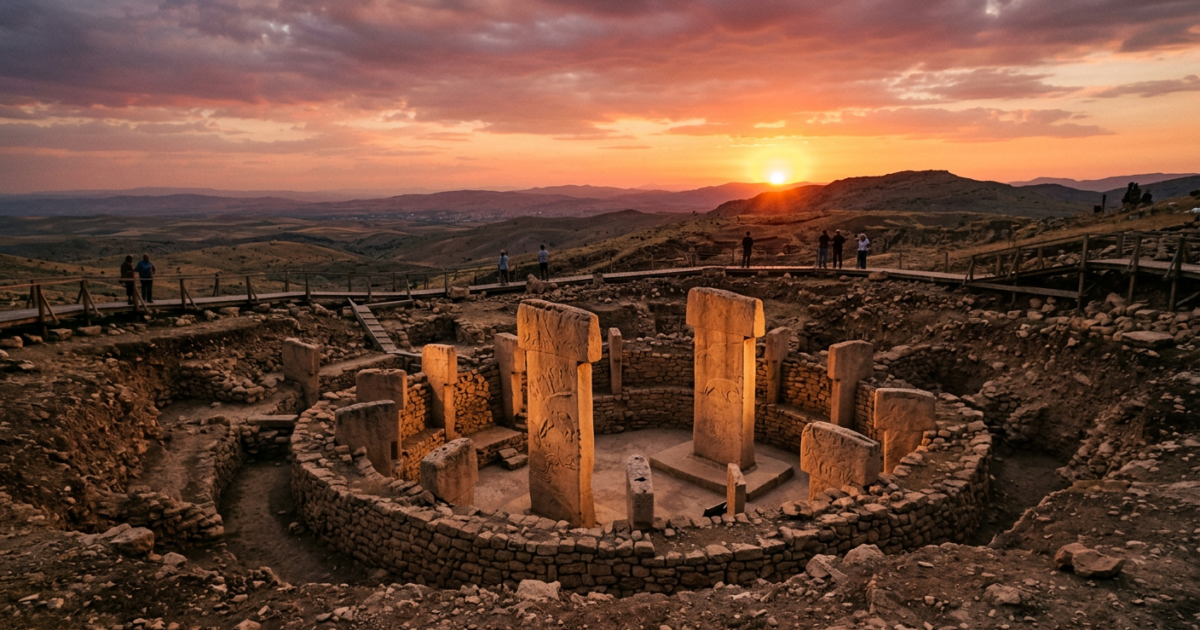
In 1994, German archaeologist Klaus Schmidt began excavating a hill in southeastern Turkey called Göbekli Tepe. What he found there over the following two decades dismantled the foundational timeline of human civilization so completely that the academic field has spent thirty years in a kind of controlled retreat, acknowledging the data while resisting its implications.
The site is 11,600 years old. It contains massive carved stone pillars, arranged in precise circular formations, decorated with sophisticated bas-relief animal carvings, and organized according to what appears to be deliberate astronomical alignment. The people who built it, by the standard archaeological timeline of the period, should not have been capable of building it.
What the Timeline Predicted
Before Göbekli Tepe, the accepted narrative of human civilizational development ran something like this: for most of the Paleolithic, humans lived in small nomadic bands, subsisting by hunting and gathering, with cognitive and social complexity sufficient for survival but not for monumental organization. Around 10,000 BCE, the Neolithic revolution began — agriculture emerged, settlements formed, social hierarchies developed, and eventually the organizational capacity for large-scale construction appeared. Stonehenge, the oldest version, dates to around 3000 BCE. The pyramids to around 2500 BCE.
Göbekli Tepe was built at 9600 BCE. By nomadic hunter-gatherers. Who then, apparently, buried it deliberately around 8000 BCE and moved on.
The Problem the Site Creates
The construction of Göbekli Tepe required the coordination of hundreds of workers over an extended period. It required the quarrying, transport, and precise erection of limestone pillars weighing up to 20 tons. It required an organizational and symbolic framework sophisticated enough to motivate and sustain collective labor at a scale not thought possible for the period.
This is not a minor anomaly. This is evidence that complex social organization — the kind that produces monumental architecture — predates agriculture by at least a thousand years. It inverts the assumed causal sequence. The prevailing model held that agriculture enabled settlement, settlement enabled social hierarchy, and social hierarchy enabled organized construction. Göbekli Tepe suggests that organized construction — driven by religious or cosmological motivation — may have preceded and perhaps enabled the agricultural transition.
What Remains Unexcavated
Only a small fraction of the site has been excavated. Ground-penetrating radar surveys have identified at least sixteen additional enclosures beneath the surface. The excavated portion, which has occupied archaeologists for thirty years, may represent less than five percent of the total structure.
This is significant because it means the conclusions drawn so far are based on an incomplete picture. The site may be substantially larger, more complex, and more organizationally sophisticated than current evidence suggests. The implications, which are already paradigm-disrupting based on what has been uncovered, may become more so as excavation continues.
The Questions That Don’t Get Asked in Polite Company
If Göbekli Tepe represents the organizational capacity of 9600 BCE, what does that imply about the preceding millennia? Anatomically modern humans have existed for approximately 300,000 years. The behavioral modernity associated with complex cognition appears in the archaeological record at least 100,000 years ago. The assumption that this cognitive capacity sat largely dormant, producing minimal organizational complexity, for 90,000 years before suddenly generating Göbekli Tepe has never been rigorously defended. It has simply been assumed.
The alternative — that there were earlier periods of civilizational development whose physical record has been destroyed by time, sea level rise, glaciation, or deliberate burial — is not scientifically impossible. It is archaeologically difficult to confirm. Difficulty of confirmation is not the same as implausibility.
Göbekli Tepe should have opened that question widely. Instead, it was integrated into the existing framework as an impressive anomaly, and the framework was adjusted as little as possible to accommodate it.
We are comfortable with mystery only when it confirms what we already believe about ourselves.— Klaus Schmidt, paraphrased from field notes
Sources & Further Reading
- Smithsonian Magazine — Göbekli Tepe: The World’s First Temple
- Science — “Göbekli Tepe: A Neolithic Site in Southeastern Turkey” (Schmidt, 2006)
- German Archaeological Institute — The Tepe Telegrams (ongoing excavation updates)
- Cambridge Archaeological Journal — Cult and Feasting in Neolithic Community Formation
Leave a Reply