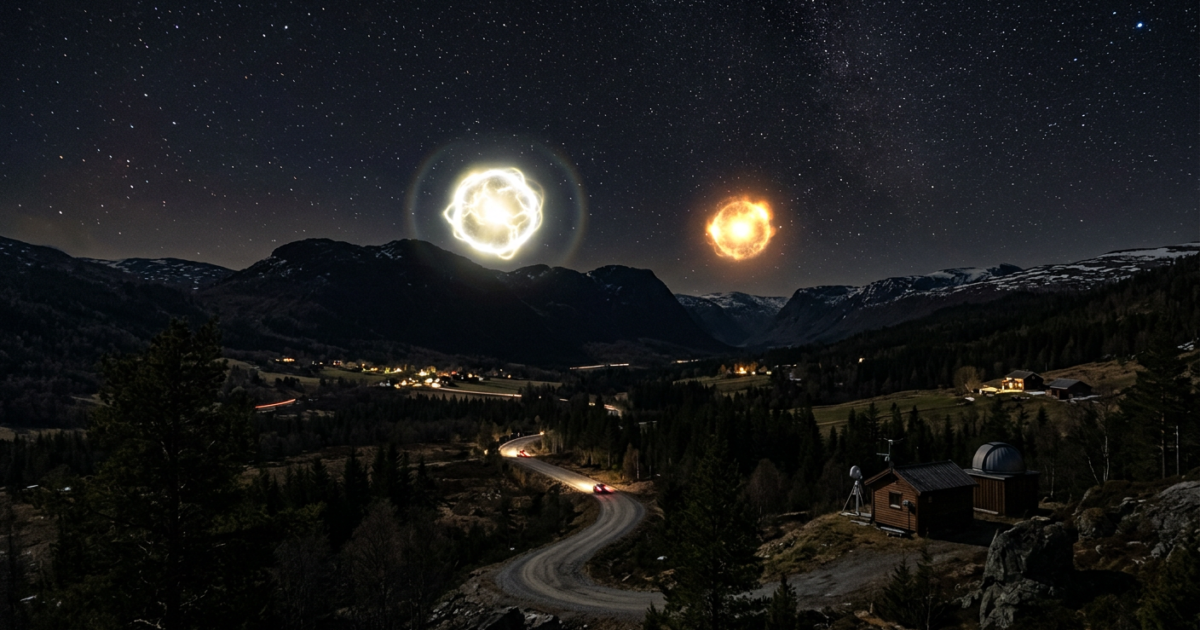
The Hessdalen valley in central Norway is a remote stretch of agricultural and forested terrain with a population of roughly 150 people. Since at least 1981, it has been producing luminous aerial phenomena that defy conventional explanation, have been photographed thousands of times, measured by scientific instruments on multiple research expeditions, and subjected to analysis by physicists, geologists, and atmospheric scientists across several countries.
No one has explained them.
This is not for lack of trying. The Hessdalen lights are, by a significant margin, the most rigorously scientifically investigated unexplained luminous phenomena in the world. The body of data is substantial. The quality of observation is high. The conclusion of the scientific literature, stated plainly, is that something is happening in that valley that current physical models do not account for.
What Has Been Observed
The lights appear most frequently in winter, though they have been documented year-round. They vary in color — predominantly white and yellow, occasionally red — and in size, from small points to objects reportedly spanning several meters in diameter. They move, sometimes slowly, sometimes at velocities that produce measurable Doppler shifts in radar returns. They hover. They pulsate. They occasionally split into multiple objects or merge.
The first systematic scientific investigation, Project Hessdalen, was conducted between 1983 and 1985 by a team of Norwegian scientists. They documented 188 observations in the first year alone and gathered radar, laser, magnetometer, and spectrometer data on the phenomena. The instrumentation confirmed that the lights were physically real — they reflected radar, generated magnetic field perturbations, and produced spectral signatures inconsistent with known atmospheric optical phenomena.
The Current Research Station
Since 1998, a permanent automated research station has been operating in the valley, continuously monitoring for luminous events using cameras, spectrometers, magnetometers, and radar. The station has accumulated one of the most comprehensive datasets on unexplained aerial phenomena in existence. Papers from the station’s data have been published in peer-reviewed journals including the Journal of Scientific Exploration and Acta Astronautica.
The proposed explanations that have been seriously advanced by researchers include: combustion of hydrogen and oxygen released by geological processes, piezoelectric effects from fault activity producing plasma, ionized dust clouds, and Coulomb scattering of electrons in dusty plasma. Each of these explanations accounts for some aspects of the observed phenomena. None accounts for all of them. None explains the behavior — the apparent controlled movement, the persistence, the pulsation patterns.
Why This Matters Beyond Norway
The Hessdalen lights are valuable to serious inquiry into unexplained phenomena precisely because they are not attached to the more contentious frameworks that surround UAP discussion. They are not associated with military encounters, government secrecy, or extraterrestrial hypotheses in the mainstream literature. They are simply a documented physical phenomenon that does not fit existing models.
Their existence, rigorously established by decades of scientific measurement, is important because it demonstrates that the category of “genuine unexplained physical phenomena” is not empty. Something is happening in Hessdalen. It is real. It is measurable. It is recurring. It is unexplained.
If that category is not empty in Norway — if the universe contains physical processes that produce persistent, structured, self-directed luminous phenomena that current physics cannot model — then the epistemological implications extend well beyond one Norwegian valley.
The Scientific Community’s Response
The response of the mainstream scientific community to Hessdalen has been, largely, indifference. The research exists. The data is accessible. The conclusions are appropriately cautious. The mainstream does not dispute the observations. It simply does not engage with them, because engaging with them would require grappling with a phenomenon that does not fit the available explanatory framework.
This is not scientific fraud. It is something more insidious: the operation of institutional incentives that make certain lines of inquiry professionally costly regardless of the quality of the evidence supporting them.
Leave a Reply