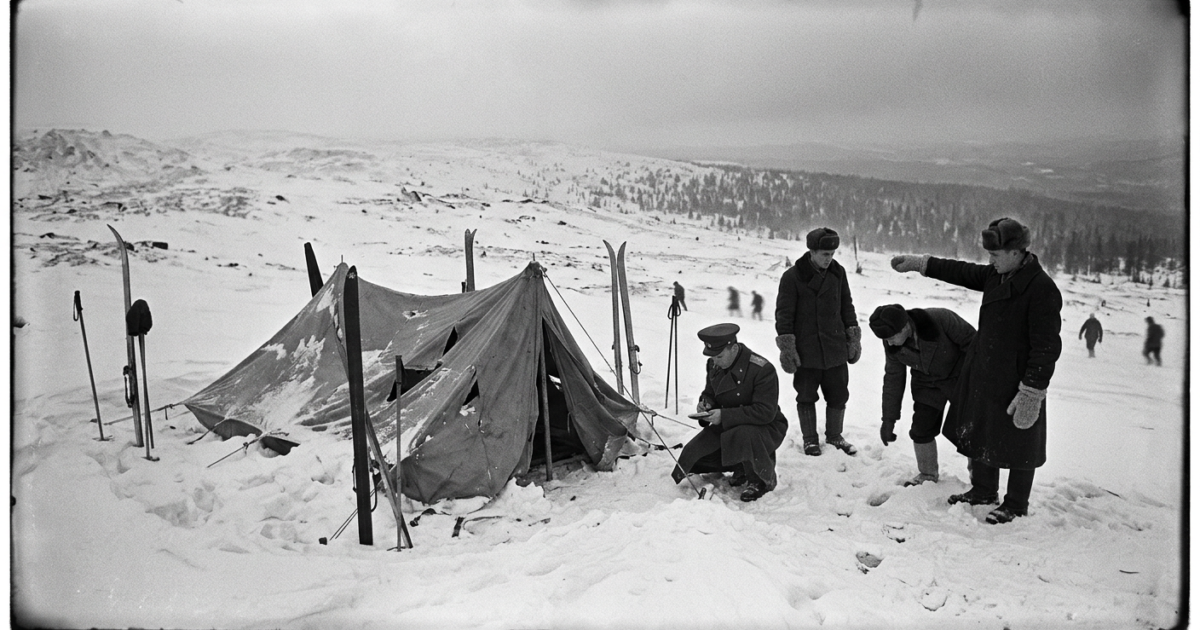
On the night of February 1-2, 1959, nine experienced Soviet hikers died on the eastern slopes of Kholat Syakhl in the northern Urals. They died in circumstances so anomalous that Soviet investigators closed the case without a satisfactory explanation, sealed the files for decades, and classified the official findings under a category that translated roughly as “compelling unknown force.”
The case has generated investigation and speculation for sixty years. In July 2020, Russian prosecutors announced their official conclusion: an avalanche had most likely forced the group from their tent. A separate 2021 study by physicists at ETH Zurich and EPFL modeled a specific slab avalanche mechanism — triggered partly by katabatic wind accumulation and a cut made in the slope to pitch the tent — that they argued could account for the injuries. Neither conclusion has fully satisfied researchers who have worked the case files. The conclusion was presented as definitive. It satisfied almost no one who had engaged seriously with the forensic evidence.
What the Evidence Established
The group — experienced mountaineers, most of them students at Ural Polytechnical Institute, led by Igor Dyatlov — had set up camp on the slope of Kholat Syakhl on the evening of February 1. Rescuers found their tent weeks later. It had been cut open from the inside. The hikers had left it, in temperatures of approximately -30°C, without their outer clothing and boots.
They were found at varying distances from the tent, most having died of hypothermia. But three members of the group showed injuries inconsistent with hypothermia and inconsistent with the terrain. Nikolai Thibeaux-Brignollel had a massive skull fracture. Lyudmila Dubinina and Semyon Zolotaryov had severe chest injuries — multiple broken ribs, damage to the heart — of a kind that a Soviet forensic examiner described as comparable to the injuries produced by a car accident. There were no external wounds corresponding to these injuries. The force that caused them had been applied without breaking the skin.
Dubinina was also found without her tongue and parts of her lips. Some accounts include her eyes among the missing tissue, though this detail is disputed in the forensic literature. The absence of these soft tissues was attributed by investigators to decomposition and the action of water. Some forensic analysts have disputed this explanation given the condition of surrounding tissue.
The Radiation Finding
Several items of clothing belonging to group members showed elevated radiation levels when tested. This finding was included in the original investigative files, released when Soviet archives opened, and has been noted by researchers ever since. The 2021 official conclusion does not address it.
Soviet authorities were conducting nuclear tests in the region during this period. The Ural mountains were in the vicinity of military testing ranges. The presence of radiation on the clothing of hikers who died under anomalous circumstances in a region of active military testing is a data point that the official explanation has consistently declined to integrate.
The Problems with the Avalanche Explanation
The slab avalanche explanation, offered across the 2020 Russian inquiry and the 2021 Swiss study, accounts for why the hikers might have left their tent in panic — a sudden violent air event could have been terrifying and disorienting. It does not account for the crushing internal injuries to three members without external wounds. It does not account for the radiation. It does not explain why experienced mountaineers, having exited their tent in an emergency, did not attempt to return to it when no immediate threat was visible. The tent was intact and the equipment inside it would have been lifesaving.
What Remains True After Sixty Years
The Dyatlov Pass incident remains genuinely unexplained. Not in the sense that no one has offered explanations — the explanations are numerous, ranging from military accident to infrasound-induced panic to something less easily named. They remain unexplained in the specific sense that no proposed explanation accounts for all of the documented physical evidence without contradiction.
The case is valuable not because it points to any particular conclusion, but because it demonstrates the durability of genuine anomaly. Sixty years of investigation, two official inquiries, thousands of pages of analysis, and the physical evidence continues to resist resolution. Some things remain genuinely unknown. Acknowledging that is not weakness. It is the beginning of honest inquiry.
The mountains have no obligation to give us answers that fit our frameworks.— truth
Leave a Reply